Situation Summary
Bulgaria faces an elevated near-term security posture following a cross-border drone incursion and explosion near critical energy infrastructure on 2026-08-08, coupled with concurrent bomb threats across major urban centers. The incident has triggered a national security response and a documented shift in border defense resources from the Turkish to Romanian frontier, signaling official assessment of a new threat vector. Organized crime enforcement actions (street racing, corruption at water utilities) and civil unrest in provincial areas remain ongoing but secondary to the infrastructure-proximity incident. Overall composite threat remains moderate (rank #147 globally), but trajectory is upward and localized to high-population zones.
Key Developments
- Kardam (Bulgaria–Romania border), 2026-08-08: A drone entered Bulgarian airspace from Romania, exploded approximately 100 meters inside the border near the former Kardam crossing and in proximity to the Trans-Balkan gas pipeline corridor; Bulgarian Defense Ministry and Border Police deployed to inspect. No casualties or infrastructure damage reported, but incident confirmed as airspace violation.
- Kardam / Trans-Balkan gas pipeline sector, 2026-08-08: Multiple sources confirm the explosion occurred near a critical energy infrastructure compressor station, prompting immediate multi-agency security response and on-site investigation of drone type and origin.
- Romania–Bulgaria border (General Toshevo sector), 2026-08-08: Romanian border police detected the drone acoustically before the blast; Bulgarian patrols confirmed the explosion, establishing cross-border detection and corroborating airspace violation rather than accidental incursion.
- Sofia (national security), 2026-08-08: Bulgaria's Security Council convened post-incident; officials announced redeployment of border air-defense and counter-drone assets from the Turkish border to the Romanian frontier in response to the emerging threat.
- Sofia, Varna, Burgas, 2026-08-07–08: Regional reporting documented multiple bomb threats targeting government and institutional buildings across three major cities; evacuations and searches conducted; no explosive devices recovered in available reporting.
- Sofia city center, 2026-08-06: Police arrested three individuals involved in an organized street racing operation (background context for ongoing organized crime enforcement).
- Haskovo (provincial), ongoing since early August: Civil unrest and protests following an 18-year-old murder; tensions between public anger and law enforcement continue (background context; not a new 24-h development).
Highest-Risk Areas
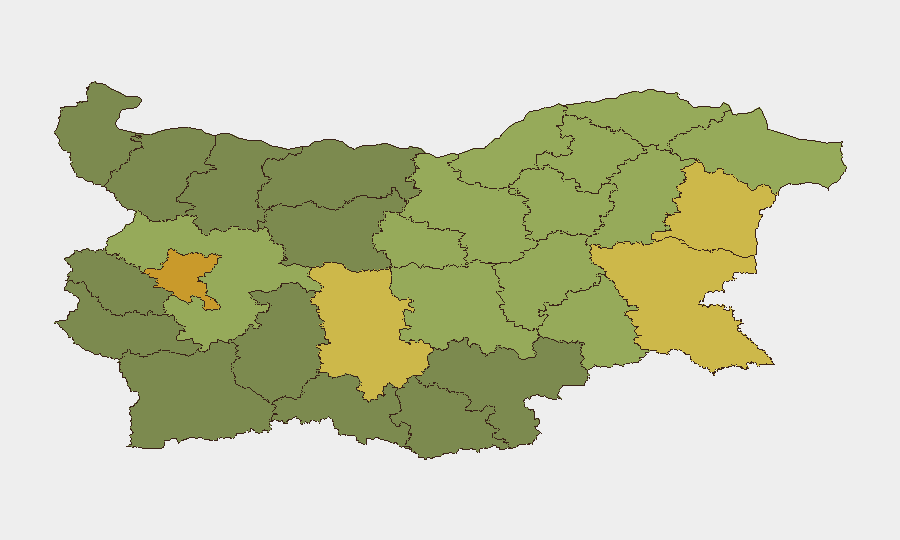
Sofia-City (72), Plovdiv (68), and Varna (65) dominate the sub-national risk ranking, driven by population density, critical infrastructure concentration, and the current convergence of bomb threats and law-enforcement operations. The drone incident near the Romanian border has elevated risk perception in border-adjacent regions and energy infrastructure zones; however, Sofia-City remains the single highest-risk area due to institutional presence, transport hubs, and documented protest activity. Burgas (62) and Sofia province (58) also warrant monitoring given their combined role as energy, maritime, and administrative nodes.
How GeoBit Would Assist
Security teams should deploy AOI Monitoring & Early Warning on Sofia-City and Varna government/institutional buildings, the Kardam border zone, and Trans-Balkan pipeline infrastructure to detect further drone activity or threat signals in real time. OSINT Fusion & Corroboration (Twitter/Telegram, news feeds, multi-language search) will disambiguate bomb-threat credibility and track attribution of the drone incident. Routing & Network Analysis can identify alternative travel corridors and facility access points in high-risk urban zones if primary routes or buildings are compromised.
7-Day Outlook
The drone incident represents a new and unattributed threat vector requiring 72–96 hours of active investigation; border tensions with Romania may escalate if attribution occurs. Bomb threats in major cities are likely to persist or recur as copycat incidents or genuine security tests; institutional vigilance will remain elevated. Travel and asset exposure in Sofia-City, Varna, and Burgas should be reviewed for contingency protocols.
Highest-Risk Areas — Ranked
| # | State / Region | Risk |
|---|---|---|
| 1 | Sofia-City | 72 |
| 2 | Plovdiv | 68 |
| 3 | Varna | 65 |
| 4 | Burgas | 62 |
| 5 | Sofia | 58 |
| 6 | Ruse | 55 |
| 7 | Stara Zagora | 52 |
| 8 | Sliven | 50 |
| 9 | Shumen | 48 |
| 10 | Razgrad | 47 |
| 11 | Yambol | 45 |
| 12 | Dobrich | 44 |
Sources
Previous Daily Briefs
A new Bulgaria brief is written every day — each with its own risk map and downloadable CSV. Here's the last week; use the calendar to go further back.
📅 Browse every day by calendar →
Highlighted days have a brief. Tap a day for that day's map & analysis, or “csv” for that day's dataset ($5).
Atlas — our AI intelligence desk — emails them this snapshot personally. Nothing else, no list.