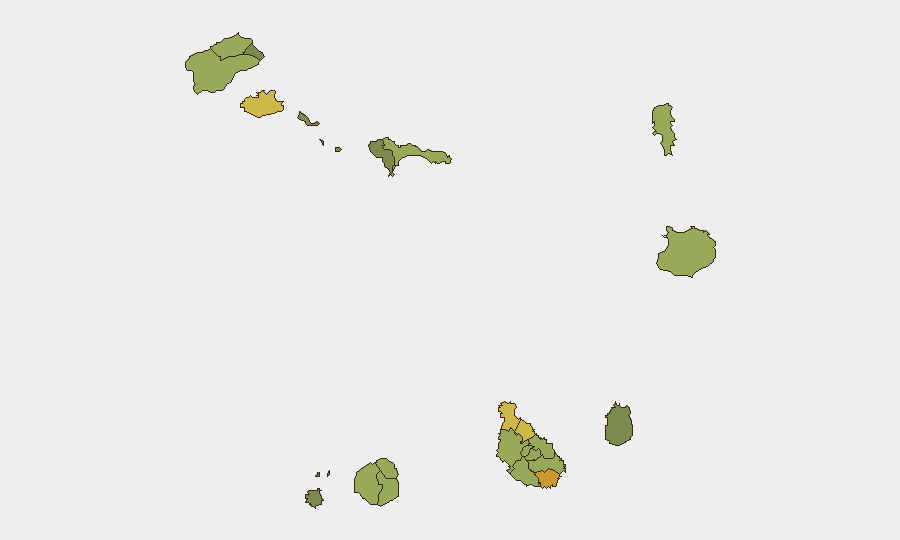
Situation Summary
Cape Verde remains a low-threat environment with a global composite threat score of 2 and no tracked discrete security events in the current reporting window. No credible cross-confirmed incidents—including protests, crime spikes, infrastructure failures, or civil unrest—were identified in the 19–20 July 2026 period. The most recent diplomatic development (a Guinea-Bissau freeze announced 16–20 July) has not generated operational security consequences within Cape Verde's borders. The overall security trajectory remains stable.
Key Developments
- Nationwide (19–20 July 2026) — No new security incidents, protests, or infrastructure disruptions confirmed across Cape Verde in the past 48 hours.
- Praia (19–20 July 2026) — No confirmed crime spikes, transport disruptions, or civil unrest reported in the capital during the current window.
- São Miguel (19–20 July 2026) — No verified local security or governance incidents identified; baseline localized crime sensitivity remains unchanged.
- Guinea-Bissau / Cape Verde diplomatic track (16–20 July 2026) — Guinea-Bissau announced a diplomatic freeze, but no cascading security impacts—arrests, restrictions on travel, or border incidents—have materialized inside Cape Verde.
- Nationwide political environment (19–20 July 2026) — No new instability events confirmed; prior parliamentary confidence vote remains historical context, not an active development.
Highest-Risk Areas
Praia (risk 72), São Miguel (68), and São Vicente (65) comprise the top three risk drivers, reflecting localized governance, crime, and socioeconomic pressures concentrated on the inhabited islands. Tarrafal (62) and São Filipe (58) represent secondary clusters. The risk distribution is primarily driven by urban crime, informal-sector tensions, and occasional localized governance friction rather than organized conflict or political instability. No single area presents acute imminent threat to corporate operations or personnel.
How GeoBit Would Assist
Security teams with personnel or assets in Cape Verde would use Intel Sweep and global event feeds for continuous baseline monitoring and rapid incident detection; X/Twitter & Telegram OSINT and sentiment & temporal analysis to track early warning signs of unrest in high-risk municipalities (Praia, São Miguel, São Vicente); and AOI Monitoring & Early Warning to establish persistent watch on corporate facilities, transport routes, or operations centers with automated alerting on localized disturbance. Routing & Network Analysis supports contingency planning for alternative journey routes in urban areas if situational change occurs.
7-Day Outlook
No material change in Cape Verde's security posture is anticipated over the next 7 days. The Guinea-Bissau diplomatic freeze is unlikely to escalate into direct operational risk to Cape Verde-based personnel or assets in the near term. Routine monitoring of Praia and São Miguel for minor crime and governance friction remains the primary duty-of-care focus; escalation probability remains low absent new triggering events.
Highest-Risk Areas — Ranked
| # | State / Region | Risk |
|---|---|---|
| 1 | Praia | 72 |
| 2 | São Miguel | 68 |
| 3 | São Vicente | 65 |
| 4 | Tarrafal | 62 |
| 5 | São Filipe | 58 |
| 6 | Santa Catarina | 58 |
| 7 | Santa Cruz | 55 |
| 8 | Mosteiros | 52 |
| 9 | São Salvador do Mundo | 52 |
| 10 | Ribeira Grande | 50 |
| 11 | Porto Novo | 48 |
| 12 | Sal | 48 |
Sources
Previous Daily Briefs
A new Cape Verde brief is written every day — each with its own risk map and downloadable CSV. Here's the last week; use the calendar to go further back.
📅 Browse every day by calendar →
Highlighted days have a brief. Tap a day for that day's map & analysis, or “csv” for that day's dataset ($5).
Atlas — our AI intelligence desk — emails them this snapshot personally. Nothing else, no list.