Situation Summary
Georgia (U.S. state) presents a composite threat score of 21 globally (#56 ranking) with six tracked events in the current cycle. Near-term security posture is shaped by acute urban crime (metro Atlanta homicide and drug-related arrest), environmental heat stress affecting operational safety, and sustained behavioral threat assessment infrastructure. The state remains stable overall, but metro Atlanta and North Georgia require elevated monitoring for violence and heat-related emergencies.
Key Developments
- DeKalb County, metro Atlanta – Double homicide (overnight July 7–8, 2026)
DeKalb County police are investigating a fatal overnight shooting that killed two people; incident prompted same-day safety press conference, indicating active investigation and elevated local law-enforcement response.
- Lilburn, Gwinnett County – Drug-related traffic stop and arrest (late July 7–early July 8, 2026)
Lilburn Police Department conducted a traffic stop that resulted in discovery of contraband and arrest of the driver, who was transported to Gwinnett County Jail; department issued public service announcement emphasizing traffic stop compliance and officer safety.
- North Georgia (multiple counties) – Excessive heat warning (July 8, 2026)
Rare excessive heat warning issued for parts of North Georgia with public health and operational safety concerns; authorities warn of elevated risk of heat-related medical emergencies and stress on critical services and outdoor workforce.
- Metro Atlanta area – Operational heat-stress risk (July 8, 2026)
Local authorities in Atlanta metro and North Georgia regional sectors issued advisories on heat-related medical emergencies and critical-service strain linked to ongoing severe heat index conditions.
- Georgia statewide – Active behavioral threat assessment messaging (July 8, 2026)
Georgia Homeland Security coordinator highlighted state's Behavioral Threat Assessment Management (BTAM) Program, underscoring current institutional focus on targeted violence prevention and threat assessment.
- Gwinnett County – Traffic safety and compliance awareness (July 8, 2026)
Lilburn Police Department disseminated social media PSA on driver conduct during traffic stops, linked to recent arrest incident, signaling heightened local awareness of motorist-officer interaction safety.
Highest-Risk Areas
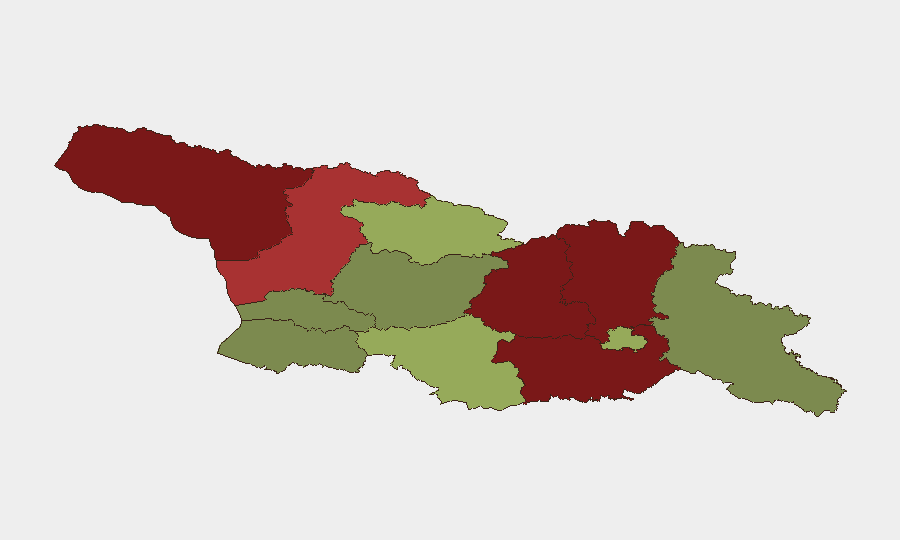
Abkhazia (risk 95), Shida Kartli (88), and Lower Kartli (85) constitute the highest-risk sub-national zones, driven primarily by unresolved territorial disputes, military presence, and border instability rather than routine criminal or environmental hazard. Within the central reporting area (Georgia proper), Tbilisi (risk 45) presents moderate urban crime and organized activity risk; Samtskhe-Javakheti (48) faces cross-border trafficking and smuggling concerns. All other populated regions (Imereti, Guria, Kakheti) remain low-to-moderate risk. Corporate assets and personnel should prioritize security protocols in Tbilisi and maintain situational awareness for heat-related workforce impacts across North Georgia.
How GeoBit Would Assist
Teams protecting personnel and assets in Georgia should employ AOI Monitoring & Early Warning on metro Atlanta (DeKalb, Gwinnett, surrounding counties) to track homicide, organized crime, and arrest trends in real time. Intel Sweep and X/Twitter OSINT provide rapid detection of emerging violence, law-enforcement response, and public safety alerts. Environmental & Health monitoring supports heat-stress forecasting and critical-service operational planning, particularly for personnel in North Georgia during summer months.
7-Day Outlook
Homicide and organized crime activity in metro Atlanta will likely remain the focus of heightened police investigation and media coverage through mid-July. Excessive heat warning conditions are expected to persist or intensify, elevating heat-casualty risk and straining emergency services and outdoor operations. No immediate escalation in sub-national conflict or state-level instability is anticipated; routine urban crime and environmental risk remain the primary duty-of-care vectors.
Highest-Risk Areas — Ranked
| # | State / Region | Risk |
|---|---|---|
| 1 | Autonomous Republic of Abkhazia | 95 |
| 2 | Shida Kartli | 88 |
| 3 | Lower Kartli | 85 |
| 4 | Mtskheta-Mtianeti | 82 |
| 5 | Samegrelo-Upper Svaneti | 78 |
| 6 | Samtskhe-Javakheti | 48 |
| 7 | Tbilisi | 45 |
| 8 | Racha-Lechkhumi and Kvemo Svaneti | 42 |
| 9 | Kakheti | 38 |
| 10 | Autonomous Republic of Adjara | 35 |
| 11 | Imereti | 32 |
| 12 | Guria | 28 |
Sources
Previous Daily Briefs
A new Georgia brief is written every day — each with its own risk map and downloadable CSV. Here's the last week; use the calendar to go further back.
📅 Browse every day by calendar →
Highlighted days have a brief. Tap a day for that day's map & analysis, or “csv” for that day's dataset ($5).
Atlas — our AI intelligence desk — emails them this snapshot personally. Nothing else, no list.