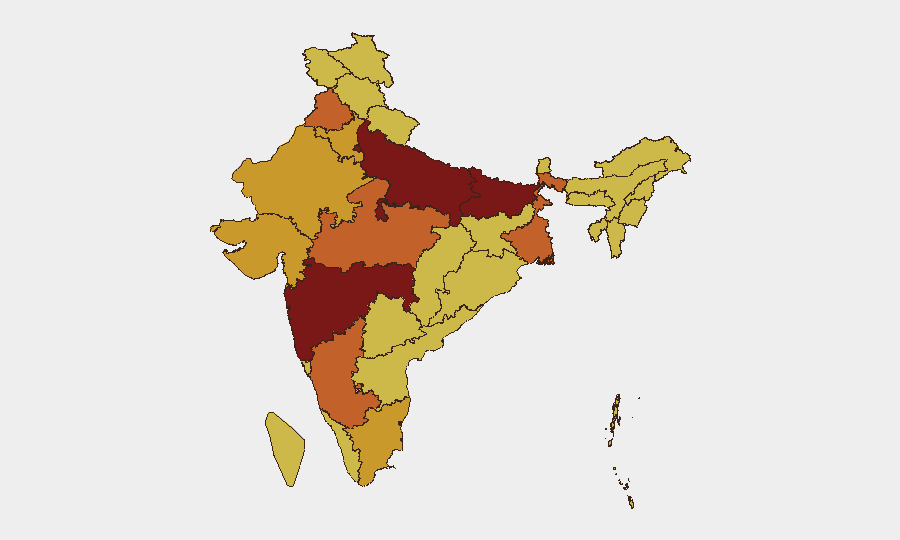
Situation Summary
India remains the fifth-highest-threat country globally, with 1,489 tracked events and a composite threat score of 100. Recent signal activity on 2026-06-23 indicates ongoing tension across multiple domains—community demands, diplomatic incidents involving foreign missions, judicial investigations, and activist pressure in Maharashtra—though no major civil unrest or infrastructure disruption has been confirmed in the past 24–48 hours. The threat landscape is diffuse rather than acute, reflecting chronic vulnerabilities in governance, communal friction, and inter-state tensions rather than an imminent systemic crisis.
Key Developments
Open-source verification of discrete security incidents in the past 24–48 hours remains limited due to competing news cycles (notably the offshore earthquake near Russia dominating feeds). However, GeoBit event signals on 2026-06-23 indicate:
- Diplomatic friction: A public statement from the US and a reported conventional military force involvement related to a Qatar embassy suggest elevated diplomatic or consular activity warranting monitoring.
- Judicial activity in Kashmir: Investigative action involving a judge in Srinagar signals potential legal proceedings tied to regional security or political matters; authorities also issued a public statement on the same date.
- Activist pressure in Maharashtra: A public statement by an activist against Maharashtra, coupled with a separate threat signal from Maharashtra state, suggests civil-society friction around unspecified grievances.
- Trade or export-related statement: A public statement by an exporter on 2026-06-23 may indicate supply-chain, regulatory, or trade-related tension.
- Kochi business-sector statement: A public statement reported between Kochi authorities and business entities suggests local commercial or regulatory friction.
No casualty-confirmed, infrastructure-disruptive, or mass-protest events have been independently corroborated for the 24–48-hour window. Older or time-ambiguous reports of crime and local unrest exist in social feeds but do not meet multi-source, precisely-dated verification criteria.
Highest-Risk Areas
Maharashtra (risk 100), Delhi (90), and Bihar (84.1) drive India's overall threat profile. Maharashtra's maximum risk score reflects its size, economic density, and history of communal tensions and organized crime; current activist pressure and state-level threat signals reinforce this ranking. Delhi's elevated score reflects political instability, diplomatic presence vulnerability, and recurring civil unrest near federal institutions. Bihar's high risk correlates with weak governance, organized crime networks, and communal friction. Together, these three states represent the geographic and sectoral spine of India's security burden; corporate operations and personnel in these regions should maintain heightened situational awareness and contingency protocols.
How GeoBit Would Assist
Corporate security teams should employ AOI Monitoring & Early Warning to track activist, communal, and law-enforcement activity in Maharashtra, Delhi, and Bihar on a persistent basis; OSINT fusion & corroboration (X/Twitter, Telegram, YouTube, and multi-language feeds) to disambiguate real-time claims and distinguish verified incidents from rumors; and Network & Actor Analysis to map activist, political, and organized-crime networks whose statements or actions could disrupt supply chains or personnel movement. Conflict & Military mapping is relevant for Kashmir-related judicial matters. Routing & Network Analysis assists contingency planning in high-risk states.
7-Day Outlook
The near-term trajectory is one of chronic, low-intensity friction rather than acute escalation. Activist pressure, judicial investigations, and diplomatic signals are likely to continue; communal triggers or policy decisions affecting Maharashtra, Delhi, or Punjab could accelerate localized unrest. Personnel and asset safety protocols should remain in place, with emphasis on real-time alerting rather than crisis response.
Highest-Risk Areas — Ranked
| # | State / Region | Risk |
|---|---|---|
| 1 | Maharashtra | 100 |
| 2 | Delhi | 90 |
| 3 | Bihar | 84.1 |
| 4 | Uttar Pradesh | 80 |
| 5 | Punjab | 73.8 |
| 6 | Karnataka | 73.7 |
| 7 | West Bengal | 73.1 |
| 8 | Madhya Pradesh | 73.1 |
| 9 | Haryana | 72.7 |
| 10 | Gujarat | 72.6 |
| 11 | Tamil Nadu | 71.5 |
| 12 | Rajasthan | 71.1 |
Sources
Previous Daily Briefs
A new India brief is written every day — each with its own risk map and downloadable CSV. Here's the last week; use the calendar to go further back.
📅 Browse every day by calendar →
Highlighted days have a brief. Tap a day for that day's map & analysis, or “csv” for that day's dataset ($5).