Situation Summary
Iran remains the highest-risk country globally (composite threat score 100) with 1,396 tracked events as of 14 June 2026. Recent signals indicate escalating tension between the Iranian state and international actors, particularly the United States, with public statements, military posturing, and unconfirmed reports of strikes dominating the information environment. A potential U.S.–Iran deal framework is reportedly under negotiation, though ground-level security dynamics across Iranian provinces show no substantive de-escalation. The current trajectory points toward continued volatility over the next 7–14 days pending negotiation outcomes.
Key Developments
- 2026-06-13 · Public Statement · ADMINISTRATION vs IRAN – U.S. Administration issued formal statement regarding Iran; specific content and location of impact not yet cross-verified in available reporting.
- 2026-06-12 · Conventional Military Force · MILITARY vs IRAN – Iranian military reported engagement; corroboration pending from independent sources.
- 2026-06-12 · Conventional Military Force · WASHINGTON vs IRAN – U.S. military action claimed in social/video posts; unconfirmed in multi-source reporting. Alleged geographic scope and targets remain unverified.
- 2026-06-11 · Aerial Weapons · NORWEGIAN vs IRAN – Norwegian aerial weapons involvement reported; location, scale, and damage assessment not yet independently confirmed.
- Unconfirmed claims – Social media and video posts circulate allegations of fresh U.S. strikes on Iranian targets and Iranian retaliatory actions, but these lack corroboration in the provided source set and should not be treated as verified incidents pending multi-source confirmation.
Note: The last 24–48 hours are dominated by negotiation updates (potential U.S.–Iran deal framework possibly signed within 48–72 hours) and regional tension alerts (Strait of Hormuz, Gulf bases) rather than verified on-the-ground security incidents. Specific incident locations, casualty figures, and infrastructure impact remain unconfirmed in available open sources.
Highest-Risk Areas
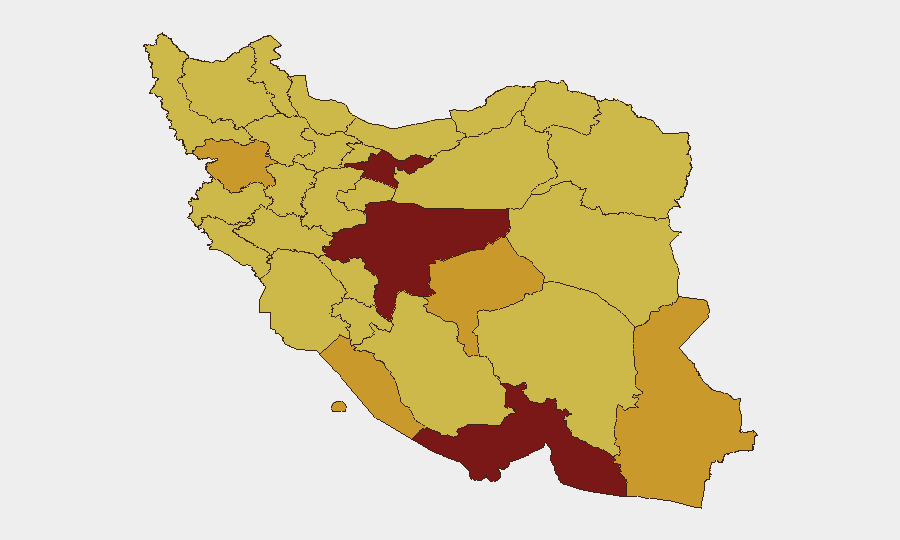
Tehran Province (risk 100) and Isfahan Province (91.9) carry the highest composite risk scores, driven by political decision-making centers, military/security installations, and concentrated population density. Hormozgan Province (80) and Bushehr Province (72.9) face elevated maritime and energy-sector risk given proximity to the Strait of Hormuz and nuclear/petrochemical facilities. Broader-based risk (70–72 range) across Kurdistan, Sistan and Baluchestan, Yazd, and Khuzestan provinces reflects border volatility, ethnic tensions, and energy infrastructure exposure. Tehran and Isfahan should remain priority focus areas for organizations with personnel or assets in Iran.
How GeoBit Would Assist
- Intel Sweep & OSINT Fusion – Real-time multi-language monitoring and corroboration of U.S.–Iran military claims, strike reports, and negotiation developments across news, X/Twitter, and Telegram to separate verified incidents from rumor.
- AOI Monitoring & Early Warning – Persistent geographic watch on Tehran, Isfahan, and Hormozgan provinces with automated alerting for new militant activity, security operations, or infrastructure damage.
- Conflict & Military Tracking – Force-structure and weapons-capability analysis to assess Iranian military response posture and U.S. regional positioning, informing duty-of-care decisions for personnel near sensitive installations.
7-Day Outlook
If a U.S.–Iran negotiated framework advances over the next 48–72 hours, temporary de-escalation messaging may reduce immediate military tension; however, on-the-ground compliance and verification challenges typically delay actual security improvement. Conversely, if negotiations stall or collapse, expect renewed rhetoric, potential asymmetric responses (cyber, proxy activity), and heightened risk in Tehran, Isfahan, and Gulf-adjacent provinces. Organizations should maintain contingency protocols and situational awareness through 21 June pending framework clarity.
Highest-Risk Areas — Ranked
| # | State / Region | Risk |
|---|---|---|
| 1 | Tehran Province | 100 |
| 2 | Isfahan Province | 91.9 |
| 3 | Hormozgan Province | 80 |
| 4 | Bushehr Province | 72.9 |
| 5 | Kurdistan Province | 72.7 |
| 6 | Sistan and Baluchestan Province | 72.4 |
| 7 | Yazd Province | 71.3 |
| 8 | Kohgiluye and Buyer Ahmad Province | 70.8 |
| 9 | Khuzestan Province | 70.5 |
| 10 | East Azerbaijan Province | 70.5 |
| 11 | Kerman Province | 70.5 |
| 12 | Golestan Province | 70.3 |
Sources
Previous Daily Briefs
A new Iran brief is written every day — each with its own risk map and downloadable CSV. Here's the last week; use the calendar to go further back.
📅 Browse every day by calendar →
Highlighted days have a brief. Tap a day for that day's map & analysis, or “csv” for that day's dataset ($5).