Situation Summary
Iraq faces a sharp, near-term escalation in security risk driven by U.S.–Iran regional tensions projected to manifest in kinetic activity within the next 24–48 hours. U.S. Embassy Baghdad has issued urgent advisories for American citizens to limit movement and prepare to shelter in place, citing credible threats of Iran-aligned militia attacks on U.S. interests across central Iraq. Concurrent reporting indicates Iranian-backed militias are preparing strikes on American bases and facilities throughout Iraqi territory, while broader civil unrest and militia mobilization are anticipated in Shi'a-majority areas. The spike in threat reporting—assassination, aerial weapons use, small-arms combat, and conventional military force signals in the last 48 hours—reflects a volatile, fast-moving environment with limited real-time on-the-ground confirmation but elevated confidence in imminent risk.
Key Developments
- Baghdad, 14 Jun – U.S. Embassy issued heightened-alert advisory instructing American citizens to limit movement, remain alert, and prepare to shelter in place amid credible threats of Iran-aligned militia attacks on U.S. targets in central Iraq.
- Nationwide (U.S. bases/facilities), 14 Jun – Regional reporting cites Iranian military sources indicating that Iranian-backed militias are preparing attacks on American bases across Iraq and Syria within the next 24–48 hours; these are projected rather than yet-confirmed but are being assessed as credible near-term threats.
- Iraq airspace, 14 Jun – Regional flight disruptions and cancellations reported on Iran–Iraq–Jordan routes, including Istanbul Airport cancellations due to anticipated ballistic-missile flight paths; indicates heightened overflight risk and potential short-notice air-traffic rerouting over Iraqi territory.
- Iraqi territorial waters / Basra approach, 14 Jun – U.S. forces reported actively intercepting Iranian attack drones in the Strait of Hormuz; escalation extends maritime-security risk to Iraqi ports and offshore infrastructure in the Gulf.
- Nationwide (Iraq), 13–14 Jun – Event-signal cluster shows assassination of security official, small-arms combat (involving Canadian personnel), conventional military force deployment, and aerial-weapons use; signals suggest active military/security operations and possible militia mobilization.
- Nationwide (Iraq), 14 Jun – Regional narratives, citing Iranian state sources, claim conflict "will definitely resume within 24–48 hours"; even unconfirmed, these narratives are driving anxiety about spillover, militia mobilization, and protests in Iran-aligned Shi'a areas and around U.S. diplomatic/military sites.
Highest-Risk Areas
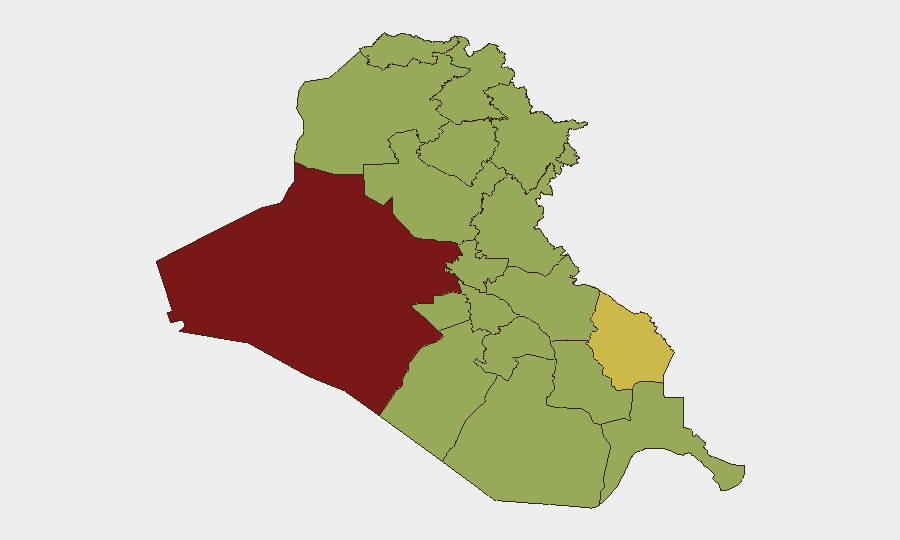
Al-Anbar Governorate (80.5) remains the highest-risk sub-national zone, driven by persistent ISIS and Sunni-armed-group activity along supply routes and near Syrian border corridors. Maysan (68.1) and Diyala (57.9) follow, reflecting militia presence, drug-trafficking networks, and Iranian cross-border influence. Baghdad (56.4), despite its lower rank than Al-Anbar, is now the focal point of imminent threat due to U.S. embassy presence, concentration of American and coalition facilities, and reported militia targeting; the convergence of current U.S.–Iran tensions with high population density and political volatility elevates daily personnel and asset risk in the capital significantly above its baseline ranking.
How GeoBit Would Assist
Security teams should use Intel Sweep and global event-feed monitoring to track real-time militia mobilization, base-security alerts, and confirmed incidents as they unfold over the next 48 hours. AOI Monitoring & Early Warning on U.S. facilities, embassy compounds, and main supply routes will provide continuous alerting if kinetic activity materializes. Routing & Network Analysis can identify alternative travel corridors and safe-passage options if movement becomes necessary, while Maritime & Aviation tracking will flag disruptions or threats to personnel evacuation routes via Iraqi airspace and Gulf ports.
7-Day Outlook
The next 48 hours represent a critical window; if projected militia attacks materialize, Iraq-wide personnel-movement restrictions and potential temporary base lockdowns are likely. Even if kinetic activity remains limited, heightened security posture, flight delays, and civil unrest in major cities are probable through 21 June. Risk trajectory depends heavily on whether U.S.–Iran escalation extends into confirmed Iraqi-territory strikes; absent that, risk may stabilize at elevated but manageable levels by late week.
Highest-Risk Areas — Ranked
| # | State / Region | Risk |
|---|---|---|
| 1 | Al-Anbar Governorate | 80.5 |
| 2 | Maysan Governorate | 68.1 |
| 3 | Diyala Governorate | 57.9 |
| 4 | Baghdad Governorate | 56.4 |
| 5 | Babil Governorate | 50.5 |
| 6 | Wasit Governorate | 50.5 |
| 7 | Al-Qadisiyah Governorate | 50.5 |
| 8 | Dhi Qar Governorate | 50.5 |
| 9 | Al-Muthanna Governorate | 50.5 |
| 10 | Al-Basra Governorate | 50.5 |
| 11 | Al-Najaf Governorate | 50.5 |
| 12 | Saladin Governorate | 50.5 |
Sources
Previous Daily Briefs
A new Iraq brief is written every day — each with its own risk map and downloadable CSV. Here's the last week; use the calendar to go further back.
📅 Browse every day by calendar →
Highlighted days have a brief. Tap a day for that day's map & analysis, or “csv” for that day's dataset ($5).