Situation Summary
Latvia remains a low-threat jurisdiction globally (rank #125, composite score 9), but faces elevated border-security pressures tied to irregular migration flows from Belarus and ongoing regional military readiness. A coordinated surge in illegal-crossing attempts, including the discovery of an underground tunnel crossing on 11 August, has prompted operational escalation by authorities. Eastern border districts continue to experience heightened threat warnings and reduced air-traffic predictability. The security posture reflects NATO-aligned defensive posture and critical-infrastructure hardening rather than acute internal instability.
Key Developments
- Latvia–Belarus border, 11 August 2026: Border guards detected 15 people crossing illegally through an underground tunnel constructed from Belarusian territory. The discovery prompted immediate tactical response and reinforced concerns over novel crossing methods.
- Latvia–Belarus border (eastern region), 11 August 2026: Authorities launched Operation "Vilkatis" to tighten controls, deploy armed-forces personnel, and increase drone and helicopter surveillance following a documented surge in irregular-migration attempts.
- Eastern border region, 11 August 2026: Authorities announced increased frequency of vehicle checkpoints on roads in the eastern border area as part of anti-smuggling and illegal-crossing prevention measures.
- Critical infrastructure (national), 10–11 August 2026: Heightened protection remained in place around key sites including the Daugava dam near Rīga and Inčukalns underground gas storage, with expanded patrol schedules.
- Rīga, Kuldīga, Valmiera, Alūksne, 8 August 2026: Latvian National Armed Forces conducted planned mobilization and crisis-readiness exercises to validate wartime call-up procedures and response protocols.
- Latvia–Belarus border crossing network, ongoing as of 11 August: IT-systems disruptions continued to affect border-processing workflows for passenger and freight traffic, a technical challenge since early August.
- Eastern airspace (Ludza, Krāslava, Rēzekne districts), ongoing into 11 August: Elevated airspace-threat warnings remained active in response to prior drone-related activity and detection concerns.
Highest-Risk Areas
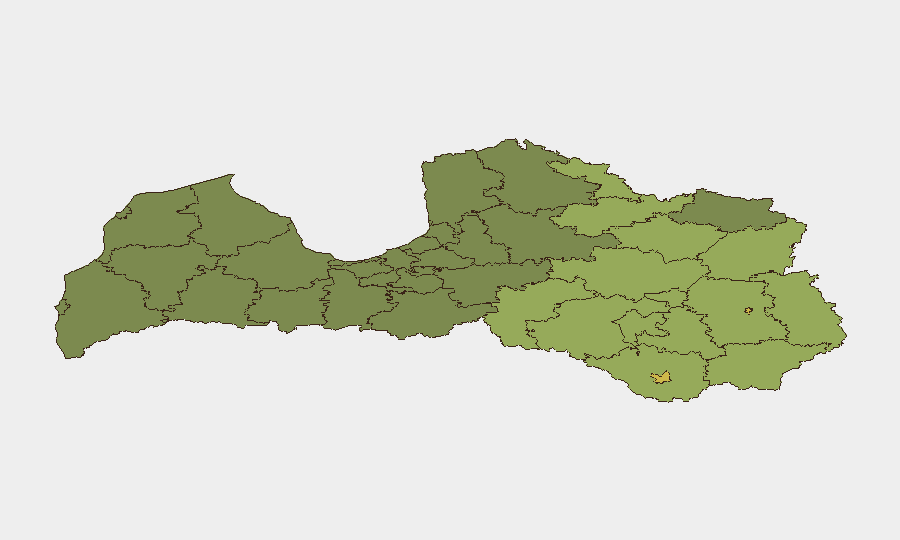
Rēzekne (risk 68) and Daugavpils (risk 65) dominate the sub-national ranking, with Rēzeknes novads (58), Ludzas novads (55), and Balvu novads (52) comprising a high-risk corridor in the southeast. This concentration reflects geographic proximity to the Belarus border, limited border-crossing infrastructure, and ongoing irregular-migration pressure. The ranking suggests elevated exposure to border-related incidents, smuggling activity, and potential infrastructure disruption in these predominantly rural, lower-population-density areas. Corporate and NGO operations in these regions should prioritize supply-chain continuity and personnel-movement protocols.
How GeoBit Would Assist
Security teams should deploy AOI Monitoring & Early Warning on the eastern border region, particularly high-risk novads, to detect pattern shifts in crossing activity and operational posture. OSINT Fusion & Corroboration across border-authority statements, local reporting, and Telegram/social-media channels would provide early signals of coordinated migrant movements or smuggling-network activity before they reach checkpoints. GIS & Spatial Analysis linked to satellite and drone-imagery monitoring would enable dynamic mapping of tunnel-construction risk zones, fence-line integrity, and enforcement-vehicle positioning to inform traveler routing and asset-protection priorities.
7-Day Outlook
Border-enforcement intensity is expected to remain elevated through mid-to-late August as Operation Vilkatis consolidates. Irregular-crossing attempts may shift to alternative methods or less-monitored crossing points, sustaining operational pressure across the eastern border. No systemic escalation to critical infrastructure is currently indicated, but supply-chain delays at border crossings and intermittent airspace restrictions should be factored into duty-of-care planning.
Highest-Risk Areas — Ranked
| # | State / Region | Risk |
|---|---|---|
| 1 | Rēzekne | 68 |
| 2 | Daugavpils | 65 |
| 3 | Rēzeknes novads | 58 |
| 4 | Ludzas novads | 55 |
| 5 | Balvu novads | 52 |
| 6 | Preiļu novads | 50 |
| 7 | Krāslavas novads | 48 |
| 8 | Jēkabpils novads | 47 |
| 9 | Augšdaugavas novads | 46 |
| 10 | Aizkraukles novads | 45 |
| 11 | Varakļānu novads | 44 |
| 12 | Līvānu novads | 43 |
Sources
Previous Daily Briefs
A new Latvia brief is written every day — each with its own risk map and downloadable CSV. Here's the last week; use the calendar to go further back.
📅 Browse every day by calendar →
Highlighted days have a brief. Tap a day for that day's map & analysis, or “csv” for that day's dataset ($5).
Atlas — our AI intelligence desk — emails them this snapshot personally. Nothing else, no list.