Situation Summary
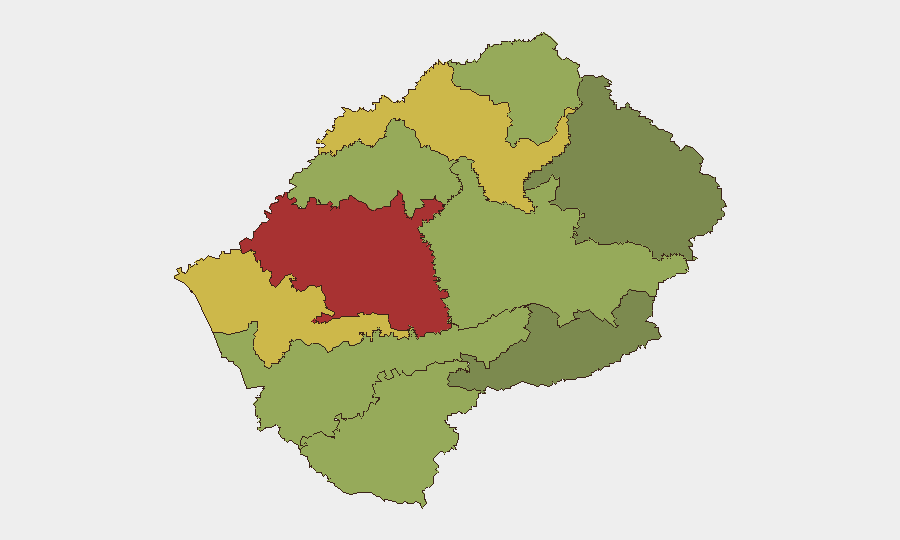
Lesotho remains a low-frequency, low-intensity threat environment at the national level (composite score 4; no tracked discrete events in the current 24–48 hour window). The country's security posture is stable, with no active armed conflict, large-scale civil unrest, or terrorism incidents reported. Risk remains geographically concentrated in urban and peri-urban districts, particularly Maseru, where criminality and community safety concerns drive elevated threat scores.
Key Developments
- Morija, 24 July 2026 — World Vision Lesotho handed over a newly constructed Child-Friendly Child and Gender Protection Unit office to the Lesotho Mounted Police Service. This is a policing infrastructure and capacity-building initiative, not a security incident; it reflects ongoing donor engagement in law-enforcement support.
No discrete security incidents (violent crime, civil disorder, terrorism, trafficking, or cyber events) were corroborated within Lesotho's borders during the last 24–48 hours. Cross-border arrests of Lesotho nationals in South Africa (notably in July and earlier months related to ATM bombing and illegal mining incidents) remain outside Lesotho territory and do not constitute domestic threat developments.
Highest-Risk Areas
Maseru District dominates the risk landscape (score 78), followed by Mafeteng (65) and Leribe (62). These three districts account for the bulk of Lesotho's recorded criminality, including armed robbery, stock theft, and organized property crime. Maseru's elevated risk reflects its status as the national capital and economic hub, where urban density, informal settlements, and limited police capacity create operational and targeting opportunities for criminal actors. Peripheral districts (Qacha's Nek, Mokhotlong, Quthing) register notably lower risk scores, indicating crime and instability are confined primarily to central and urban zones. Risk does not appear to be spreading geographically or intensifying at the national level.
How GeoBit Would Assist
Corporate security and duty-of-care teams with operations in Lesotho would deploy AOI Monitoring & Early Warning tools to establish persistent surveillance of Maseru and secondary districts, with automated alerting for events affecting office, facility, or personnel safety. Intel Sweep and X/Twitter & Telegram OSINT capabilities would sustain real-time monitoring of criminal networks, community tensions, and police operations, enabling rapid threat-level adjustments and evacuation decisions. Risk & Threat Assessment and Network & Actor Analysis would profile high-risk districts and criminal organizations, informing staff briefings, movement protocols, and asset-protection measures.
7-Day Outlook
No significant escalation in security incidents is forecast for the next seven days. Lesotho's baseline criminality (theft, robbery, trafficking) will likely persist at current levels without triggering national-level instability or international response. Security teams should maintain routine vigilance in Maseru and Mafeteng while monitoring for any spillover from South African border incidents or regional political developments affecting Lesotho's stability.
Highest-Risk Areas — Ranked
| # | State / Region | Risk |
|---|---|---|
| 1 | Maseru District | 78 |
| 2 | Mafeteng District | 65 |
| 3 | Leribe District | 62 |
| 4 | Berea District | 58 |
| 5 | Mohale's Hoek District | 52 |
| 6 | Butha-Buthe District | 48 |
| 7 | Thaba-Tseka District | 45 |
| 8 | Quthing District | 42 |
| 9 | Mokhotlong District | 38 |
| 10 | Qacha's Nek District | 28 |
Sources
Previous Daily Briefs
A new Lesotho brief is written every day — each with its own risk map and downloadable CSV. Here's the last week; use the calendar to go further back.
📅 Browse every day by calendar →
Highlighted days have a brief. Tap a day for that day's map & analysis, or “csv” for that day's dataset ($5).
Atlas — our AI intelligence desk — emails them this snapshot personally. Nothing else, no list.