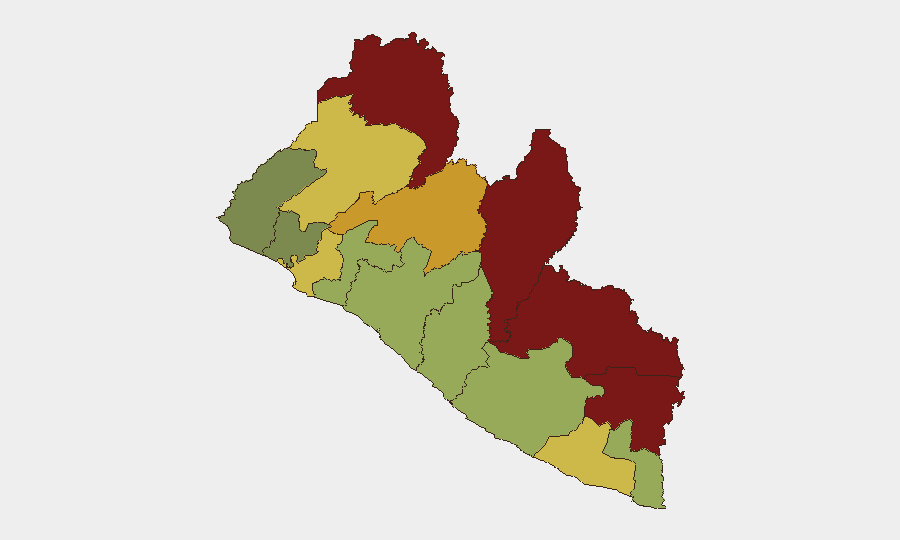
Situation Summary
Liberia's overall security environment remains stable, with no major armed conflict, large-scale civil unrest, or infrastructure sabotage reported in the last 24–48 hours. The country ranks #117 globally on GeoBit's threat index (composite score 7), indicating below-average risk relative to global peers. However, localized instability in the northern and southeastern counties—particularly Nimba, Lofa, and Grand Gedeh—continues to drive elevated sub-national risk, while Monrovia faces ongoing protest activity and high-profile criminal proceedings that warrant monitoring.
Key Developments
- Monrovia – 18 July 2026: Four consolidated event signals logged (public statements, demands directed at administration and president, and reduced diplomatic relations), suggesting domestic political friction; no kinetic incidents or mass unrest confirmed as of 20 July.
- Monrovia – 17 July 2026 (planned protest): The Liberia National Police deployed officers at "strategic locations across Monrovia" ahead of the Solidarity and Trust for a New Day (STAND) anti-government march; police reported prior interception of suspected improvised incendiary devices linked to the demonstration.
- Monrovia – 15 July 2026 (protest-related vehicle action): LNP grounded a vehicle used to promote the "Save Liberia" protest after inspection revealed mechanical defects; authorities stated the action was safety-driven and not protest suppression.
- Monrovia / Roberts International Airport – 16 July 2026 (repatriation): Seventeen Liberian nationals arrived via emergency government repatriation from South Africa, responding to heightened security threats against foreign nationals in that country.
- Monrovia – 16 July 2026 (major narcotics case): Monrovia City Court found probable cause in the US$19.2 million cocaine trafficking case involving Paul Jamaal King and co-defendants; the matter was referred to Criminal Court "C" for trial, an ongoing governance and organized-crime risk indicator.
- Maritime – Mid-July 2026 (flag-state exposure): Three Liberia-flagged tankers (AL BAHYAH, MOMBASA B, STOLT MAGNESIUM) were attacked off Oman, resulting in crew injuries and evacuations; this represents current maritime security risk for vessels registered under Liberian flag outside territorial waters.
Highest-Risk Areas
Nimba County (risk 92) and Lofa County (risk 88) dominate the sub-national ranking, with Grand Gedeh and River Gee counties also exceeding risk score 80. These northern and southeastern border regions face persistent vulnerabilities tied to cross-border movement, limited state presence, and residual organized-crime activity. Montserrado County (risk 64), which encompasses Monrovia, ranks eighth; its elevated score reflects political volatility, protest activity, and high-profile criminal cases rather than armed conflict. Security teams with personnel or assets in the northern counties should assume higher baseline risk and tighter operational constraints than the capital.
How GeoBit Would Assist
Security teams should deploy AOI (area-of-interest) monitoring with alerting on Nimba, Lofa, and Grand Gedeh counties to detect emerging armed activity or cross-border incidents in near-real time. OSINT fusion and sentiment analysis of social media, radio, and local news would provide early warning of protest escalation or political instability in Monrovia ahead of demonstration dates. Maritime and aviation tracking of Liberia-flagged vessels and Roberts International Airport activity would enable duty-of-care teams to anticipate supply-chain disruption, personnel movements, and exposure to narcotics-related enforcement actions.
7-Day Outlook
The near-term environment is expected to remain stable absent new protest mobilization or criminal incidents in Monrovia. Northern county risks are unlikely to shift sharply without evidence of renewed armed activity or border incursions. Continued monitoring of the STAND protest aftermath and the Roberts Airport cocaine case court proceedings is warranted to detect secondary instability or organized-crime retaliation.
Highest-Risk Areas — Ranked
| # | State / Region | Risk |
|---|---|---|
| 1 | Nimba County | 92 |
| 2 | Lofa County | 88 |
| 3 | Grand Gedeh County | 85 |
| 4 | River Gee County | 83 |
| 5 | Bong County | 72 |
| 6 | Gbarpolu County | 68 |
| 7 | Grand Kru County | 65 |
| 8 | Montserrado County | 64 |
| 9 | Rivercess County | 58 |
| 10 | Sinoe County | 55 |
| 11 | Margibi County | 52 |
| 12 | Grand Bassa County | 48 |
Sources
Previous Daily Briefs
A new Liberia brief is written every day — each with its own risk map and downloadable CSV. Here's the last week; use the calendar to go further back.
📅 Browse every day by calendar →
Highlighted days have a brief. Tap a day for that day's map & analysis, or “csv” for that day's dataset ($5).
Atlas — our AI intelligence desk — emails them this snapshot personally. Nothing else, no list.