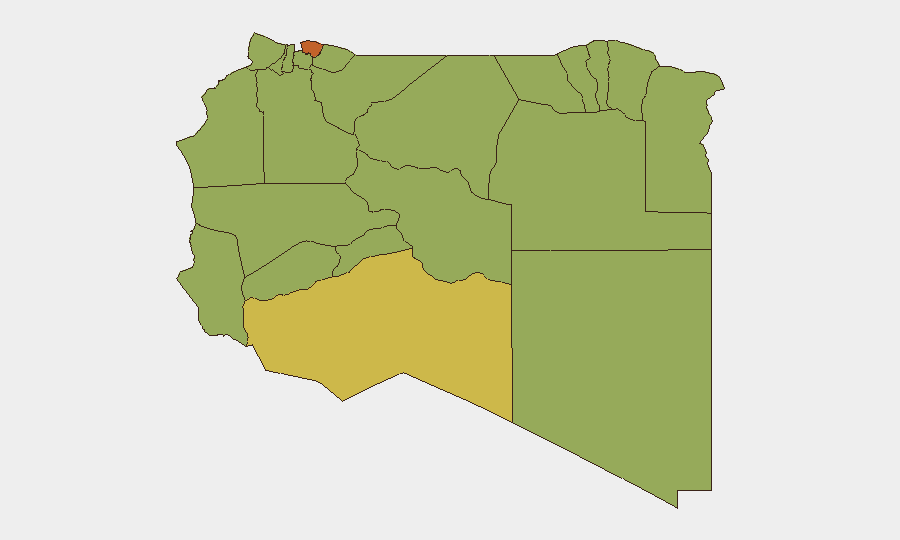
Situation Summary
Libya remains a fragmented state with competing governance structures and persistent localized security challenges, ranking #24 globally with a composite threat score of 63. The past 48 hours show a mixed picture: diplomatic and institutional activity (trilateral border talks, high-level Turkish–LNA engagement) alongside detention-related abuses, military operations in the east, and international law-enforcement actions. Tripoli dominates the threat landscape (risk 74), while southern and western districts present elevated but secondary risks. The trajectory suggests continued institutional friction, cross-border security coordination efforts, and localized military posturing without imminent major escalation.
Key Developments
- Tripoli, 22 Jun – Libyan Interior Ministry convened trilateral border-security meeting with Tunisia and Algeria to address cross-border organized crime, terrorism, and irregular migration; signals tightening of western and southern frontier controls.
- Tripoli, 22 Jun – Multiple detention-related incidents reported, including allegations of physical assault within prison facilities; UNHCR and diplomatic sources issued public statements on detainee conditions, indicating institutional human-rights concerns.
- Tripoli, 22 Jun – Libyan Ministry of Defense received 21 repatriated citizens from Niger in connection with border-security and irregular-migration operations along the southern frontier.
- Tripoli, 22 Jun – Italian national arrested in connection with International Criminal Court proceedings; indicates active international legal cooperation and external accountability mechanisms touching Libya's political-security environment.
- Benghazi, 21 Jun – Conventional military force activity reported with no confirmed casualty figures; reflects ongoing localized military posturing in eastern Libya.
- Benghazi, 23 Jun – Turkish National Intelligence Organisation chief İbrahim Kalın met Libyan National Army deputy commander Saddam Haftar to discuss institutional unification, stability measures, and Turkey–Libya security cooperation.
- Tripoli, 23 Jun – US State Department investigation initiated and embassy relations reduced; signals diplomatic friction over unspecified governance or human-rights concerns.
Highest-Risk Areas
Tripoli (risk 74) accounts for the majority of recent incident activity and remains the nexus of political authority, detention-related violence, and international engagement. The southern and western periphery—Murzuq (67.4), Wadi al Hayaa (45.7), and border districts including Az Zawiya and Wadi al Shatii (all 44)—face elevated risk primarily from organized crime, irregular migration, and cross-border militia activity; the trilateral border meeting underscores these zones as trafficking and smuggling corridors. Benghazi (eastern Libya) presents secondary but persistent military tension. Risk concentration reflects Libya's dual-governance structure (Tripoli-based Government of National Accord vs. eastern-based Libyan National Army) and limited state capacity in peripheral regions.
How GeoBit Would Assist
Security teams with personnel or assets in Libya should use OSINT Fusion & Corroboration and Entity Extraction to monitor the Turkish–Libyan security dialogue and track LNA force movements around Benghazi. Persistent Area-of-Interest Monitoring & Early Warning on Tripoli detention facilities, border crossings (especially southern routes via Niger), and the Tripoli–Benghazi political axis would provide actionable early signals of escalation or abuses. Network & Actor Analysis coupled with Conflict & Military tracking will clarify factional alignments and military capability shifts as Turkey deepens engagement with the LNA.
7-Day Outlook
Diplomatic and institutional stabilization efforts (Turkish mediation, trilateral border coordination) will likely continue, but detention abuses and inter-authority friction suggest simmering internal legitimacy challenges. Military activity in Benghazi and the southern border region will remain elevated. No imminent national-level escalation is indicated, though localized flare-ups and detention-related incidents should be monitored closely.
Highest-Risk Areas — Ranked
| # | State / Region | Risk |
|---|---|---|
| 1 | Tripoli | 74 |
| 2 | Murzuq | 67.4 |
| 3 | Wadi al Hayaa | 45.7 |
| 4 | Nalut | 44 |
| 5 | Ghat | 44 |
| 6 | Baladiyah Surman | 44 |
| 7 | Az Zawiya District | 44 |
| 8 | Wadi al Shatii | 44 |
| 9 | Kufra | 44 |
| 10 | Nuqat al Khams | 44 |
| 11 | Jafara | 44 |
| 12 | Murqub | 44 |
Sources
Previous Daily Briefs
A new Libya brief is written every day — each with its own risk map and downloadable CSV. Here's the last week; use the calendar to go further back.
📅 Browse every day by calendar →
Highlighted days have a brief. Tap a day for that day's map & analysis, or “csv” for that day's dataset ($5).