Situation Summary
Malta remains a low-threat jurisdiction globally (composite score 4; 0 tracked discrete events), with no acute security crisis. However, recent localized incidents—including a fireworks factory explosion, maritime interdiction operations, and a bail-granted threat against senior political figures—underscore persistent risks in public safety, maritime enforcement, and civil order. Risk concentration in Valletta, Sliema, and Saint Julian's reflects urban density and transient populations; the nationwide enforcement of fines-based deportation rules for non-resident visitors signals tightening administrative controls.
Key Developments
- Salini–Magħtab (near Naxxar), 3 August 2026: A fireworks factory explosion generated a large smoke plume over Magħtab, with an initial powerful blast followed by secondary detonations. Cause and casualty status remain unconfirmed in available open-source coverage.
- Marsaxlokk Port, 4 August 2026: Armed Forces of Malta intercepted and confiscated a vessel carrying illegally caught Bluefin tuna following Sea Ranger Unit alert; vessel towed to port. Signals ongoing maritime law-enforcement activity in southern coastal zones.
- Birżebbuġa, 2–3 August 2026 (decision reported last 48h): Local band clubs agreed to suspend a planned weekend fireworks display following court injunction over alleged property damage risk; decision triggered community backlash and debate on liability and tradition.
- Pietà/Valletta, last 48 hours: A man was granted bail after threatening to shoot Prime Minister Robert Abela, opposition MP Alex Borg, and former PM Joseph Muscat via text warning that "all of Malta will hear about me" if he did not receive assistance. Threat assessment and prosecution status not detailed in available reporting.
- Malta SAR Zone, recent (reported last 48h): 42 migrants intercepted by Libyan vessels in Malta's search-and-rescue zone and returned to Libya; operation raised legal and human-rights concerns regarding Malta's role and international obligations.
- Nationwide, June–present: Non-resident visitor fines-based deportation enforcement remains active: accumulation of €200+ in safety or public-order fines can trigger residence permit revocation and deportation if assessed as a public-order or safety risk by the principal immigration officer.
Highest-Risk Areas
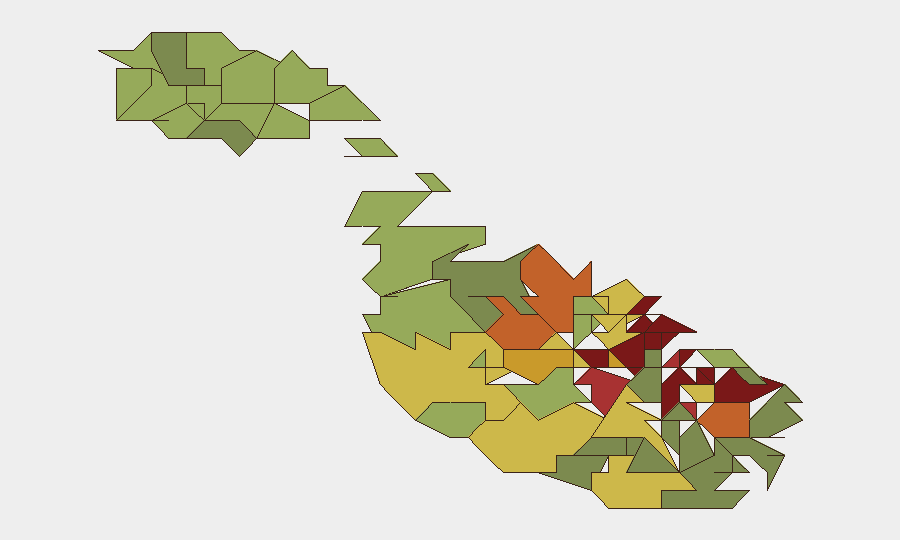
Valletta (95), Sliema (92), and Saint Julian's (90) dominate the sub-national ranking, reflecting their roles as administrative, commercial, and leisure hubs with high foot traffic, dense nightlife, mixed resident–tourist populations, and historical public-order flashpoints. Hamrun, Paola, and Msida (87–85) follow, suggesting risk clusters in central and harbor-adjacent urban zones. The concentration in urban cores rather than periphery or rural areas aligns with transient demographics, event density, and enforcement visibility; peripheral towns (Żabbar, Cospicua, Senglea at 80–81) show lower scores, indicating lower recorded or reported incident density.
How GeoBit Would Assist
Security teams with personnel or assets in Malta should employ AOI Monitoring & Early Warning on Valletta, Sliema, and Saint Julian's to track emerging civil-order, protest, or incident signals in real time. Intel Sweep and X/Twitter & Telegram OSINT capture localized threat chatter, permit revocation enforcement trends, and maritime incident updates faster than official channels. Network & Actor Analysis and Sentiment Analysis on online forums and local social media reveal community friction (e.g., fireworks-ban backlash, migrant-operation criticism) that may precede localized unrest or administrative changes affecting duty-of-care posture.
7-Day Outlook
No acute escalation is forecast. The fireworks factory explosion will likely trigger regulatory review; maritime interdictions and migrant operations will continue as routine enforcement. Monitoring of the Pietà threat case and any legal proceedings is warranted. Risk profile remains stable absent unexpected civil-order events or external shocks (e.g., regional maritime tensions, EU policy shifts on migration).
Highest-Risk Areas — Ranked
| # | State / Region | Risk |
|---|---|---|
| 1 | Valletta | 95 |
| 2 | Sliema | 92 |
| 3 | Saint Julian's | 90 |
| 4 | Gżira | 88 |
| 5 | Hamrun | 87 |
| 6 | Paola | 86 |
| 7 | Msida | 85 |
| 8 | Birkirkara | 84 |
| 9 | Birgu | 83 |
| 10 | Senglea | 82 |
| 11 | Cospicua | 81 |
| 12 | Żabbar | 80 |
Sources
Previous Daily Briefs
A new Malta brief is written every day — each with its own risk map and downloadable CSV. Here's the last week; use the calendar to go further back.
📅 Browse every day by calendar →
Highlighted days have a brief. Tap a day for that day's map & analysis, or “csv” for that day's dataset ($5).
Atlas — our AI intelligence desk — emails them this snapshot personally. Nothing else, no list.