Situation Summary
Mauritania remains under moderate composite security stress with no major armed incidents, terror attacks, or large-scale unrest confirmed in the past 24–48 hours. A labor strike at Rosso hospital and a police narcotics operation represent routine administrative and enforcement activity rather than security escalation. Background risks—terrorism in border regions, cross-border trafficking, and low-level political tensions around opposition figures and the former president—persist but have not translated into active incidents in the immediate term.
Key Developments
- Rosso Hospital Strike (Trarza) – 2–3 August: A general strike has paralyzed the Centre hospitalier de Rosso, significantly disrupting medical services. No violence reported, but residents and travelers may face reduced access to emergency and routine care until resolution.
- Narcotics Network Dismantled (Tiris Zemmour & Nouakchott-Ouest) – 2–3 August: The Mauritanian gendarmerie announced the dismantling of a drug trafficking network following joint operations in Zouerate (north) and Nouakchott-Ouest. No casualties or armed confrontation reported; operation highlights ongoing organized-crime activity along trafficking corridors in the north and capital region.
- No Active Violent Incidents Nationwide (24–48h assessment) – As of 3 August: Open-source monitoring confirms absence of confirmed terror attacks, armed clashes, or mass unrest in the most recent cycle, consistent with 28 July structured threat assessment.
- Border & Desert Zones Remain Under Travel Advisory – Ongoing: Mali and Algeria border regions (Hodh El Gharbi, Hodh Ech Chargui, Guidimaka, Assaba, parts of Tagant, Tiris Zemmour) maintain heightened risk of terrorist activity, kidnappings, and cross-border crime despite no discrete incident in the past 24–48 hours.
- Political Tensions Dormant but Latent – Last verified incidents 22–28 July: Court rulings against opposition MPs (27 July) and security measures around the former president remain potential triggers for demonstrations, but no confirmed protests or clashes occurred in the past 24–48 hours.
Highest-Risk Areas
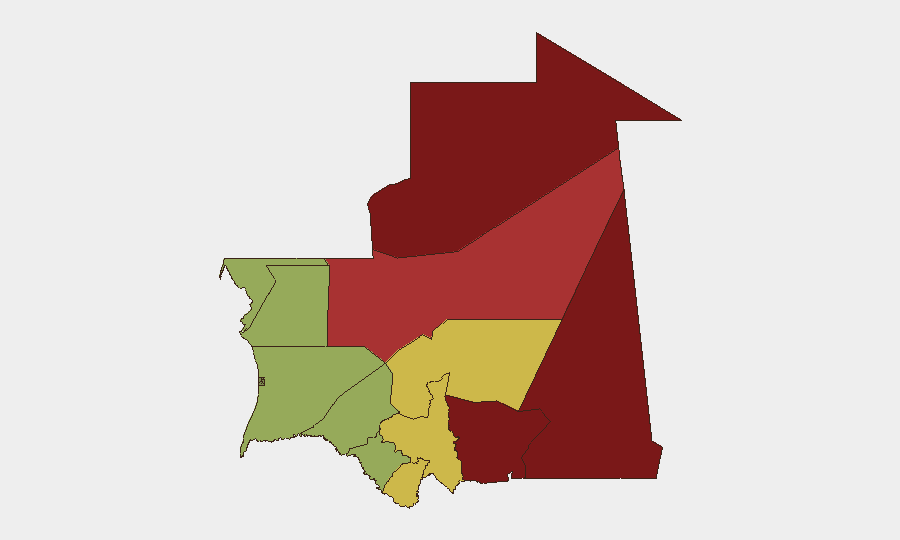
Tiris Zemmour (risk 95) and Hodh Ech Chargui (risk 85) drive the highest sub-national threat scores, followed by Hodh El Gharbi (80) and Adrar (78)—all border or deep-desert regions vulnerable to terrorism, kidnapping, trafficking, and cross-border militant activity linked to ungoverned space in Mali and Algeria. Tagant (68) and Guidimaka (65) sustain elevated risk for similar reasons. Risk intensity declines sharply in coastal and central zones (Brakna 48, Dakhlet Nouadhibou 45) but remains non-negligible due to organized crime and urban crime in Nouakchott and Nouadhibou.
How GeoBit Would Assist
Security teams should deploy AOI Monitoring & Early Warning on high-risk border regions (Tiris Zemmour, Hodh Ech Chargui, Guidimaka) to detect nascent militant activity, trafficking, or cross-border incursions before they escalate. Intel Sweep, multi-language OSINT fusion, and Telegram/X intelligence provide continuous horizon-scanning of opposition movements, police operations, and militant forums to anticipate political flare-ups or coordinated attacks. Routing & Network Analysis enables identification of safer transit corridors and real-time alternative pathways for personnel in Nouakchott and travel to northern zones, avoiding checkpoints and active trafficking routes.
7-Day Outlook
The security environment is expected to remain steady over the next 7 days absent new triggering events (opposition court cases, militant claims of attack). The Rosso hospital strike may resolve within days through negotiation. Border and northern desert risks remain chronic and unchanged; any escalation would likely be signaled through increased militant claims, kidnapping alerts, or cross-border incursions—all trackable via OSINT within hours of occurrence.
Highest-Risk Areas — Ranked
| # | State / Region | Risk |
|---|---|---|
| 1 | Tiris Zemmour | 95 |
| 2 | Hodh Ech Chargui | 85 |
| 3 | Hodh El Gharbi | 80 |
| 4 | Adrar | 78 |
| 5 | Tagant | 68 |
| 6 | Guidimaka | 65 |
| 7 | Assaba | 62 |
| 8 | Gorgol | 58 |
| 9 | Trarza | 55 |
| 10 | Inchiri | 52 |
| 11 | Brakna | 48 |
| 12 | Dakhlet Nouadhibou | 45 |
Sources
Previous Daily Briefs
A new Mauritania brief is written every day — each with its own risk map and downloadable CSV. Here's the last week; use the calendar to go further back.
📅 Browse every day by calendar →
Highlighted days have a brief. Tap a day for that day's map & analysis, or “csv” for that day's dataset ($5).
Atlas — our AI intelligence desk — emails them this snapshot personally. Nothing else, no list.