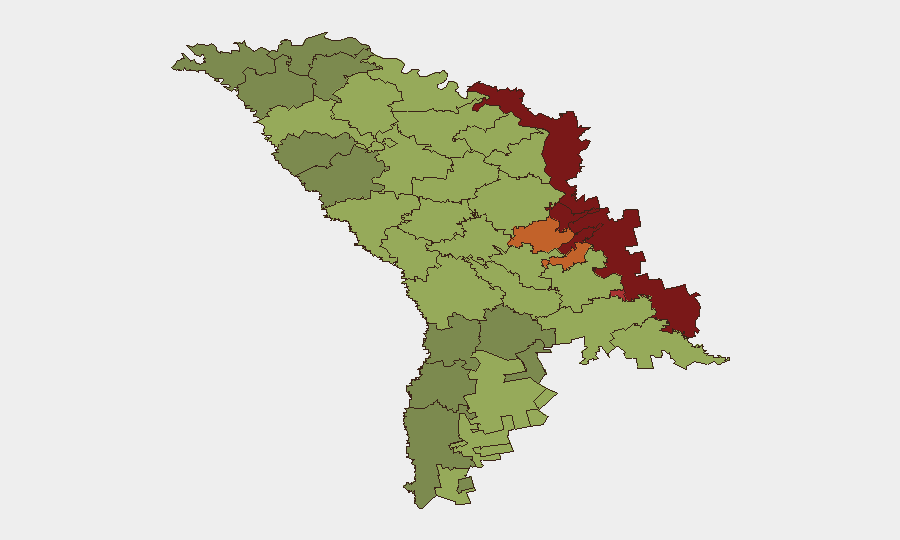
Situation Summary
Moldova faces acute infrastructure and energy strain from Russian strikes on Ukraine's power sector and direct hits on regional facilities, compounded by weather damage to domestic transmission lines. A fourth consecutive day of electricity supply disruption is driving controlled disconnections and fuel shortages; cross-border security disruptions near Odesa have closed key transit routes. The threat profile remains elevated in separatist-controlled eastern regions and border districts, with drone activity now confirmed in southern Moldova within the last 24 hours.
Key Developments
- Crocmaz, Ștefan Vodă district (2026-08-09): An object fell and ignited a fire; police recovered fragments consistent with combat-drone wreckage and dispatched explosives specialists for examination. This represents the second confirmed drone incident in Moldova in five days.
- Northern Moldova (night 2026-08-08 to 2026-08-09): Heavy rain and hurricane-force winds downed or damaged approximately 10 high-voltage towers on the 330 kV Bălți–Dnestrovsk transmission line, compounding energy-sector disruption.
- Isaccea–Vulcănești electricity link (2026-08-09): Russian overnight strikes on Ukraine's energy infrastructure damaged Moldova's primary cross-border electricity connection with Romania, severing a critical source of imported power.
- Novodnistrovsk hydroelectric station (2026-08-09): A reported Russian strike caused an oil leak into the Dniester River, creating an imminent threat to Moldova's water-supply infrastructure and downstream civilian populations.
- National electricity system (2026-08-09): Energocom announced purchase of 9,209 MWh for supply on 2026-08-09 after four consecutive days of demand-supply deficit; controlled disconnections are possible if regional conditions deteriorate further.
- Odesa–Reni crossing (2026-08-09): Russian attacks on Odesa region have partially closed the Odesa–Reni route and blocked access to some Moldovan border crossings. Moldovan border police advised travelers to avoid the area and cease travel to Odesa.
- Fuel supply (2026-08-08 to 2026-08-09): Over 40 gas stations in northwestern Moldova reported diesel depletion; national reserves cover approximately 7.6 days of consumption, signaling near-term transport and logistics vulnerability.
Highest-Risk Areas
The left-bank Dniester region (Administrative-Territorial Units of the Left Bank, Dubăsari, Bender) remains the highest-risk corridor due to ongoing separatist control, proximity to the conflict zone, and limited state authority. Border districts (Criuleni, Rezina, Ștefan Vodă, Căușeni) now face compounded risk from drone activity and cross-border strike effects. Chișinău and Orhei rank lower but remain exposed to indirect effects—infrastructure damage, supply chain disruption, and potential secondary drone incidents—particularly given the confirmed drone strike in southern Moldova on 2026-08-09.
How GeoBit Would Assist
Security teams should deploy AOI Monitoring & Early Warning on Ștefan Vodă, Cahul, and border districts to detect further drone activity in real time; simultaneously, Intel Sweep and OSINT fusion should track Russian strike patterns on Ukrainian energy infrastructure to anticipate Moldova's secondary impacts. Routing & Network Analysis can identify alternative supply routes (fuel, electricity, logistics) and assess travel safety around the Odesa–Reni closure; satellite imagery analysis should be tasked to assess damage to the Isaccea–Vulcănești line and hydroelectric facilities for duty-of-care decision-making.
7-Day Outlook
Electricity and fuel shortages are likely to persist through the weekend pending stabilization of Ukraine's energy grid and repair of cross-border links; controlled disconnections may expand if regional supply tightens. Drone activity in southern and border regions should be anticipated to continue as part of broader Russian operations against Ukrainian infrastructure; weather improvements may reduce transmission-line vulnerability but will not resolve the underlying power-deficit problem.
Highest-Risk Areas — Ranked
| # | State / Region | Risk |
|---|---|---|
| 1 | Administrative-Territorial Units of the Left Bank of the Dniester | 85 |
| 2 | Dubăsari | 82 |
| 3 | Bender | 79 |
| 4 | Criuleni | 75 |
| 5 | Rezina | 58 |
| 6 | Taraclia | 55 |
| 7 | Gagauzia | 54 |
| 8 | Căușeni | 53 |
| 9 | Soroca | 52 |
| 10 | Ștefan Vodă | 51 |
| 11 | Orhei | 50 |
| 12 | Chișinău | 49 |
Sources
Previous Daily Briefs
A new Moldova brief is written every day — each with its own risk map and downloadable CSV. Here's the last week; use the calendar to go further back.
📅 Browse every day by calendar →
Highlighted days have a brief. Tap a day for that day's map & analysis, or “csv” for that day's dataset ($5).
Atlas — our AI intelligence desk — emails them this snapshot personally. Nothing else, no list.