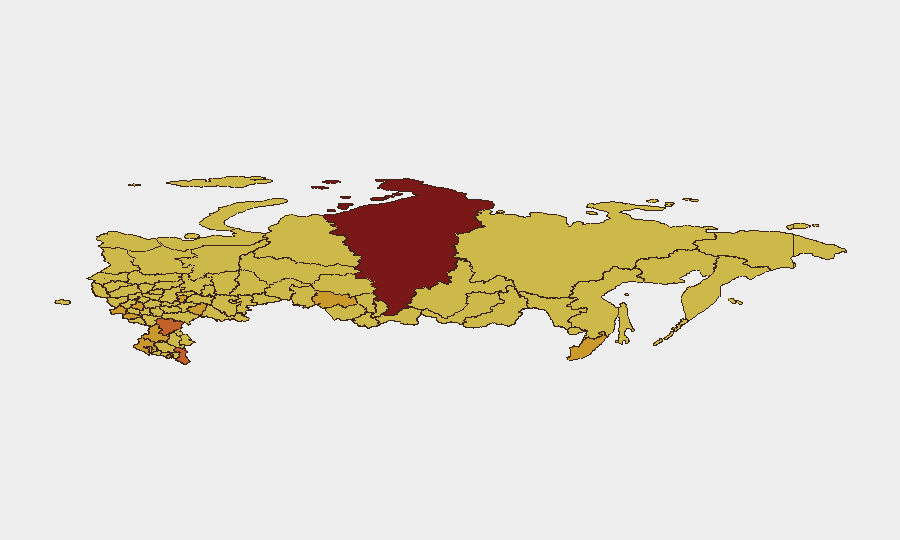
Situation Summary
Russia faces sustained Ukrainian long-range strike operations targeting energy and military-industrial infrastructure across multiple southern and central regions, with confirmed attacks on oil facilities in Krasnodar Krai, Volgograd Oblast, and missile-component manufacturing in Chuvashiya over the past 48 hours. Moscow remains the composite highest-risk location (score 100), driven by active war dynamics and 651 tracked events, while southern energy and logistics hubs in Krasnoyarsk Krai, Krasnodar Krai, and Volgograd Oblast have escalated to near-parity risk levels following recent strikes. Russian air-defense posture is being reinforced across southern regions, though the geographic depth and dispersal of Ukrainian targeting suggest continued vulnerability in critical infrastructure corridors.
Key Developments
- Volna, Krasnodar Krai – 14–15 June 2026: Ukrainian drone attack on Black Sea oil/sea terminal killed 1, injured 3, and ignited fire at crude-oil export facility; strike corroborated by Krasnodar governor and US media outlets.
- Volgograd Oblast – night of 14–15 June 2026: Ukraine's General Staff confirmed strike on oil preparation and pumping station as part of campaign against military and energy infrastructure deep inside Russian territory.
- Cheboksary, Chuvashiya – 11–12 June 2026 (recent): Ukrainian long-range FP-5 "Flamingo" missiles struck military factory producing drone and missile components approximately 900 km from front line, per Zelensky statement.
- Saint Petersburg – within past week (pre-15 June): Ukrainian attack set ablaze oil terminal and damaged naval base; prompted Putin statement on air-defense reinforcement and cited as direct trigger for current heightened southern-region security posture.
- Southern Russia air-defense activation – 14–15 June 2026: Russian officials announced reinforced air-defense measures over southern regions, particularly around energy infrastructure and Black Sea facilities, in direct response to Ukrainian drone and missile activity.
- Russian-occupied Donetsk and Zaporizhzhia – night of 14–15 June 2026: Ukraine's General Staff reported strikes on Russian military and energy infrastructure in occupied territories integral to Russian logistics and military basing.
Highest-Risk Areas
Moscow dominates composite risk (100) as the administrative, political, and symbolic epicenter of Russian state authority, with highest concentration of tracked events. However, Krasnoyarsk Krai (97.4) and southern energy-corridor states—Krasnodar Krai (72.3), Volgograd Oblast (73.2), and Rostov Oblast (71.6)—now present acute near-term operational risk due to confirmed Ukrainian targeting of oil terminals, refineries, and military-logistics nodes. Saint Petersburg (75.1), as Russia's second city and naval hub, remains persistently elevated following recent strikes on petroleum and naval facilities. Risk is driven equally by active combat operations (primarily Ukraine-front spillover and long-range strikes) and by critical-infrastructure vulnerability in energy and defense-industrial sectors.
How GeoBit Would Assist
Corporate security teams with assets or personnel in Russia should employ AOI Monitoring & Early Warning on high-risk energy and logistics nodes in southern regions to receive alert notification of strike activity or military repositioning. Routing & Network Analysis capabilities enable identification of alternative transport corridors and safe-passage planning in Krasnodar, Volgograd, and Saint Petersburg. Conflict & Military battle-mapping and Satellite & Imagery analysis provide real-time damage assessment and infrastructure-status verification post-incident, critical for duty-of-care decisions on personnel movement or facility operations.
7-Day Outlook
Ukrainian long-range strike operations are likely to persist against energy and military-industrial targets in southern and central Russia through the forecast week. Russian air-defense reinforcement may reduce strike success rate but is unlikely to halt operations entirely, given Ukraine's demonstrated ability to penetrate defenses across dispersed targets. Personnel and asset exposure remains highest in Krasnodar Krai, Volgograd Oblast, and Saint Petersburg; travel and supply-chain continuity should be reassessed daily in those zones.
Highest-Risk Areas — Ranked
| # | State / Region | Risk |
|---|---|---|
| 1 | Moscow | 100 |
| 2 | Krasnoyarsk Krai | 97.4 |
| 3 | Saint Petersburg | 75.1 |
| 4 | Dagestan | 73.6 |
| 5 | Volgograd Oblast | 73.2 |
| 6 | Samara Oblast | 72.9 |
| 7 | Krasnodar Krai | 72.3 |
| 8 | Primorsky Krai | 72 |
| 9 | Bryansk Oblast | 72 |
| 10 | Tula Oblast | 72 |
| 11 | Chuvashia | 71.6 |
| 12 | Rostov Oblast | 71.6 |
Sources
Previous Daily Briefs
A new Russia brief is written every day — each with its own risk map and downloadable CSV. Here's the last week; use the calendar to go further back.
📅 Browse every day by calendar →
Highlighted days have a brief. Tap a day for that day's map & analysis, or “csv” for that day's dataset ($5).