Situation Summary
South Korea's composite threat score of 7 places it at #91 globally, reflecting elevated but manageable risk. Recent event signals (15–17 June) indicate domestic political friction—disapproval gestures toward the presidency, small-arms confrontation reporting, and inter-ministerial disagreements—alongside North Korean rhetorical escalation. The concentrated geographic clustering of risk in North Chungcheong (31.4) and Seoul (27.8) suggests localized political or security tensions rather than nationwide instability. Overall trajectory remains contained, but incoming signals warrant real-time monitoring.
Key Developments
- 15 June, South Korea: Multiple "Disapprove" signals involving the presidency and South Korean entities; one "Small Arms Combat" event reported between South Korea and the presidency. Nature and location of armed incident remain unclear from available data.
- 16 June, Seoul/nationwide: Public statement issued by South Korea; separate public statement by South Korea directed at a corporation, indicating corporate-government friction or regulatory action.
- 16 June, nationwide: North Korea issued rejection statement (content unknown); likely related to inter-Korean or sanctions matter.
- 17 June, nationwide: North Korea issued public statement directed at China, signaling potential diplomatic realignment or sanctions-evasion coordination.
- 17 June, nationwide: South Korea issued disapproval toward Interior Ministry, indicating domestic executive-bureaucratic tension.
Data caveat: Event signals lack granular incident detail (specific locations, casualty counts, operational context). Live web research did not yield corroborating news items within the 24–48 hour window; the Coupang data-breach fine (11 June, Seoul) falls outside the current reporting period.
Highest-Risk Areas
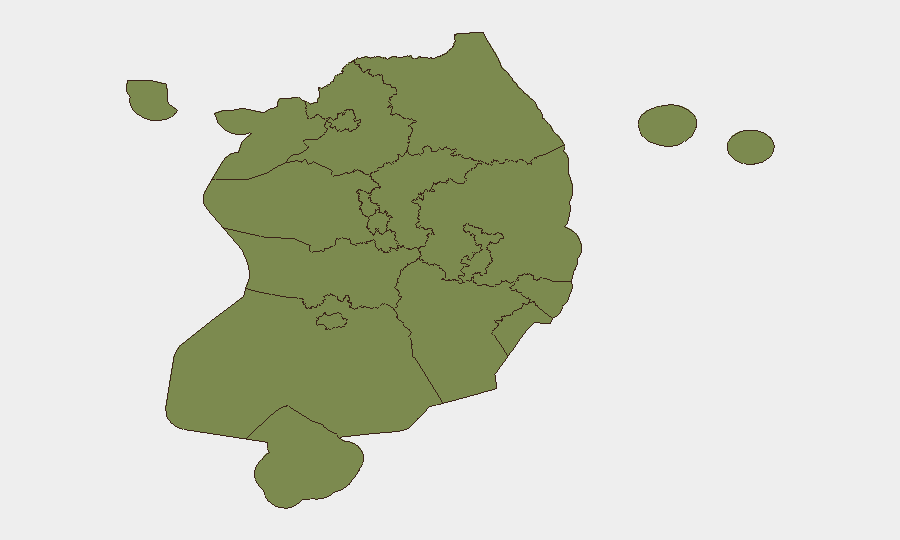
North Chungcheong and Seoul drive the national risk profile, together accounting for over 59 of the composite score. North Chungcheong's elevated risk (31.4) is notable for a non-capital region and may reflect military installations, border-adjacent infrastructure, or concentrated industrial targets; Seoul's risk (27.8) aligns with its role as the political and economic center, where presidential, ministerial, and corporate activity concentrates. Incheon (13.5) ranks third, likely reflecting port and transportation hubs. The sharp drop-off beyond these three (North Gyeongsang at 7.7) suggests that risk is geographically contained rather than dispersed, a pattern typical of political rather than criminal or terror-driven threat environments.
How GeoBit Would Assist
Security and risk teams should deploy AOI Monitoring & Early Warning on Seoul, North Chungcheong, and Incheon to track real-time incident escalation and alert on protest, executive, or military activity changes. Intel Sweep (global event feeds, X/Telegram OSINT, multi-language search) would disambiguate the 15–17 June event signals—specifically, the nature and location of the small-arms report and the corporate-government friction. Network & Actor Analysis would clarify relationships between presidential, ministerial, and corporate entities involved in the disapproval and rejection signals, enabling duty-of-care teams to assess whether their operations or personnel face regulatory, political, or security exposure.
7-Day Outlook
Political friction appears to be the dominant driver, with no signals of armed escalation, terrorism, or organized crime surge. However, the lack of detailed incident corroboration means that next 48–72 hours will be critical for confirming whether small-arms language reflects an isolated event or a pattern. If North Korean rhetoric intensifies and Seoul-based corporate or regulatory action accelerates, risk scores may climb; conversely, if the signals represent routine political disagreement, trend should stabilize or decline by 21 June.
Highest-Risk Areas — Ranked
| # | State / Region | Risk |
|---|---|---|
| 1 | North Chungcheong | 31.4 |
| 2 | Seoul | 27.8 |
| 3 | Incheon | 13.5 |
| 4 | North Gyeongsang | 7.7 |
| 5 | South Jeolla | 7.2 |
| 6 | Jeju | 6.8 |
| 7 | Busan | 4.5 |
| 8 | Gyeonggi | 2.3 |
| 9 | Gangwon State | 1.4 |
| 10 | South Chungcheong | 1.4 |
| 11 | Sejong | 1.4 |
| 12 | Jeonbuk State | 1.4 |
Sources
Previous Daily Briefs
A new South Korea brief is written every day — each with its own risk map and downloadable CSV. Here's the last week; use the calendar to go further back.
📅 Browse every day by calendar →
Highlighted days have a brief. Tap a day for that day's map & analysis, or “csv” for that day's dataset ($5).