Situation Summary
Thailand's composite threat score stands at 99 (rank #16 globally), driven primarily by acute political unrest centered in Bangkok following the leak of a private conversation between the prime minister and Cambodian counterparts on 23 June 2026. Large-scale demonstrations demanding PM resignation have occupied Government House environs and central Bangkok streets over 23–24 June, with police deploying riot-control assets and imposing selective road closures. The convergence of political instability, active protest movements, and military-adjacent signaling (evidenced in recent event tracking) creates a volatile near-term environment for corporate operations and personnel.
Key Developments
- Bangkok, Government House area – 23 June 2026: Thousands of protesters assembled after the leaked PM–Cambodia call circulated online, with demonstrators signaling political dissatisfaction and demanding resignation; heavy police presence reported overnight into 24 June.
- Bangkok, city center and commercial districts – 24 June 2026: Large crowds returned to central Bangkok streets on 24 June, causing significant traffic disruption on major routes and raising risk of incidental clashes near protest corridors.
- Bangkok, Government House vicinity – 24 June 2026 (afternoon/evening): Demonstrator numbers increased by late afternoon; minor scuffles reported between protesters and security forces as police attempted access restrictions around compound entrances.
- Bangkok, key intersections near Government House – 24 June 2026: Authorities implemented road closures and diversions at multiple junctions and deployed additional riot-control units in anticipation of renewed mobilization.
- Bangkok, government complex area – 24 June 2026: Coordinated marches organized by civil society and student activists converged from university areas toward the government complex, with the leaked conversation serving as the focal rallying point and escalating political tension.
- Nationwide event signals (22–24 June): Tracked events include small arms combat (22 June), administrative sanctions by the Supreme Court (24 June), worker arrest/detention actions (24 June), and disapproving statements by the National Police Chief (24 June), indicating stress across multiple institutional domains.
Highest-Risk Areas
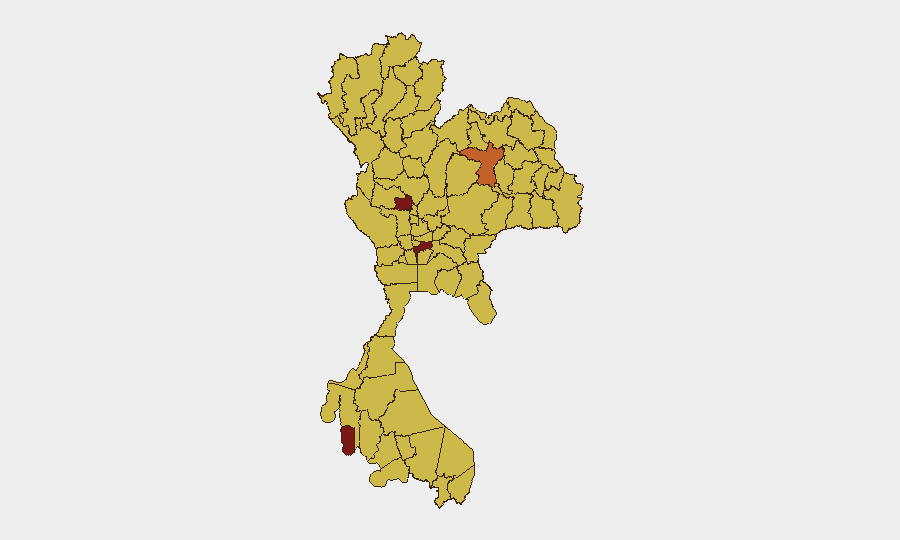
Bangkok dominates the risk landscape at 99.3, reflecting the concentration of political authority, protest infrastructure, and security-force activity in the capital. Chai Nat Province (95), Phuket Province (86.4), and the northeastern provinces (Khon Kaen, Nakhon Ratchasima, Bueng Kan, Nong Khai, Udon Thani, and Sakon Nakhon all at 69–73.6) represent secondary risk clusters, likely reflecting historical labor unrest, border-adjacent instability, and dispersed political sentiment. For corporate duty-of-care purposes, Bangkok remains the immediate priority; northeastern provinces warrant monitoring for secondary spillover, particularly if protests escalate or if regional labor actions intensify.
How GeoBit Would Assist
Security and risk teams should deploy AOI Monitoring & Early Warning on Bangkok's Government House complex and major CBD intersections to track protest scale, police positioning, and movement restrictions in real time. Intel Sweep (X/Twitter, Telegram OSINT, sentiment analysis) combined with Network & Actor Analysis will identify emerging protest leadership, coordination channels, and escalation signals. Routing & Network Analysis enables alternative journey planning for personnel and supply chains to circumvent closure zones and reduce exposure to crowd encounters.
7-Day Outlook
Protest momentum is likely to persist through the weekend and into early next week absent a significant policy or leadership concession. Risk of localized confrontation between demonstrators and security forces remains elevated, particularly during peak gathering hours. Corporate operations should maintain flexible staffing postures in Bangkok, pre-position alternative routes, and monitor police/military posturing for signals of broader crackdown or institutionalization of restrictions.
Highest-Risk Areas — Ranked
| # | State / Region | Risk |
|---|---|---|
| 1 | Bangkok | 99.3 |
| 2 | Chai Nat Province | 95 |
| 3 | Phuket Province | 86.4 |
| 4 | Khon Kaen Province | 73.6 |
| 5 | Nakhon Ratchasima Province | 70.7 |
| 6 | Chiang Mai Province | 70.7 |
| 7 | Bueng Kan Province | 69.3 |
| 8 | Nong Khai Province | 69.3 |
| 9 | Udon Thani Province | 69.3 |
| 10 | Sakon Nakhon Province | 69.3 |
| 11 | Nakhon Phanom Province | 69.3 |
| 12 | Chaiyaphum Province | 69.3 |
Sources
Previous Daily Briefs
A new Thailand brief is written every day — each with its own risk map and downloadable CSV. Here's the last week; use the calendar to go further back.
📅 Browse every day by calendar →
Highlighted days have a brief. Tap a day for that day's map & analysis, or “csv” for that day's dataset ($5).