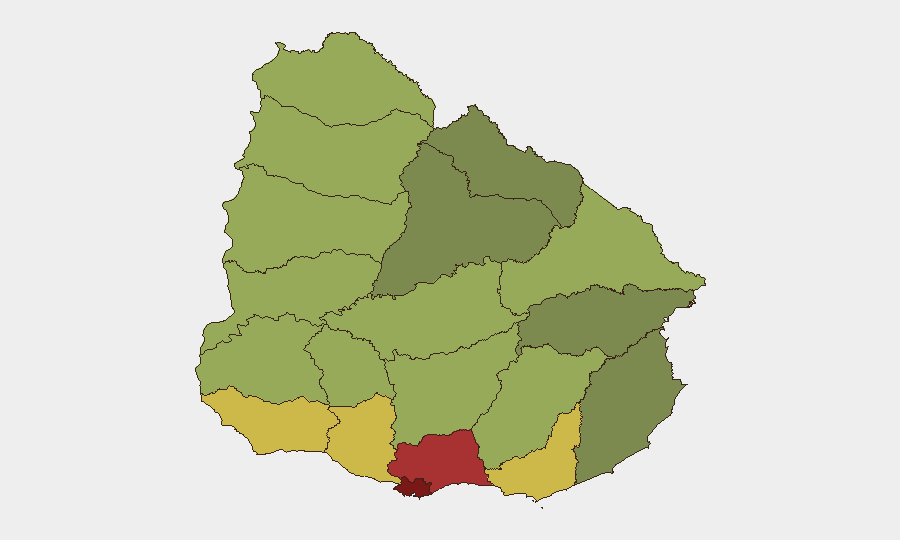
Situation Summary
Uruguay remains the most peaceful country in Latin America and the Caribbean, with no credible security incidents, civil unrest, political violence, or infrastructure disruptions confirmed in the past 24–48 hours across reliable open sources or official channels. The national security environment shows no deterioration; the U.S. Embassy continues routine advisory posture without event-specific alerts. Overall threat trajectory remains stable and low-risk relative to regional comparators.
Key Developments
No confirmed security, conflict, civil-unrest, crime, or political-instability incidents inside Uruguay in the past 24–48 hours were identified across credible news, official government, or social-media sources. Open reporting emphasizes Uruguay's ongoing stability and low-threat baseline. Routine law-enforcement and administrative activity may continue, but no discrete incidents meeting operational reporting thresholds have emerged.
*Note: Event signals flagged in the GeoBit platform (arrests, statements by judicial and executive figures, references to international actors) have not been independently cross-verified as involving domestic Uruguay security threats in the 24–48 hour window. Further platform-based intelligence sweep and OSINT corroboration may clarify their operational relevance.*
Highest-Risk Areas
Montevideo (composite risk 92) and Canelones (78) account for the plurality of tracked risk and reflect urbanization, population density, and historical concentration of property crime and interpersonal violence in the capital and its metropolitan ring. Maldonado (68), a coastal and tourism-dependent department, ranks third and warrants attention for transient populations and port-adjacent vulnerabilities. These three departments should be the geographic focus of duty-of-care planning and asset-protection protocols; personnel or supply chains operating in Montevideo especially should maintain situational awareness and standard urban-security discipline. Risk levels in all other departments remain materially lower and do not signal acute threats.
How GeoBit Would Assist
A corporate security team with personnel or assets in Uruguay would employ AOI Monitoring & Early Warning to establish persistent watch on Montevideo and Canelones, with automated alerting on new conflict, crime, or civil-unrest signals. OSINT Fusion & Corroboration (including multi-language news, X/Twitter, and Telegram intelligence) would triangulate real incidents from noise, reducing false alarms and confirming operational relevance. GIS & Spatial Analysis and Routing & Network Analysis would support contingency planning, alternative-journey options, and real-time movement decisions for field teams or supply logistics.
7-Day Outlook
No acute catalyst for security deterioration is apparent; Uruguay's political and institutional stability, combined with low baseline conflict and crime, suggests maintenance of current threat profile over the next 7 days. Routine monitoring for any shifts in judicial or executive statements, labor unrest, or cross-border activity should continue; however, no escalation scenario is indicated at present. Standard duty-of-care protocols (staff situational awareness, embassy registration, travel-corridor familiarity) remain appropriate and sufficient for most corporate operations.
Highest-Risk Areas — Ranked
| # | State / Region | Risk |
|---|---|---|
| 1 | Montevideo | 92 |
| 2 | Canelones | 78 |
| 3 | Maldonado | 68 |
| 4 | San José | 64 |
| 5 | Colonia | 62 |
| 6 | Soriano | 58 |
| 7 | Río Negro | 56 |
| 8 | Salto | 54 |
| 9 | Artigas | 52 |
| 10 | Paysandú | 50 |
| 11 | Florida | 48 |
| 12 | Flores | 46 |
Sources
Previous Daily Briefs
A new Uruguay brief is written every day — each with its own risk map and downloadable CSV. Here's the last week; use the calendar to go further back.
📅 Browse every day by calendar →
Highlighted days have a brief. Tap a day for that day's map & analysis, or “csv” for that day's dataset ($5).