Situation Summary
Botswana remains a low-threat environment regionally, ranked #165 globally with a composite threat score of 7 and no tracked security events in the current review period. Institutional stability is being reinforced by leadership transitions in the security establishment and elevated diplomatic engagement with major powers, though urban concentrations—particularly Gaborone, South-East District, and Lobatse—carry elevated localized risk. The security posture is stable with no indication of near-term destabilization.
Key Developments
- Mahalapye, 14 October: A magistrate faced a threat-to-kill charge following an alleged WhatsApp message threatening two colleagues and referencing suicide; the charge sheet was formally dated 14 October and reflects internal institutional tension.
- Gaborone, 14–18 October: The Regional Magistrate's Court continued proceedings in multiple high-profile corruption cases involving former ministers, politicians, businesspeople, and senior public officials, maintaining judicial focus on institutional accountability.
- Beijing / Gaborone, 13–14 October: President Duma Boko and President Xi Jinping elevated China–Botswana relations to a comprehensive strategic cooperative partnership, signing security cooperation, Global Security Initiative, green minerals, health, and personnel training agreements—a significant shift in Botswana's external-security alignment.
- Gaborone, 13 October: Aobakwe Moemedi Monamo assumed the role of acting director-general of the Directorate of Intelligence and Security following the retirement of Peter Fana Magosi, marking a leadership transition in Botswana's principal intelligence agency.
- South-East District, 14 October: A robbery incident was reported in Metsimotlhabe; insufficient corroborated detail available for expanded assessment.
- Central District, 14 October: A death was reported in Maitengwe; insufficient corroborated detail available for expanded assessment.
Highest-Risk Areas
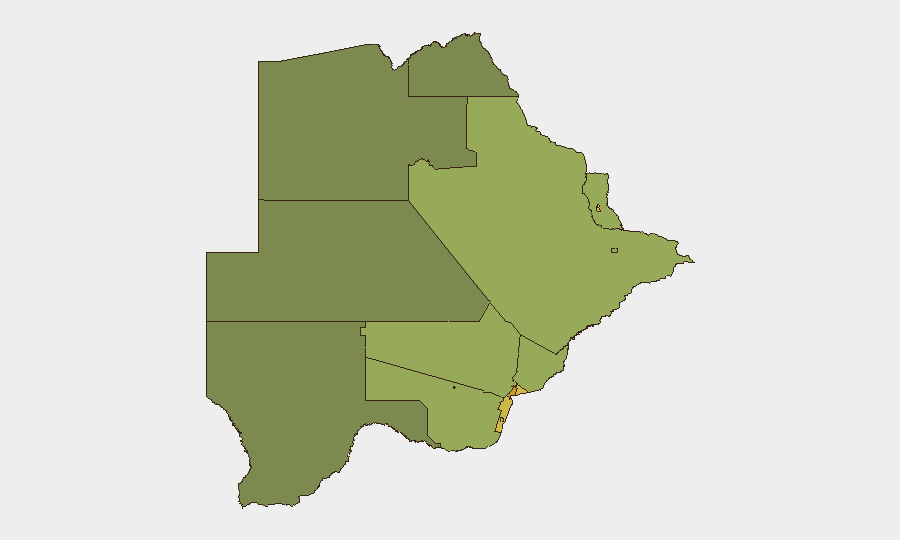
Gaborone (risk 72), South-East District (68), and Lobatse (65) are the primary drivers of national risk, reflecting concentrated urban criminal activity, economic density, and population mobility. Francistown, Jwaneng, and Selebi Phikwe (scores 62, 61, and 58 respectively) present secondary risk nodes associated with mining and commercial activity. Northern and central districts carry materially lower risk. The ranking reflects urban concentrations of property crime, interpersonal violence, and commercial fraud rather than political instability or organized terrorism.
How GeoBit Would Assist
Security teams in Botswana would employ AOI (Area-of-Interest) Monitoring & Early Warning on Gaborone and South-East District to detect emerging crime clusters or incident patterns before they scale; OSINT fusion and corroboration (X/Twitter, Telegram, local news integration) to distinguish verified incidents from rumor in real time; and GIS & Spatial Analysis to map risk corridors and optimize travel routing for personnel and asset movements. Intel Sweep and multi-language search capabilities track leadership and institutional changes—such as the Directorate transition—that affect duty-of-care compliance and security coordination.
7-Day Outlook
No imminent destabilization is forecast. The intelligence leadership transition and China–Botswana strategic partnership elevation will evolve over weeks; no acute security consequence is expected. Urban localized crime will remain the primary exposure for corporate operations and travelers. Continued judicial proceedings on corruption cases may generate institutional friction but do not threaten systemic stability.
Highest-Risk Areas — Ranked
| # | State / Region | Risk |
|---|---|---|
| 1 | Gaborone | 72 |
| 2 | South-East District | 68 |
| 3 | Lobatse | 65 |
| 4 | Francistown | 62 |
| 5 | Jwaneng | 61 |
| 6 | Selebi Phikwe | 58 |
| 7 | Southern District | 55 |
| 8 | Kgatleng District | 50 |
| 9 | Kweneng District | 48 |
| 10 | North-East District | 45 |
| 11 | Central District | 42 |
| 12 | North-West District | 38 |
Sources
Previous Weekly Briefs
A new Botswana brief is written every Monday, covering the week — each with its own risk map and downloadable CSV. Use the calendar to go further back.
- October 13, 2026
- October 6, 2026
- September 29, 2026
- September 23, 2026
- September 16, 2026
- September 9, 2026
- September 3, 2026
📅 Browse past briefs by calendar →
Highlighted days have a brief. Tap a day for that day's map & analysis, or “csv” for that day's dataset ($5).
Atlas — our AI intelligence desk — emails them this snapshot personally. Nothing else, no list.