Situation Summary
Montenegro remains a low-threat environment at the national level (rank #154 globally) with no discrete security incidents tracked in the current reporting window. However, wildfire activity along coastal and mountainous zones—particularly around Herceg Novi—has prompted evacuations and civil-protection mobilization as of mid-August, creating short-term operational disruptions. Political friction between Podgorica and Belgrade has elevated diplomatic tensions but has not translated into street-level unrest. Sub-national risk concentration in the northeastern municipalities (Plav, Gusinje, Rožaje) reflects structural vulnerabilities tied to organized crime and cross-border trafficking, not acute emergency conditions.
Key Developments
- Herceg Novi and coastal municipalities (Bijela/Baošići), 14–16 August 2026 – Large wildfires forced precautionary evacuations of approximately 30 residents; firefighters contained spread but residents remain on standby for further orders. Latest confirmed activity up to 16 August; current status of active fires on 17–18 August not confirmed in available feeds.
- Multiple coastal and interior municipalities (Nikšić, Bar, Kolašin), 13–16 August 2026 – Montenegro's Interior Ministry reported active wildfire operations across several jurisdictions; civil-protection and police drones deployed for fire-prone area surveillance with authorities investigating possible deliberate ignition.
- Karasovići–Debeli Brijeg border crossing (Croatia–Montenegro), 10–11 August (reported 14 August) – Vehicle queue wait times reached approximately 10 hours during peak summer tourism, creating congestion and heat-exposure risks for travelers; no security-related incident reported.
- National level, 12–14 August 2026 – High-level public dispute between Montenegro's prime minister and Serbia's president regarding alleged Serbian interference in internal politics; no associated street violence or civil unrest documented in available sources.
- Data gap: 17–18 August 2026 – No new discrete incidents retrieved from public sources for the immediate 24–48 hour window; wildfire risk remains the primary short-term operational factor for coastal and mountain municipalities.
Highest-Risk Areas
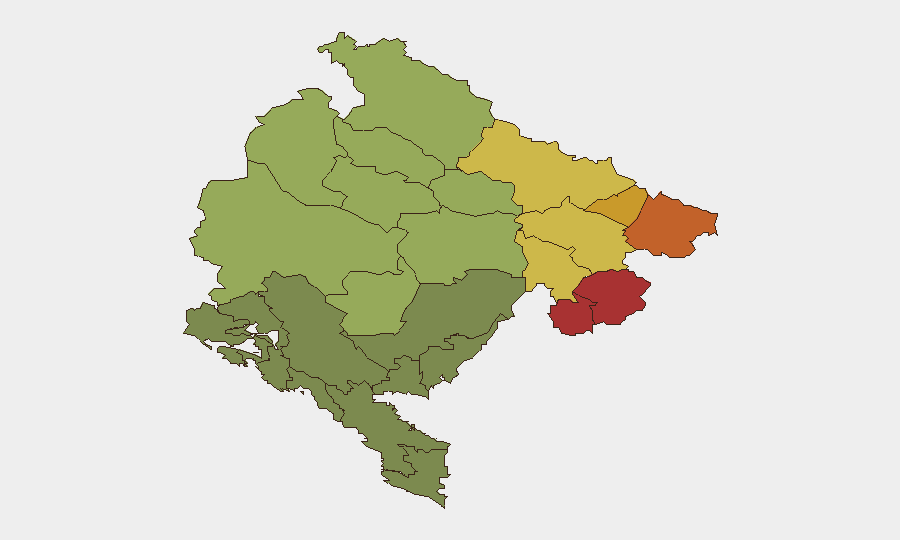
The northeastern frontier municipalities—Plav (score 78), Gusinje (76), and Rožaje (74)—dominate the sub-national risk ranking and reflect chronic exposure to organized crime, drug trafficking, and smuggling networks that exploit the porous Albania and Kosovo borders. Bijelo Polje, Berane, and Plužine show moderate-to-high scores driven by similar cross-border vulnerabilities and limited state presence. These rankings are structural, not event-driven, and indicate persistent vulnerabilities rather than imminent threats to most corporate operations. Coastal municipalities (Herceg Novi, Bar) currently face acute environmental hazard (wildfire) that temporarily elevates logistical and safety risk.
How GeoBit Would Assist
Security teams in Montenegro would benefit from AOI Monitoring & Early Warning on high-risk municipalities (especially Plav, Gusinje) to detect trafficking incidents or cross-border incursions in near-real-time. Multi-language OSINT & Telegram/X monitoring focused on civil-protection and police feeds, plus local news outlets, would provide 24–48 hour granularity on wildfire evolution, evacuation orders, and road closures—critical for duty-of-care personnel in Herceg Novi or mountain regions. Routing & Network Analysis capabilities allow dynamic alternate-route planning around active fire zones and border-crossing congestion.
7-Day Outlook
Wildfire risk along the coast and interior mountains will likely persist through late August given seasonal heat patterns; further evacuation orders or road closures are plausible. Political tension with Serbia will remain elevated but is unlikely to generate operational risk in Podgorica or major urban centers. Overall threat posture for Montenegro is expected to remain low unless acute environmental or cross-border incidents escalate.
Highest-Risk Areas — Ranked
| # | State / Region | Risk |
|---|---|---|
| 1 | Plav Municipality | 78 |
| 2 | Gusinje Municipality | 76 |
| 3 | Rožaje Municipality | 74 |
| 4 | Petnjica Municipality | 72 |
| 5 | Andrijevica Municipality | 68 |
| 6 | Bijelo Polje Municipality | 65 |
| 7 | Berane Municipality | 62 |
| 8 | Plužine Municipality | 58 |
| 9 | Pljevlja Municipality | 55 |
| 10 | Šavnik Municipality | 52 |
| 11 | Žabljak Municipality | 50 |
| 12 | Kolašin Municipality | 48 |
Sources
Previous Daily Briefs
A new Montenegro brief is written every day — each with its own risk map and downloadable CSV. Here's the last week; use the calendar to go further back.
- August 15, 2026
- August 13, 2026
- August 11, 2026
- August 9, 2026
- August 7, 2026
- August 5, 2026
- August 4, 2026
📅 Browse every day by calendar →
Highlighted days have a brief. Tap a day for that day's map & analysis, or “csv” for that day's dataset ($5).
Atlas — our AI intelligence desk — emails them this snapshot personally. Nothing else, no list.