Situation Summary
Albania faces elevated civil unrest in Tirana driven by the seventh week of the "Flamingo Revolution" anti-government protests, with police-protester clashes now resulting in injuries on both sides and escalating symbolic acts (including toppling of a bust of PM Rama). The national threat ranking remains moderate (#156 globally, composite score 3), but Tirana County's risk score of 31.5 reflects acute localized volatility concentrated in the capital. Concurrent incidents—wildfire infrastructure disruption in Fier, drug operations in Krujë, and maritime fatalities in coastal areas—indicate fragmented operational challenges, though none signal systemic state-level instability.
Key Developments
- Tirana – Parliament clashes, 23 July. Police deployed riot gear, water cannons, tear gas, and pepper spray to disperse hundreds of anti-government protesters on Elbasan Street outside Parliament. Health Ministry reported 6 police officers and 11 protesters injured and treated; traffic suspended in surrounding districts.
- Tirana – escalated protest symbolism, evening 23 July. Large crowds gathered in central Tirana demanding PM Rama's resignation and opposing a Trump/Kushner-linked coastal resort development. Demonstrators toppled a bust of Edi Rama; police maintained heavy cordons around Parliament and nearby streets.
- Tirana – Police Station No. 3 confrontation, 24 July. Protesters demanding release of detainees from prior anti-government protests clashed with officers; police used water jets to disperse crowds, causing property damage and at least one officer injured. Protesters planned to march to Tirana court for detention hearings.
- Fier – wildfire and infrastructure impact, 24 July. A fast-moving wildfire near Drizë village forced evacuation of 11 families and closure of the Qafa e Kosovicës–Cakran road due to fire spread risk, disrupting regional transport.
- Krujë – narcotics operation, 24 July. State Police arrested two suspects in connection with cannabis cultivation in the Krujë area as part of ongoing drug-production enforcement.
- Velipojë (Shkodër) – sexual violence arrest, 24 July. An 18-year-old male arrested following procedural actions in a case of suspected sexual assault; same 24-hour cycle recorded a 79-year-old man suffering fatal cardiac arrest at Velipojë beach.
- Sarandë/Ksamil – maritime fatality, 24 July. Body of a 61-year-old fisherman recovered off Ksamil islands following search efforts, indicating recent coastal fatality in a tourism area.
- Divjakë – road accident, 24 July. Head-on vehicle collision on Divjakë–Tre Urat road near Gërmenj village caused temporary disruption.
Highest-Risk Areas
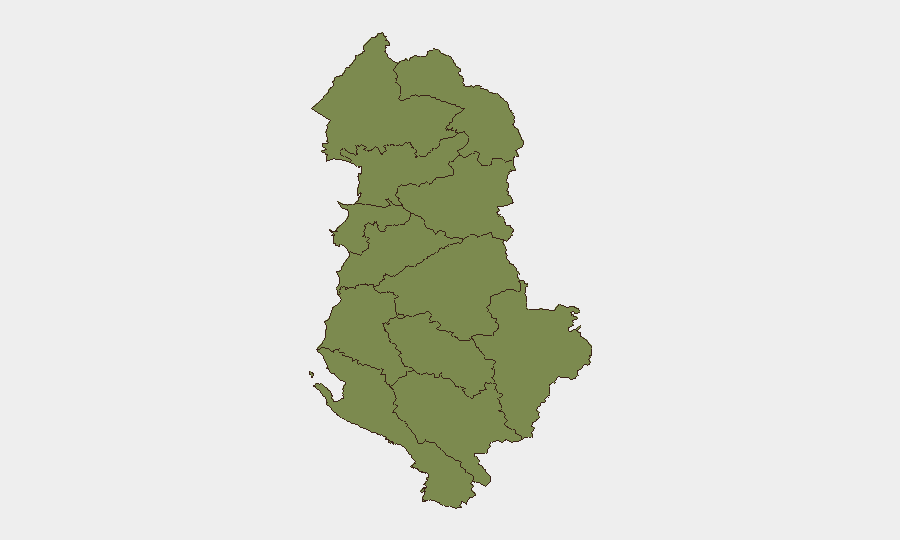
Tirana County dominates the risk landscape with a score of 31.5—more than four times higher than any other jurisdiction—reflecting ongoing civil unrest, police-protester clashes, and concentration of state institutions. Elbasan County (7.4) is the secondary hotspot, though significantly lower in absolute terms. All remaining counties cluster at 1.5–3.7, indicating risk is sharply concentrated in the capital and its immediate hinterland rather than distributed nationally. The "Flamingo Revolution" now in its seventh week, combined with densely populated urban geography and proximity of Parliament, courts, and police facilities, sustains tactical flashpoint risk in Tirana's central districts.
How GeoBit Would Assist
Teams with staff or assets in Tirana should employ AOI Monitoring & Early Warning to track Parliament and police facility perimeters for protest escalation signals; OSINT fusion (X/Twitter, Telegram, local media) to map protest timing, routes, and organizer statements; and Routing & Network Analysis to model alternative travel corridors avoiding police lines and blocked intersections. For broader situational awareness, Multi-language search and sentiment analysis across Albanian media and social platforms supports real-time detection of protest momentum shifts.
7-Day Outlook
Protest activity will likely remain elevated around Parliament and police facilities, with planned court marches creating additional friction points through late July. Weather-driven risks (wildfire conditions in central and southern regions) and routine crime enforcement will persist. No indicators suggest imminent violence escalation beyond police crowd-control measures or fundamental governance crisis.
Highest-Risk Areas — Ranked
| # | State / Region | Risk |
|---|---|---|
| 1 | Tirana County | 31.5 |
| 2 | Elbasan County | 7.4 |
| 3 | Fier County | 3.7 |
| 4 | Durrës County | 1.5 |
| 5 | Shkodër County | 1.5 |
| 6 | Kukës County | 1.5 |
| 7 | Lezhë County | 1.5 |
| 8 | Dibër County | 1.5 |
| 9 | Berat County | 1.5 |
| 10 | Korçë County | 1.5 |
| 11 | Vlorë County | 1.5 |
| 12 | Gjirokastër County | 1.5 |
Sources
Previous Daily Briefs
A new Albania brief is written every day — each with its own risk map and downloadable CSV. Here's the last week; use the calendar to go further back.
📅 Browse every day by calendar →
Highlighted days have a brief. Tap a day for that day's map & analysis, or “csv” for that day's dataset ($5).
Atlas — our AI intelligence desk — emails them this snapshot personally. Nothing else, no list.