Situation Summary
Bhutan remains a stable, low-threat environment with no confirmed security incidents or civil unrest reported in the last 24–48 hours. The country ranks #179 globally on composite threat, reflecting its strong institutional stability and minimal conflict activity. However, seven event signals logged across 11–15 July—primarily administrative sanctions, detention matters, and inter-agency communications—are pending verification and do not yet indicate operational security escalation. No corroborating open-source reporting confirms specific incidents affecting corporate operations or duty-of-care obligations at this time.
Key Developments
No confirmed incidents with independent corroboration have been identified in the last 24–48 hours. The seven signals currently tracked (dated 13–15 July) remain unverified and lack multiple independent sources required for operational reporting. They include administrative actions within prison services and education entities, and one inter-state diplomatic signal (Bhutan–Sri Lanka relations reduction), but no on-ground security, crime, infrastructure, or civil-unrest incidents are confirmed by news wires, official advisories, or vetted OSINT platforms. Corporate security teams should treat these signals as *alerts pending verification* rather than confirmed developments. Responsible monitoring will continue; any escalation will be flagged immediately upon independent confirmation.
Highest-Risk Areas
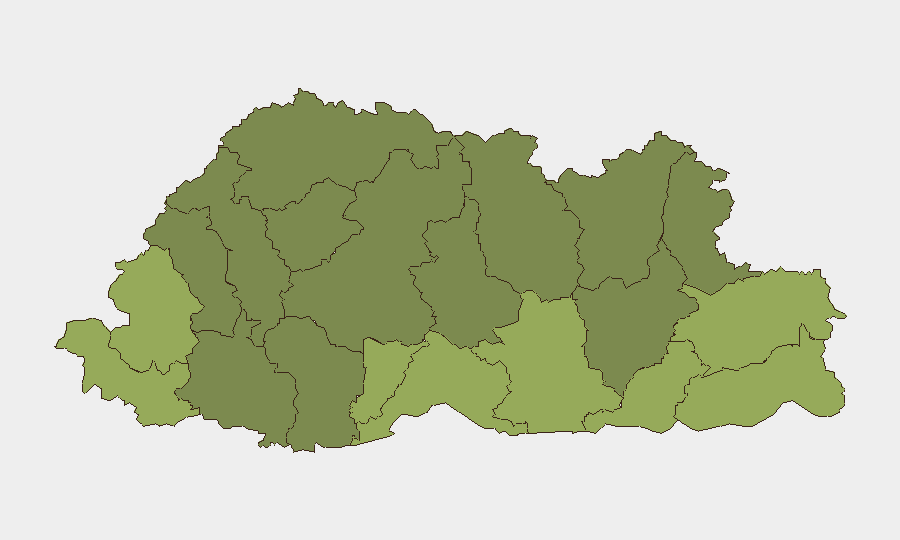
The southern and eastern border districts—Samtse, Sarpang, Haa, Pemagatshel, and Samdrup Jongkhar (composite risks 58, 55, 52, 50, and 48 respectively)—carry the highest relative risk profiles. These areas share porous frontiers with India and Nepal, where cross-border movements, informal trade, and occasional criminal transit have historically generated lower-level security concerns. Samtse District, closest to the volatile terai region of Nepal, shows the highest sub-national score, likely reflecting proximity to transnational trafficking routes and informal population flows. Central and northern districts (Thimphu, Punakha, Lhuntse) show markedly lower risk and remain the safest operational zones for corporate activity.
How GeoBit Would Assist
Corporate security teams should deploy AOI (Area-of-Interest) Monitoring & Early Warning on Samtse and Sarpang districts to detect emerging border incidents or civil disturbances with real-time alerting. Intel Sweep and multi-language OSINT fusion across Bhutanese news, government statements, and regional outlets will provide early detection of any escalation not yet visible in English-language wires. Routing & Network Analysis can support contingency planning for personnel or supply movement, identifying alternative routes around high-risk southern districts if incident activity escalates. Together, these capabilities enable sub-48-hour detection and duty-of-care response before incidents reach operational impact.
7-Day Outlook
No significant security escalation is forecasted for the next seven days based on current signal density and baseline stability. The unverified signals logged to date do not form a pattern indicating imminent civil unrest, political instability, or infrastructure disruption. Ongoing monitoring of administrative proceedings and border-district activity will continue; any confirmation of the pending signals or emergence of new verified incidents will trigger immediate update to security posture and personnel guidance.
Highest-Risk Areas — Ranked
| # | State / Region | Risk |
|---|---|---|
| 1 | Samtse District | 58 |
| 2 | Sarpang District | 55 |
| 3 | Haa District | 52 |
| 4 | Pemagatshel District | 50 |
| 5 | Samdrup Jongkhar District | 48 |
| 6 | Tsirang District | 45 |
| 7 | Zhemgang District | 42 |
| 8 | Trashigang District | 40 |
| 9 | Mongar District | 38 |
| 10 | Gasa District | 35 |
| 11 | Lhuntse District | 32 |
| 12 | Wangdue Phodrang District | 30 |
Sources
Previous Daily Briefs
A new Bhutan brief is written every day — each with its own risk map and downloadable CSV. Here's the last week; use the calendar to go further back.
📅 Browse every day by calendar →
Highlighted days have a brief. Tap a day for that day's map & analysis, or “csv” for that day's dataset ($5).
Atlas — our AI intelligence desk — emails them this snapshot personally. Nothing else, no list.