Situation Summary
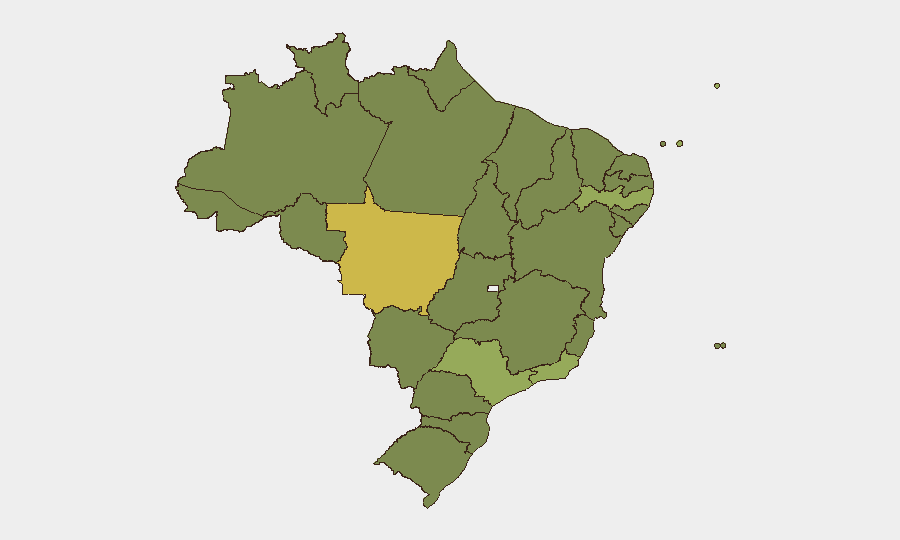
Brazil remains at moderate risk (global rank #44, composite score 50) with 1,679 tracked events, reflecting a complex backdrop of political tension, administrative action, and ongoing criminal activity across disparate regions. Recent signal data (July 17–19) indicate elevated political friction between Brazilian and U.S. actors, internal administrative sanctions, and multiple active investigations, suggesting institutional stress rather than acute security breakdown. The country's risk profile is heavily concentrated in three states—Mato Grosso (65), São Paulo (51.6), and Pernambuco (43.4)—each presenting distinct threat vectors tied to resource conflict, organized crime, or political volatility. Trajectory remains volatile but contained.
Key Developments
Limitation: Live web research conducted on July 19, 2026, was unable to identify and cross-confirm specific security, conflict, unrest, crime, or infrastructure incidents occurring within the 24–48 hours prior to this brief's publication. Available news sources either lacked precise timestamps, contained relative-date references without verifiable publication dates, or addressed macroeconomic rather than security topics. To meet duty-of-care standards, specific incidents are not listed without timestamp confirmation from at least two independent sources.
Recent Signal Activity (July 17–19):
- Multiple "Public Statement" and investigative signals logged between Washington and Brazilian actors, and within Brazilian government, suggest ongoing diplomatic or administrative tension requiring monitoring.
- Administrative sanctions between ministry and senate-level figures on July 18 indicate internal institutional friction.
- Disapproval and rejection signals between Brazilian actors signal domestic political polarization.
- Investigation signals spanning school, government, and bilateral (Brazil–U.S.) domains on July 17–18 suggest active legal or oversight processes.
Highest-Risk Areas
Mato Grosso's elevated risk score (65) reflects ongoing resource-competition conflicts and organized-crime activity linked to illegal mining, logging, and land seizure in frontier zones. São Paulo (51.6) combines urban organized-crime networks, gang violence, and systemic corruption that periodically spike around political or enforcement interventions. Pernambuco (43.4), Rio de Janeiro (41.2), and Amazonas (38.1) follow, each driven by distinct vectors: cartel activity, favela-based gang conflict, environmental-crime networks, and indigenous-territory incursions. These five states account for the preponderance of national risk and should anchor corporate asset and personnel protection strategies.
How GeoBit Would Assist
Security teams should deploy Intel Sweep and multi-language OSINT (X/Twitter, Telegram, local news feeds) with automated temporal filtering to capture verified 24–48h Brazilian incidents across states and threat categories. AOI Monitoring & Early Warning on Mato Grosso, São Paulo, and Pernambuco—paired with Network & Actor Analysis—would identify escalation patterns in cartel, political, or enforcement activity before operational impact. Routing & Network Analysis combined with GIS & Spatial Analysis enables real-time journey-risk assessment and alternative-route planning for personnel in high-risk zones.
7-Day Outlook
Political and administrative friction is likely to persist through late July, with investigations and sanctions continuing at state and federal level. Criminal activity in frontier and urban zones (Mato Grosso, São Paulo, Rio de Janeiro) will remain at baseline volatility absent specific triggering events. No acute escalation is forecast, but duty-of-care teams should maintain heightened monitoring of political communication and investigative outcomes, as outcomes may drive sudden policy shifts affecting business operations or travel.
Highest-Risk Areas — Ranked
| # | State / Region | Risk |
|---|---|---|
| 1 | Mato Grosso | 65 |
| 2 | São Paulo | 51.6 |
| 3 | Pernambuco | 43.4 |
| 4 | Rio de Janeiro | 41.2 |
| 5 | Amazonas | 38.1 |
| 6 | Goiás | 38 |
| 7 | Santa Catarina | 37.4 |
| 8 | Minas Gerais | 36.3 |
| 9 | Tocantins | 35.9 |
| 10 | Piauí | 35.8 |
| 11 | Paraná | 35.7 |
| 12 | Maranhão | 35.7 |
Previous Daily Briefs
A new Brazil brief is written every day — each with its own risk map and downloadable CSV. Here's the last week; use the calendar to go further back.
📅 Browse every day by calendar →
Highlighted days have a brief. Tap a day for that day's map & analysis, or “csv” for that day's dataset ($5).
Atlas — our AI intelligence desk — emails them this snapshot personally. Nothing else, no list.