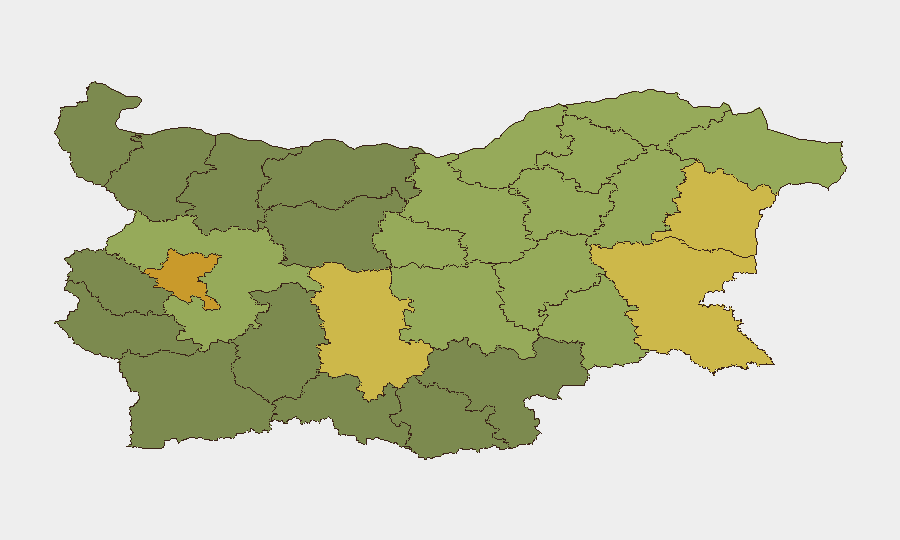
Situation Summary
Bulgaria faces a sustained low-threat environment with a composite risk score of 5 globally, though recent cross-border drone incursions along the Romania frontier (08-08 and 08-09 August) have elevated scrutiny of critical infrastructure and airspace control. The incidents appear unintentional but signal potential operational spillover from ongoing regional tensions. Sofia-City and Plovdiv remain the highest-risk sub-national zones, driven by institutional exposure and urban density rather than active kinetic events.
Key Developments
- Kardam border sector, Bulgaria-Romania (08-08 Aug) – An unidentified drone, assessed as a Maya decoy variant, crossed from Romanian airspace and detonated in a sunflower field ~100 m inside Bulgarian territory near General Toshevo. Bulgarian defence ministry reported no casualties, infrastructure damage, or evidence of intentional targeting; authorities cordoned the site for analysis.
- Trans-Balkan gas pipeline compressor station vicinity (08-08 Aug) – The drone blast occurred approximately 1 km from Bulgaria's compressor facility on the Trans-Balkan pipeline, triggering heightened scrutiny of the critical energy asset; no impact to operations was reported.
- Bulgarian-Romanian border surveillance posture (post-08-08) – Bulgaria's defence ministry announced increased border surveillance, redeployment of troops to the frontier, and activation of drone detection and countermeasure capabilities across the sector in response to the incursion.
- Sofia government and institutional facilities (07-08 Aug) – Unconfirmed bomb threats prompted evacuations and searches of government and institutional buildings; no explosive devices were recovered. Threat assessment classified as low-credibility.
- Varna and Burgas institutional sites (07-08 Aug) – Coordinated unconfirmed bomb threats triggered similar precautionary evacuations; no devices located. Pattern suggests low-probability hoax activity.
Highest-Risk Areas
Sofia-City (risk 72) and Plovdiv (risk 68) drive Bulgaria's internal risk profile, reflecting institutional density, population concentration, and baseline urban crime/instability factors rather than active conflict or terrorism. Varna (65) and Burgas (62) rank third and fourth, likely reflecting port infrastructure exposure and maritime-related vulnerabilities. The recent drone incursions have not materially altered sub-national rankings but underscore that northern border regions—particularly Ruse (55) and Razgrad (47)—warrant enhanced monitoring for unintended spillover from neighboring conflict zones.
How GeoBit Would Assist
Security teams should employ Intel Sweep and multi-language OSINT fusion to track evolving drone activity and cross-border incidents in real time, coupled with AOI (area-of-interest) monitoring and early warning on the Bulgaria-Romania frontier, Trans-Balkan pipeline route, and Sofia institutional corridors. Satellite and imagery analysis would provide persistent visibility on border infrastructure, drone launch patterns, and critical asset proximity; network and actor analysis can map threat-actor intent and capability behind the Maya drone variants. GIS and spatial analysis enables rapid risk correlation between incidents and protected assets or populations.
7-Day Outlook
No escalation is anticipated absent new cross-border incidents or credible threat intelligence. Bulgarian authorities will likely sustain heightened border monitoring and drone-detection posture through mid-August. Corporate and institutional security should maintain standard duty-of-care protocols, remain alert to unconfirmed threats, and coordinate with local authorities on facility evacuation procedures in Sofia and major cities; the current threat environment does not warrant protective measures beyond standard practice.
Highest-Risk Areas — Ranked
| # | State / Region | Risk |
|---|---|---|
| 1 | Sofia-City | 72 |
| 2 | Plovdiv | 68 |
| 3 | Varna | 65 |
| 4 | Burgas | 62 |
| 5 | Sofia | 58 |
| 6 | Ruse | 55 |
| 7 | Stara Zagora | 52 |
| 8 | Sliven | 50 |
| 9 | Shumen | 48 |
| 10 | Razgrad | 47 |
| 11 | Yambol | 45 |
| 12 | Dobrich | 44 |
Previous Daily Briefs
A new Bulgaria brief is written every day — each with its own risk map and downloadable CSV. Here's the last week; use the calendar to go further back.
📅 Browse every day by calendar →
Highlighted days have a brief. Tap a day for that day's map & analysis, or “csv” for that day's dataset ($5).
Atlas — our AI intelligence desk — emails them this snapshot personally. Nothing else, no list.