Situation Summary
Cyprus remains a fragmented security environment characterized by territorial division, periodic military posturing, and localized criminal activity. Over the past week, Turkish military rhetoric intensified alongside domestic law-enforcement operations and infrastructure expansion by the Republic of Cyprus, while protest activity and isolated incidents of assault and explosives discovery continued. The overall threat level remains moderate, with risk concentrated in the divided north (Nicosia, Famagusta, Kyrenia districts) and southern urban centers showing significantly lower exposure.
Key Developments
- 6 October, Mari (Larnaca): Cyprus Defence Ministry awarded a contract for a year-long feasibility study on expanding Evangelos Florakis Naval Base to accommodate eight or more large naval vessels, signaling strategic military infrastructure investment in the south.
- 7 October, Nationwide: Police arrested 42 third-country nationals during a nationwide immigration enforcement operation targeting undocumented residents.
- 8 October, Multiple locations: Overnight police operations resulted in five arrests; 587 vehicle stops, 800 person checks, 36 premises inspections, 393 traffic citations (including 117 speeding violations), and seizure of nine vehicles.
- 9 October, Nicosia / Republic of Cyprus: Turkish Defence Minister Yaşar Güler publicly stated Ankara was monitoring the Republic's military cooperation and buildup, warning that Türkiye was taking countermeasures to protect Turkish Cypriot interests—escalating rhetorical tension.
- 11 October, Limassol (Spyros Kyprianou Indoor Stadium): Police prepared heightened security for Maccabi Tel Aviv sports fixtures, deploying approximately 500 officers and implementing restricted attendance and tight visiting-supporter controls.
- 12 October, Republic of Cyprus: The newly established Directorate for Combatting Organised Crime (described as "Cyprus FBI") formally began operations within the Cyprus Police to target organized criminal networks.
Highest-Risk Areas
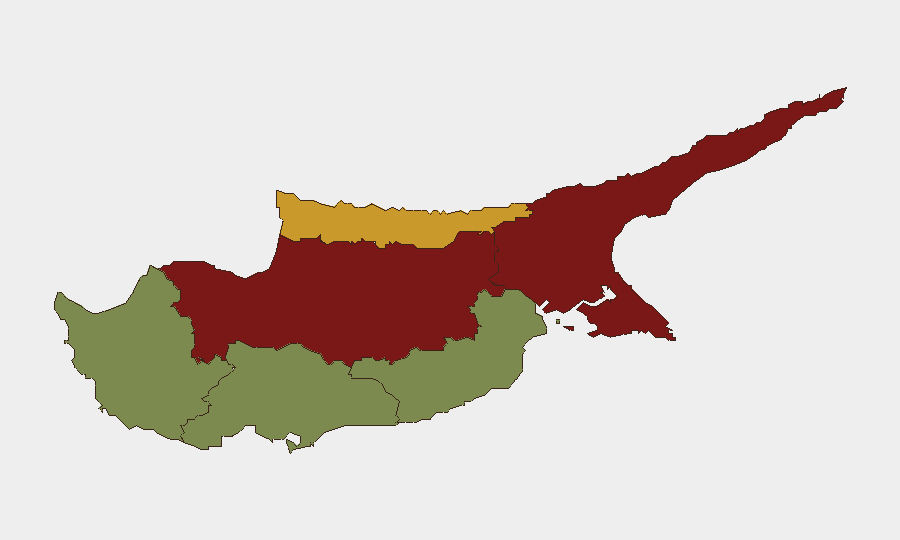
Nicosia and Famagusta dominate the risk landscape, with composite scores of 92 and 88 respectively—driven by the city's divided status, proximity to the UN buffer zone, and recurring military posturing between Greek and Turkish forces (including the 23 September farmer obstruction incident and ongoing Turkish military monitoring). Kyrenia (score 72) follows as a secondary concern. Southern districts—Larnaca (28), Limassol (22), and Paphos (18)—show substantially lower composite risk, though Limassol's infrastructure sensitivity and recent event density warrant monitoring. The north-south gradient reflects both territorial division and concentration of military activity and cross-community tension in the divided capital and buffer zone.
How GeoBit Would Assist
Security teams should deploy AOI Monitoring & Early Warning on Nicosia, the Deneia buffer zone, and military installations to detect renewed clashes or obstructions; leverage Intel Sweep and X/Twitter OSINT to track Turkish military statements and cross-community rhetoric in real time; and use Network & Actor Analysis to map organized crime cells now under the new Directorate's scrutiny. Satellite & Imagery analysis of naval base expansion and Conflict & Military force-structure tracking would support due diligence on infrastructure risk and military escalation trajectories.
7-Day Outlook
Turkish military rhetoric is likely to persist as a deterrent posture; domestic law-enforcement operations (immigration sweeps, organized-crime targeting) will continue at current tempo. Risk of localized incidents (assault, protests, isolated explosives discovery) remains stable but contained. No strategic shift in the security environment is anticipated in the near term, though any renewed buffer-zone confrontation or major military exercise announcement would warrant immediate escalation review.
Highest-Risk Areas — Ranked
| # | State / Region | Risk |
|---|---|---|
| 1 | Nicosia | 92 |
| 2 | Famagusta | 88 |
| 3 | Kyrenia | 72 |
| 4 | Larnaca | 28 |
| 5 | Limassol | 22 |
| 6 | Paphos | 18 |
Sources
Previous Weekly Briefs
A new Cyprus brief is written every Monday, covering the week — each with its own risk map and downloadable CSV. Use the calendar to go further back.
- October 5, 2026
- September 28, 2026
- September 21, 2026
- September 14, 2026
- September 7, 2026
- August 31, 2026
- August 29, 2026
📅 Browse past briefs by calendar →
Highlighted days have a brief. Tap a day for that day's map & analysis, or “csv” for that day's dataset ($5).
Atlas — our AI intelligence desk — emails them this snapshot personally. Nothing else, no list.