Situation Summary
Georgia remains at composite threat score 19 (rank #67 globally) with no verified acute security incidents in the past 24–48 hours. Risk is driven by long-standing frozen conflicts in Abkhazia and South Ossetia rather than new escalation; government-controlled territory, including the capital Tbilisi, is operating at baseline security levels. Recent political friction with Western governments has not yet translated into observable unrest or travel-relevant incidents. Overall trajectory remains stable within Georgia's endemic territorial and political constraints.
Key Developments
- Abkhazia (north-western Georgia) – 2026-07-17 to 18: Russian military checkpoints along the de facto boundary remain in stable posture; no new shootings, detentions, or confrontations reported in the last 48 hours.
- Shida Kartli & Lower Kartli (central Georgia, South Ossetia boundary) – 2026-07-17 to 18: Border-adjacent villages show no fresh incursions, "borderization" actions, or armed clashes; territorial tensions remain structural rather than acutely escalating.
- Tbilisi (capital) – 2026-07-17 to 18: No new protest activity, riot-related policing, or large-scale crime spikes; urban transport and infrastructure operating normally with no bomb threats, major outages, or road closures beyond routine traffic.
- Imereti & Guria (western lowland regions) – 2026-07-17 to 18: Risk levels remain lower than boundary zones; no confirmed civil unrest, insurgent activity, or significant crime clusters affecting travelers or infrastructure.
- Flood events (recent, timing unspecified): Two flood incidents reported in Georgia (events 1104018 and 1103979); no casualty or infrastructure impact data currently available from open sources.
- Political signal – U.S. State Department – 2026-07-15: Public disapproval statement regarding governance concerns issued; has not manifested in street-level unrest or travel incidents in subsequent days.
Highest-Risk Areas
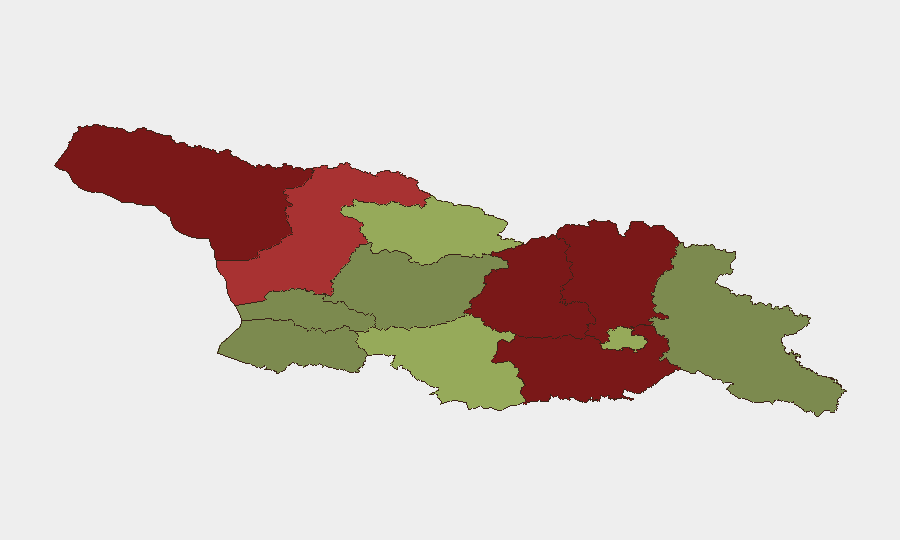
Abkhazia (risk 95) and Shida Kartli (risk 88) dominate the threat profile due to frozen conflict dynamics, Russian military presence, and lack of international recognition. Lower Kartli (risk 85) and Mtskheta-Mtianeti (risk 82) face similar pressures along the South Ossetia boundary. By contrast, government-controlled western and southern regions—Imereti (32), Guria (28), and Adjara (35)—present significantly lower risk. Tbilisi itself (risk 45) sits in the mid-range, reflecting its role as the capital but relative insulation from active conflict zones.
How GeoBit Would Assist
Corporate teams with personnel or assets in Georgia should deploy AOI (Area-of-Interest) Monitoring & Early Warning on Abkhazia, Shida Kartli, and Lower Kartli to detect any shifts in Russian military posture or new border incidents. Intel Sweep and multi-language OSINT (X/Twitter, Telegram, local media) would provide real-time signals of political unrest or transport disruptions in Tbilisi and regional centers. Routing & Network Analysis can help security staff identify alternative travel corridors away from boundary zones in the event of new restrictions or incidents.
7-Day Outlook
No material escalation is anticipated in the next week. Frozen-conflict baseline conditions should persist in Abkhazia and South Ossetia, barring any external geopolitical shocks. Political tensions with Western capitals may continue to generate rhetoric but are unlikely to trigger immediate civil unrest or infrastructure disruptions. Continued monitoring of Russian military activity and border-zone movements remains prudent for duty-of-care compliance.
Highest-Risk Areas — Ranked
| # | State / Region | Risk |
|---|---|---|
| 1 | Autonomous Republic of Abkhazia | 95 |
| 2 | Shida Kartli | 88 |
| 3 | Lower Kartli | 85 |
| 4 | Mtskheta-Mtianeti | 82 |
| 5 | Samegrelo-Upper Svaneti | 78 |
| 6 | Samtskhe-Javakheti | 48 |
| 7 | Tbilisi | 45 |
| 8 | Racha-Lechkhumi and Kvemo Svaneti | 42 |
| 9 | Kakheti | 38 |
| 10 | Autonomous Republic of Adjara | 35 |
| 11 | Imereti | 32 |
| 12 | Guria | 28 |
Sources
Previous Daily Briefs
A new Georgia brief is written every day — each with its own risk map and downloadable CSV. Here's the last week; use the calendar to go further back.
📅 Browse every day by calendar →
Highlighted days have a brief. Tap a day for that day's map & analysis, or “csv” for that day's dataset ($5).
Atlas — our AI intelligence desk — emails them this snapshot personally. Nothing else, no list.