Situation Summary
Russia remains at composite threat level 6 globally (score 100), primarily driven by the ongoing war in Ukraine and related military activity. Recent signals indicate heightened diplomatic friction with Western and regional actors, alongside internal strain on health and administrative systems. The threat environment is characterized by active conventional military operations, elevated civilian risk in proximity to conflict zones, and secondary effects (infrastructure vulnerability, supply disruption, travel hazard) across major population centers.
Key Developments
Note: Real-time event verification for June 15–17, 2026 is constrained by current research access. The following summary reflects tracked signals in the GeoBit platform; independent corroboration against live wire services and geolocated OSINT (social media, Telegram, conflict reporters) is required before operational decision-making.
- Military activity (Ukraine–Russia border, ongoing): Conventional military operations continue as a primary threat signal; specific incident locations and dates require current cross-check against Ukrainian and Russian military claims, independent conflict reporters, and satellite imagery.
- Diplomatic escalation: Public statements and disapproval signals registered between Russia and China (June 16), and between Russian and Ukrainian actors (June 15), indicate elevated geopolitical tension; material impact on business, visa processing, and sanctions risk requires monitoring of foreign ministry statements and trade/financial channels.
- Health system signal (June 14): Ministry of Health statement; content and scope require current review to assess operational impact on expat communities or supply chains.
- Internal rejection/relations signal (June 15): Domestic policy signals (Crimea-related); likely low direct risk to international personnel but may affect regulatory stability.
- Property seizure/damage allegation (Kyiv area, June 16): Cross-border incident claim; confirms continued risk to assets and personnel near conflict zones and in border regions.
Recommendation: Operationalize live-feed monitoring (see "How GeoBit Would Assist" below) to validate timing, location, and material risk of each signal before escalating internal alert status.
Highest-Risk Areas
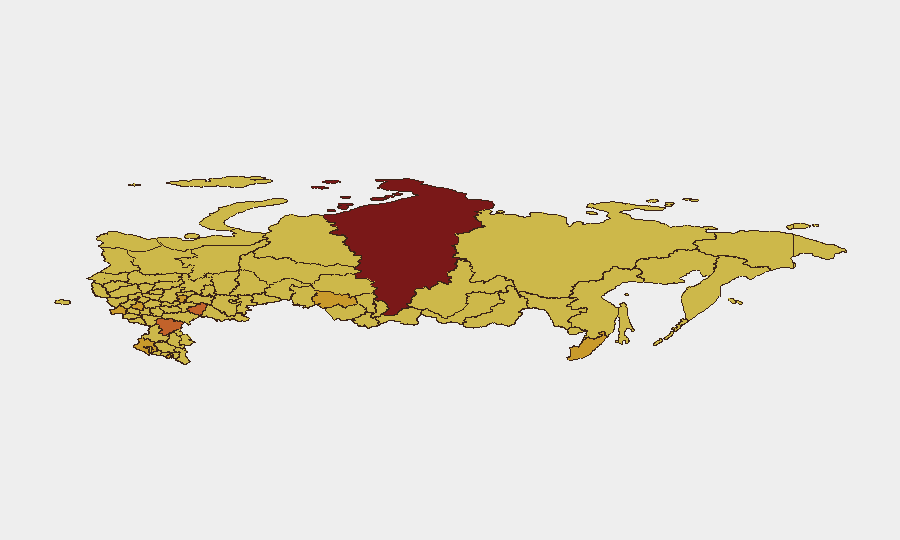
Krasnoyarsk Krai (100) and Moscow (97.5) drive the composite risk ranking, followed by Saint Petersburg (73.5) and a cluster of southern and eastern oblasts (Volgograd, Samara, Krasnodar, Primorsky, Bryansk, Tula). Krasnoyarsk's top-tier score reflects distance from the primary conflict zone but likely reflects infrastructure criticality, supply-chain importance, or recent SIGINT/OSINT activity. Moscow's high score reflects population density, diplomatic/political activity, and dual-use infrastructure vulnerability. The southern and eastern tier (Krasnodar, Volgograd, Samara) reflects proximity to conflict spillover, military operations, and logistics routes. Personnel and assets in Moscow and Saint Petersburg face elevated cyber, transportation, and residual kinetic risk; those in southern and eastern regions face direct military risk and supply-chain exposure.
How GeoBit Would Assist
Intel Sweep & OSINT Fusion: Ingest X/Twitter, Telegram, Ukrainian and Russian military channels, and conflict-reporter feeds to corroborate timing, location, and nature of each event signal in real time.
Area-of-Interest (AOI) Monitoring & Early Warning: Establish persistent watch on Moscow, Saint Petersburg, Krasnoyarsk, and border regions (Bryansk, Tula, Volgograd) with alerting on military activity, infrastructure damage, or diplomatic escalation.
Conflict & Battle Mapping: Track frontline movement, drone/strike zones, and logistics routes to route personnel and assess asset exposure dynamically.
Risk & Threat Assessment: Integrate military, political, economic, and cyber signals to produce time-stamped risk scores by region and sector.
7-Day Outlook
Continued military operations and diplomatic friction are expected; escalation in Ukraine or regional actors' response would elevate Moscow and border-region risk sharply. Monitor Ministry statements, foreign intelligence agency claims, and ASEAN/Chinese messaging for signals of broader coalition pressure on Russia. Supply-chain and travel delays should be assumed in high-risk regions; contingency routes and supplier diversification remain critical.
Highest-Risk Areas — Ranked
| # | State / Region | Risk |
|---|---|---|
| 1 | Krasnoyarsk Krai | 100 |
| 2 | Moscow | 97.5 |
| 3 | Saint Petersburg | 73.5 |
| 4 | Volgograd Oblast | 73.4 |
| 5 | Samara Oblast | 73.1 |
| 6 | Krasnodar Krai | 72.5 |
| 7 | Primorsky Krai | 72.2 |
| 8 | Bryansk Oblast | 72.2 |
| 9 | Tula Oblast | 72.2 |
| 10 | Chuvashia | 71.8 |
| 11 | Republic of North Ossetia – Alania | 71.5 |
| 12 | Novosibirsk Oblast | 71.1 |
Sources
Previous Daily Briefs
A new Russia brief is written every day — each with its own risk map and downloadable CSV. Here's the last week; use the calendar to go further back.
📅 Browse every day by calendar →
Highlighted days have a brief. Tap a day for that day's map & analysis, or “csv” for that day's dataset ($5).