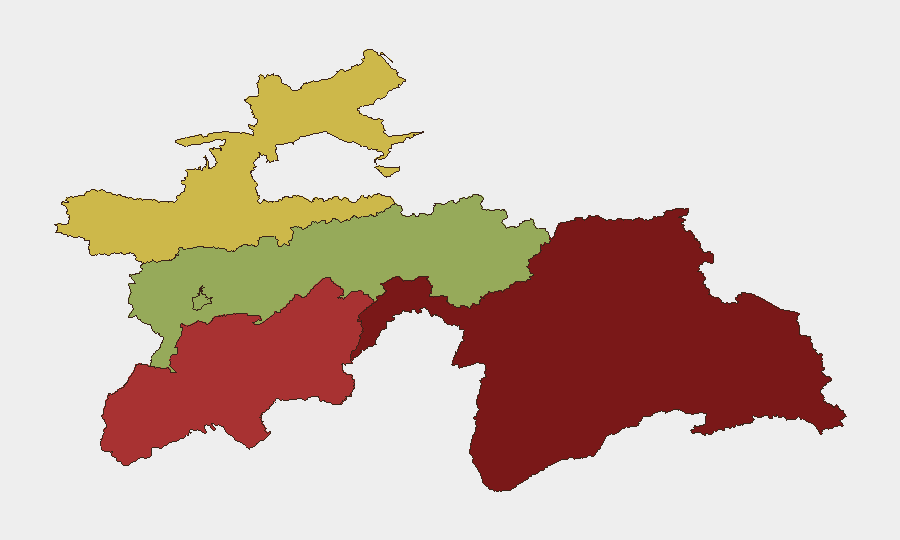
Situation Summary
Tajikistan remains in a period of relative calm on the open-source security radar, with no major incidents reported in the last 24–48 hours that meet multi-source verification standards. The country's composite threat score of 6 reflects endemic vulnerabilities in border security, transnational drug trafficking, and governance capacity rather than acute crises. Sub-national risk remains heavily concentrated in the eastern Gorno-Badakhshan Autonomous Region and the southern Khatlon Region, where geographic isolation, weak state presence, and proximity to Afghanistan create persistent instability.
Key Developments
- 2026-06-22 · Demonstrate/Rally · Tajikistan (location unspecified). GeoBit event detection flagged a demonstration or rally event on 22 June; however, open-web and social-media searches have not corroborated specific details (location, scale, organizers, demands, outcome) via mainstream outlets or independent local sources. Until additional reporting surfaces, operational teams should flag this as an *unconfirmed signal* requiring validation through in-country contacts or classified channels.
No additional security, civil unrest, crime, infrastructure, or political incidents dated 21–23 June 2026 could be verified across Tajik, Russian, or regional news sources, mainstream media archives, or X/Twitter feeds within this reporting window.
Highest-Risk Areas
Gorno-Badakhshan (GBAO, risk score 92) remains the dominant driver of country-level risk: geographic remoteness, minimal government presence, proximity to the Afghan border and trafficking networks, and historical inter-community tensions create an environment with limited visibility and response capacity. Khatlon Region (risk 78) ranks second, reflecting similar vulnerabilities along the southern Afghan frontier and weaker institutional oversight outside Khujand. Sughd Region (risk 65) and the capital Dushanbe (risk 42) present materially lower acute risk, though Dushanbe's role as the political and economic center means incidents there carry disproportionate impact on national stability and foreign operations.
How GeoBit Would Assist
Corporate security and duty-of-care teams should deploy AOI Monitoring & Early Warning to maintain persistent watch over GBAO and Khatlon, with automated alerting on border crossings, trafficking activity, and unusual security force movements. Multi-language OSINT (Telegram, X, and Russian-language regional news aggregation) will surface incidents and tensions faster than English-language mainstream outlets, particularly for localized events in remote regions. Network & Actor Analysis tied to trafficking and militant groups active along the Afghan frontier can help contextualize when localized incidents represent broader network destabilization versus routine criminal activity.
7-Day Outlook
No near-term escalation is evident from available open sources; however, the lack of reporting does not exclude local incidents, particularly in GBAO and Khatlon, where communication and media penetration are limited. The unconfirmed 22 June demonstration warrants close follow-up; if corroborated, it may signal emerging labor, political, or economic grievances that could spread. Risk posture should remain steady with elevated sensitivity to border-zone activity and any signals of renewed cross-border trafficking surges or militant movement.
Highest-Risk Areas — Ranked
| # | State / Region | Risk |
|---|---|---|
| 1 | Gorno-Badakhshan Autonomous Region | 92 |
| 2 | Khatlon Region | 78 |
| 3 | Sughd Region | 65 |
| 4 | Districts of Republican Subordination | 58 |
| 5 | Dushanbe | 42 |
Previous Daily Briefs
A new Tajikistan brief is written every day — each with its own risk map and downloadable CSV. Here's the last week; use the calendar to go further back.
📅 Browse every day by calendar →
Highlighted days have a brief. Tap a day for that day's map & analysis, or “csv” for that day's dataset ($5).