Situation Summary
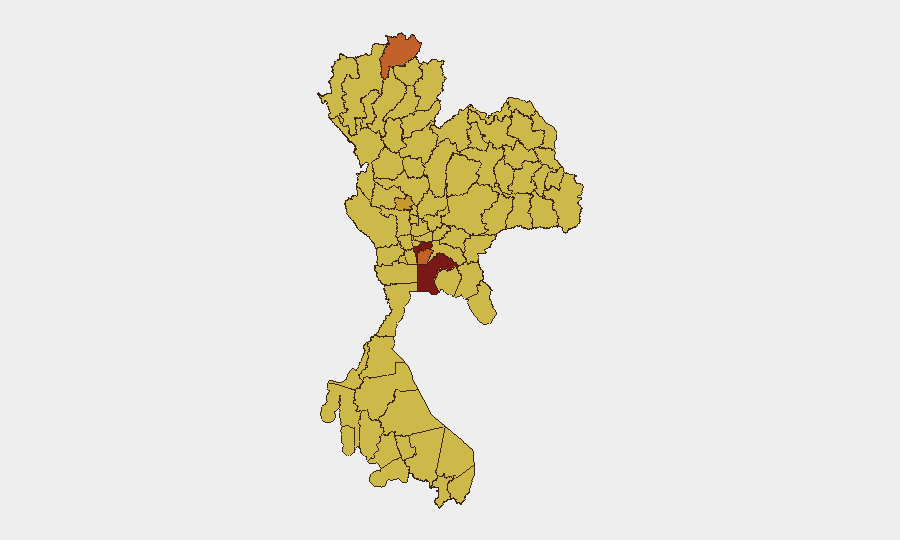
Thailand remains at moderate-to-elevated risk (composite threat score 95; rank #12 globally) with concentrated volatility in the deep south and selected urban/industrial zones. The past 48 hours have seen a sharp cluster of coordinated insurgent attacks in Narathiwat, Pattani, and Yala provinces—including roadside bombings targeting civilians, synchronized petrol station strikes, and targeted killings of local security auxiliaries—coupled with heightened military response and checkpoint activity. While the incidents are regionally contained, they signal renewed operational capacity and coordination among southern-border actors and have triggered security reinforcements that may affect logistics, tourism, and movement corridors through the south.
Key Developments
- Narathiwat, Tak Bai district – roadside IED strike (29 June, ~midday): Improvised explosive device detonated beside a drainage culvert near the Sapom intersection as a Malaysian-registered vehicle passed, injuring two Malaysian nationals and prompting immediate police, bomb-disposal, and forensic response.
- Yala & Pattani provinces – coordinated petrol station bombings (28 June, night): Approximately six assailants on two motorcycles executed simultaneous attacks on three PT petrol stations across both provinces using explosives, injuring one civilian and causing extensive infrastructure damage; described by Thai authorities as a carefully synchronized operation designed to undermine public confidence.
- Yala Province – Yala–Betong highway disruptions (27–28 June): Armed operatives set fire to multiple trucks, felled trees across a key southern logistics corridor, and placed suspected explosive devices to obstruct traffic and hinder security force movement; disruption continuing into current reporting period.
- Pattani Province, Yarang district – targeted killing (27 June): A Volunteer Defence Corps member was ambushed and shot dead near his residence, consistent with a pattern of attacks on local security auxiliaries in the region.
- Southern border provinces – reinforced military and police posture (29–30 June): Thai military increased deployments, established additional checkpoints, and intensified patrols around critical infrastructure and transport routes (especially Yala–Betong highway) in direct response to the coordinated attacks; security activity elevated across Narathiwat, Pattani, and Yala.
- National risk concentration (28–30 June assessment): While southern incidents dominate tactical risk, composite threat analysis flags Chon Buri Province (risk 96.5, including Pattaya industrial and port zones) and Bangkok (risk 83.9) as the highest-risk urban areas nationally, driven by earlier event clusters and ongoing monitoring of downstream impacts on expatriate populations and supply chains.
Highest-Risk Areas
Chon Buri Province and Bangkok carry the highest composite risk scores (96.5 and 83.9 respectively) and warrant priority monitoring for corporate assets, expat concentrations, and industrial/logistics operations. The deep-south cluster of Narathiwat, Pattani, and Yala provinces (risk range 66.7–75.5) is currently the most volatile, with demonstrated coordination, targeting of civilian and security infrastructure, and active military response creating acute travel and supply-chain disruption risk. The ranking reflects both historical incident density and recent operational tempo; Chon Buri's elevated position suggests sustained underlying conditions (organized crime, port security, cross-border trafficking) distinct from the southern insurgency.
How GeoBit Would Assist
Security teams would leverage Intel Sweep and OSINT Fusion to track evolving attack patterns in the south, monitor coordination signals on Telegram and X, and corroborate emerging actor networks. AOI Monitoring & Early Warning with persistent watch on Chon Buri, Bangkok, and the southern provinces would enable rapid alerting to downstream supply-chain and personnel movements. Routing & Network Analysis would support alternative journey planning for staff and logistics around active military checkpoints and the Yala–Betong highway disruptions.
7-Day Outlook
Thai security forces are likely to sustain elevated checkpoint density and patrol intensity across the southern border through early July, creating friction for logistics, tourism, and cross-border movement. No immediate de-escalation signals are evident; further isolated attacks or copycat operations in Chon Buri or Bangkok remain plausible within the 7-day window. Corporate risk teams should maintain heightened situational awareness for supply-chain delays and brief personnel on checkpoint protocols.
Highest-Risk Areas — Ranked
| # | State / Region | Risk |
|---|---|---|
| 1 | Chon Buri Province | 96.5 |
| 2 | Bangkok | 83.9 |
| 3 | Chiang Rai Province | 75.5 |
| 4 | Samut Prakan Province | 74.4 |
| 5 | Chai Nat Province | 72.1 |
| 6 | Loei Province | 67.9 |
| 7 | Phetchabun Province | 67.9 |
| 8 | Kalasin Province | 67 |
| 9 | Sukhothai Province | 67 |
| 10 | Nakhon Si Thammarat Province | 66.7 |
| 11 | Rayong Province | 66.7 |
| 12 | Bueng Kan Province | 66.5 |
Sources
Previous Daily Briefs
A new Thailand brief is written every day — each with its own risk map and downloadable CSV. Here's the last week; use the calendar to go further back.
📅 Browse every day by calendar →
Highlighted days have a brief. Tap a day for that day's map & analysis, or “csv” for that day's dataset ($5).