Situation Summary
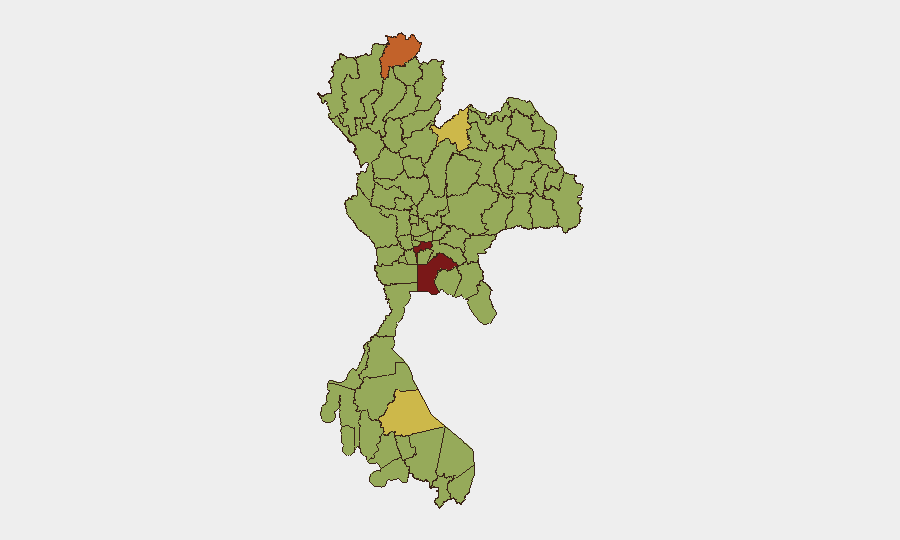
Thailand remains a moderate-risk operating environment (global rank #21, composite score 76) with concentrated vulnerability in Chon Buri and Bangkok provinces and persistent instability along southern and northern border zones. Recent activity signals show elevated law-enforcement and investigative tempo, including arrests, detentions, and inter-agency friction, suggesting institutional stress or response to ongoing criminal or security triggers. International factors—Middle East aviation disruption and heightened Thai consular coordination—are generating secondary logistical impact on travel and supply chains. The security posture is stable but operationally constrained by border restrictions and localized civil unrest.
Key Developments
- Environmental protest, Chiang Mai city (6 July) – Civic groups from Chiang Mai and Chiang Rai provinces staged a rally protesting heavy-metal and toxic-chemical discharge into the Mekong River; small-scale, issue-focused mobilization with localized movement disruption.
- Cross-border movement restrictions remain in effect (as of 6 July) – Tightened checkpoint controls and reduced operating hours at Thai land borders, initiated following a National Security Council decision (6 June), persist and affect cross-border transit and transport logistics.
- Flight cancellations and rerouting affecting Thailand (early July) – Approximately 59 flights between Thailand and the Middle East have been cancelled; about 134 flights involving Thailand overall have been disrupted, primarily at Suvarnabhumi and other major airports, creating travel delays and congestion.
- Thai Foreign Ministry elevated consular posture (Bangkok, early July) – A dedicated Middle East "war room" and 24-hour consular coordination centre established to manage evacuation and security issues for Thai nationals; Thai embassy in Tehran reporting disruptions and monitoring ongoing regional developments.
- Southern border security risk advisory maintained (current as of 6 July) – UK FCDO advisory (updated 30 June, confirmed current) continues to advise against all but essential travel to Pattani, Yala, Narathiwat, and southern Songkhla districts due to regular attacks (shootings, bombings).
- Thailand–Cambodia border closures and temple site restrictions persist (as of 6 July) – Land borders remain suspended and tourist sites including Khao Phra Wihan/Preah Vihear and Ta Muen temples remain closed, reflecting unresolved cross-border security concerns.
Highest-Risk Areas
Chon Buri Province (83.1) and Bangkok (80.5) drive the national composite score and warrant executive attention for corporate operations and personnel. Both provinces show elevated arrest/detention and investigative signals, signaling possible organized-crime, smuggling, or corruption activity. Chiang Rai Province (74.5) presents secondary risk tied to border volatility and armed small-unit activity; the three southern border provinces (Pattani, Yala, Narathiwat) carry the highest tactical risk for violence (insurgent-linked attacks) but fall outside the top 12 ranked sub-national zones, indicating they are geographically peripheral to most corporate footprints. Bangkok and Chon Buri demand real-time monitoring; travel and operations in Chiang Rai and the far south require heightened due diligence.
How GeoBit Would Assist
Security teams would deploy AOI Monitoring & Early Warning on Bangkok, Chon Buri, and Chiang Rai to catch emerging incidents (arrests, protests, violence) within hours of occurrence. Network & Actor Analysis and Intel Sweep (X/Twitter, Telegram, OSINT fusion) would track law-enforcement activity and criminal-network signals in real time. Routing & Network Analysis would model alternative border-crossing and airport routes to mitigate the current checkpoint and flight-disruption constraints. Satellite and GIS analysis would monitor persistent civil unrest or military repositioning near southern and northern border zones.
7-Day Outlook
No imminent escalation is indicated; the near-term trajectory is one of sustained but not acute tension. Border restrictions and flight disruptions are likely to persist through mid-July as Middle East volatility remains unresolved and cross-border criminal and smuggling pressures continue. Corporate teams should expect continued operational friction (delays, route changes, consular coordination delays) rather than acute security incidents, unless regional conflict spillover or organized-crime activity intensifies.
Highest-Risk Areas — Ranked
| # | State / Region | Risk |
|---|---|---|
| 1 | Chon Buri Province | 83.1 |
| 2 | Bangkok | 80.5 |
| 3 | Chiang Rai Province | 74.5 |
| 4 | Nakhon Si Thammarat Province | 61.6 |
| 5 | Loei Province | 60.8 |
| 6 | Chai Nat Province | 59.1 |
| 7 | Nonthaburi Province | 56.5 |
| 8 | Pathum Thani Province | 54.8 |
| 9 | Bueng Kan Province | 53.1 |
| 10 | Nong Khai Province | 53.1 |
| 11 | Udon Thani Province | 53.1 |
| 12 | Sakon Nakhon Province | 53.1 |
Sources
Previous Daily Briefs
A new Thailand brief is written every day — each with its own risk map and downloadable CSV. Here's the last week; use the calendar to go further back.
📅 Browse every day by calendar →
Highlighted days have a brief. Tap a day for that day's map & analysis, or “csv” for that day's dataset ($5).
Atlas — our AI intelligence desk — emails them this snapshot personally. Nothing else, no list.