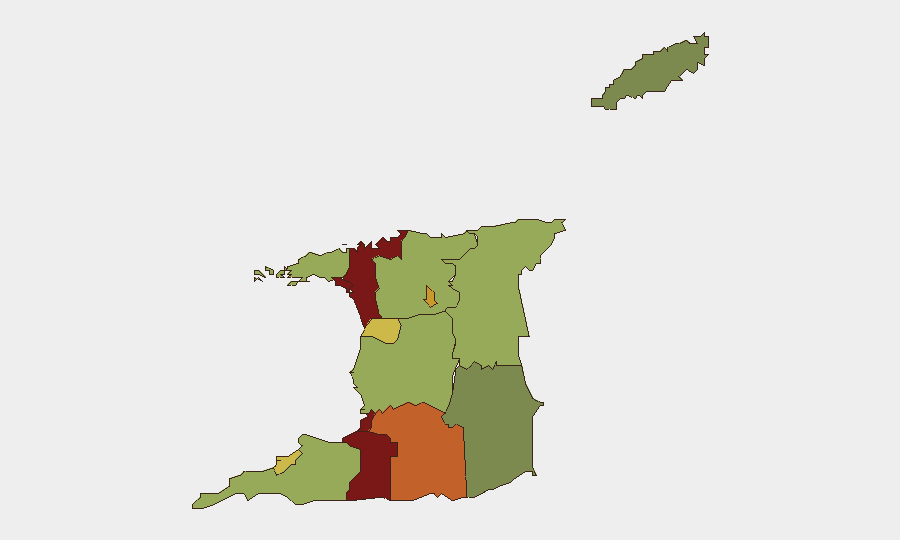
Situation Summary
Trinidad and Tobago remains a low-threat jurisdiction globally (rank #191, composite score 2.1), but sub-national risk concentrates heavily in urban centers and specific regional corridors. No major security incidents were verifiably documented in the last 24–48 hours (July 13–14, 2026) across open-source channels. However, ongoing cybersecurity vulnerabilities affecting government web infrastructure present a persistent operational risk requiring monitoring and remediation.
Key Developments
- Government Cybersecurity Incidents (Trinidad and Tobago–wide, recent/ongoing): Multiple ministry and state agency websites have been compromised through exploitation of known software vulnerabilities. Preliminary assessment suggests opportunistic rather than sophisticated targeted attacks. No precise incident date was available in current reporting; investigations are ongoing. *Implication:* Government digital infrastructure remains exposed; corporate entities should assume elevated credential-compromise and phishing risk vectors.
- Documented Website Compromise Increase (Trinidad and Tobago + Caribbean region, recent/ongoing): Local IT consultant Shivam Teelucksingh has publicly identified a recent uptick in compromised websites across Trinidad and Tobago and the broader Caribbean, prompting formal government monitoring. Precise incident dates were not publicly timestamped in available reporting. *Implication:* Sustained web-compromise activity suggests continued exploitation of legacy or unpatched systems; supply-chain and third-party vendor risk should be elevated in corporate risk assessments.
Highest-Risk Areas
San Juan-Laventille, Port of Spain, Penal-Debe, and San Fernando collectively account for the highest sub-national risk concentrations (scores 95, 88, 82, and 80 respectively). These areas historically correlate with gang-related violence, armed robbery, and homicide activity; Port of Spain additionally concentrates government, commercial, and port infrastructure, amplifying consequence of crime or civil unrest. Mid-tier risk zones (Princes Town, Arima, Chaguanas) remain volatile and warrant awareness for travel and asset positioning. Lower-risk areas (Diego Martin, Siparia, Couva-Tabaquite-Talparo) are suitable for non-essential personnel relocation, though no region is entirely without baseline crime risk.
How GeoBit Would Assist
Security teams would employ AOI Monitoring & Early Warning to track Port of Spain, San Juan-Laventille, and other high-risk zones for emerging violence, civil unrest, or infrastructure disruption, with real-time alerting to duty-of-care systems. Network & Actor Analysis and OSINT fusion (Intel Sweep, X/Telegram OSINT, entity extraction, sentiment tracking) would provide continuous visibility into activist statements, government labor disputes, and inter-community tensions flagged in the recent event signals, enabling early detection of escalation. Cyber intelligence feeds and Shodan scanning would corroborate government and corporate web-vulnerability exposures, informing vendor remediation priorities and insider-threat posture.
7-Day Outlook
Cyber remediation efforts by the Trinidad and Tobago government are likely to accelerate, reducing but not eliminating exposure to web-based intrusions. Sub-national crime activity is expected to remain at baseline elevated levels, particularly in San Juan-Laventille and Port of Spain, with no indication of major organized escalation. Monitoring should remain continuous for activist messaging and labor-related public statements, which have appeared in recent signal activity.
Highest-Risk Areas — Ranked
| # | State / Region | Risk |
|---|---|---|
| 1 | San Juan-Laventille | 95 |
| 2 | Port of Spain | 88 |
| 3 | Penal-Debe | 82 |
| 4 | San Fernando | 80 |
| 5 | Princes Town | 75 |
| 6 | Arima | 72 |
| 7 | Chaguanas | 68 |
| 8 | Point Fortin | 65 |
| 9 | Diego Martin | 58 |
| 10 | Siparia | 55 |
| 11 | Couva-Tabaquite-Talparo | 52 |
| 12 | Sangre Grande | 48 |
Sources
Previous Daily Briefs
A new Trinidad and Tobago brief is written every day — each with its own risk map and downloadable CSV. Here's the last week; use the calendar to go further back.
📅 Browse every day by calendar →
Highlighted days have a brief. Tap a day for that day's map & analysis, or “csv” for that day's dataset ($5).
Atlas — our AI intelligence desk — emails them this snapshot personally. Nothing else, no list.