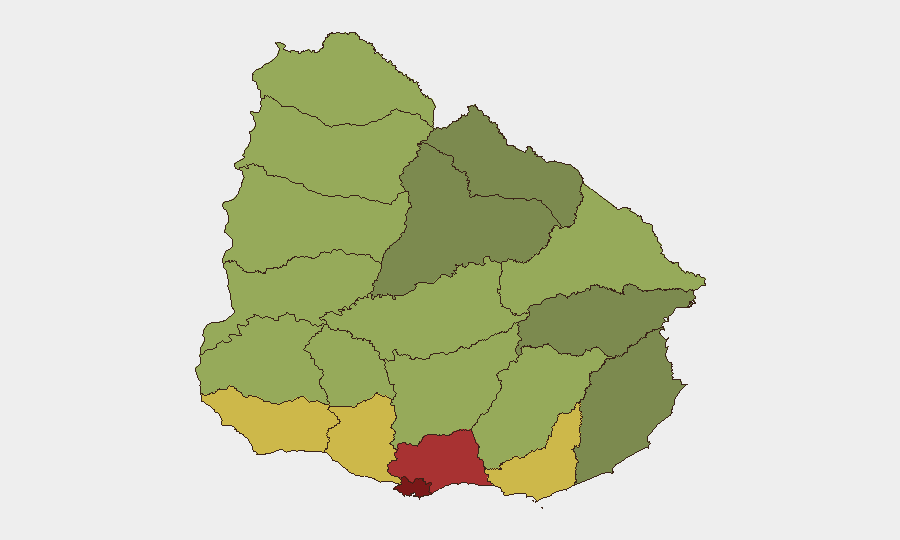
Situation Summary
Uruguay remains one of South America's most stable democracies with a composite threat score of 6—placing it outside the global top-risk tier. No significant security incidents have been confirmed in the past 24–48 hours. The security environment is characterized by localized crime concentrations in urban centers, particularly Montevideo, rather than systemic instability or political risk. Current trajectory is stable, though persistent urban crime patterns warrant continuous monitoring in high-density departments.
Key Developments
- Montevideo, Montevideo Department (2026-06-24): Uruguay's Ministry of the Interior launched an autonomous drone-dispatch program integrating ShotSpotter gunshot-detection alerts with real-time police drone response to reduce emergency-response times in the capital. This is a public-safety infrastructure development, not an incident.
- No confirmed new security incidents, civil unrest, conflict, or travel disruptions were detected in the 24–48 hour window. Older crime and gang-related activity in Montevideo and Canelones remains endemic but shows no acute spike in the current reporting period.
Highest-Risk Areas
Montevideo (risk 92) and Canelones (risk 78) dominate the risk landscape, driven by persistent urban crime, gang activity, and drug-trafficking networks concentrated in peripheral neighborhoods and transit routes. Maldonado (68) and San José (64) pose secondary risk, likely tied to transient populations, border proximity, and tourism-related vulnerabilities. Risk in northern departments (Salto, Artigas, Paysandú) remains moderate (50–54), reflecting lower population density and relative institutional capacity. Security teams with personnel or operations in the Montevideo metropolitan area should apply heightened duty-of-care protocols.
How GeoBit Would Assist
OSINT Fusion & Corroboration enables continuous multi-language monitoring of Uruguayan social media, news feeds, and telegram channels to detect emerging crime clusters, gang activity, or protest signals before they escalate. AOI Monitoring & Early Warning allows persistent watch over high-risk departments—particularly Montevideo's peripheral zones and Canelones transit corridors—with automated alerting when incident indicators surface. GIS & Spatial Analysis combined with Network & Actor Analysis maps gang territories, trafficking nodes, and criminal-actor movements to inform route planning and asset-location decisions for field teams. These capabilities together provide early-stage risk visibility and operational decision support without reliance on formal public reporting.
7-Day Outlook
No acute catalysts for instability are evident in the near term. Montevideo's new drone-dispatch system may incrementally shift criminal operational patterns but is unlikely to produce security-relevant disruption. Baseline urban crime and gang activity will remain steady-state; security teams should maintain current posture and monitor for any surge in activity tied to drug-trafficking routes or territorial disputes in the Canelones–Montevideo corridor.
NEXT BRIEF: 2026-06-26 | LAST UPDATE: 2026-06-25 09:00 UTC
Highest-Risk Areas — Ranked
| # | State / Region | Risk |
|---|---|---|
| 1 | Montevideo | 92 |
| 2 | Canelones | 78 |
| 3 | Maldonado | 68 |
| 4 | San José | 64 |
| 5 | Colonia | 62 |
| 6 | Soriano | 58 |
| 7 | Río Negro | 56 |
| 8 | Salto | 54 |
| 9 | Artigas | 52 |
| 10 | Paysandú | 50 |
| 11 | Florida | 48 |
| 12 | Flores | 46 |
Sources
Previous Daily Briefs
A new Uruguay brief is written every day — each with its own risk map and downloadable CSV. Here's the last week; use the calendar to go further back.
📅 Browse every day by calendar →
Highlighted days have a brief. Tap a day for that day's map & analysis, or “csv” for that day's dataset ($5).