Situation Summary
Yemen remains a complex, multi-layered conflict environment with humanitarian, security, and political dimensions creating persistent risk to international personnel and assets. The nation ranks #20 globally on GeoBit's composite threat index (score 72), reflecting active conventional military operations, international diplomatic pressure, and factional competition across fragmented territory. Risk is heavily concentrated in the capital region and eastern governorates, where state capacity remains minimal and armed group activity drives volatility. The security trajectory remains volatile but not acutely escalating in the immediate reporting window.
Key Developments
- Diplomatic pressure escalating (25–27 June). Public disapproval statements from the U.S. Congress and German Chancellor, and a formal UNICEF public statement (26 June), indicate international concern over governance, civilian harm, or humanitarian access. These are primarily signaling events rather than tactical incidents, but reflect rising reputational and political cost to Yemen's de facto authorities.
- Conventional military operations ongoing (25–27 June). GeoBit event feed records three separate instances of conventional military force events between 25–27 June; one incident (27 June) explicitly involves civilian exposure. Specific locations and unit identities are not clarified in available open-source corroboration; these likely reflect inter-factional clashes or Houthi-affiliated operations in northern or central Yemen, but confirmation is pending detailed reporting.
- Internal communication breakdown signals (25 June). A "Yemen vs Yemen" public statement on 25 June and separate "Yemen vs Media" statement suggest factional messaging or public disputes over narrative control. These typically precede tactical friction or indicate loss of unified command messaging.
- Mukalla-area tensions noted (25 June). A public statement referencing Mukalla (Hadramaut Governorate, ranked #3 in sub-national risk) indicates ongoing friction in this oil-and-port-critical area, though the specific nature of the dispute is not yet verified.
- Limited verified incident-level data (last 24–48h). Open-source feeds have not yet yielded multiple cross-confirmed, precisely dated incident reports from within Yemen proper for 25–27 June with specific locations and casualty/displacement metrics. Regional maritime and Iran-related reporting exists but does not constitute Yemen-internal security incidents.
Highest-Risk Areas
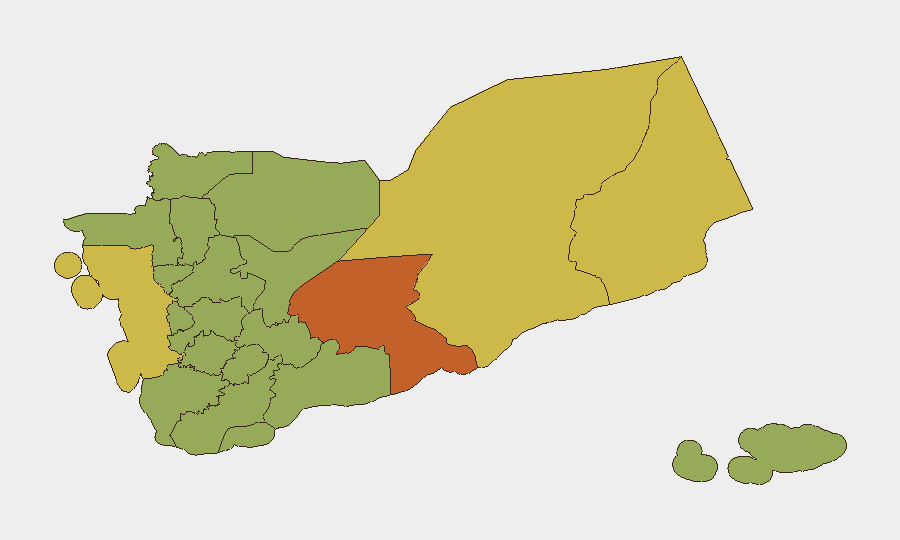
Amanat Al Asimah (Sana'a capital area, risk 80.7) and the eastern corridor—Shabwah (74.1), Hadramaut (70.4), and Al Mahrah (68.2)—drive the overall national threat score. The capital concentration reflects Houthi control, factional rivalry, and international pressure; the eastern belt combines weak state presence, tribal competition, oil infrastructure exposure, and proximity to maritime piracy and transnational militant networks. Al Hudaydah Governorate (66.8), while ranked fifth, remains critical due to port dependency and Red Sea dynamics.
How GeoBit Would Assist
Security teams in or with obligations to Yemen should prioritize AOI (Area-of-Interest) Monitoring & Early Warning on key facilities and movement routes in Amanat Al Asimah and Hadramaut, with persistent alerting on military/factional activity. Network & Actor Analysis and Conflict & Military mapping capabilities enable rapid identification of which armed factions or units are operationally active in specific regions week-to-week, supporting duty-of-care decisions on staff movement and facility security posture. Routing & Network Analysis and Maritime & Aviation tracking support alternative supply-chain and evacuation planning as conditions shift.
7-Day Outlook
Near-term escalation risk is moderate. Ongoing military operations and diplomatic criticism may trigger localized tactical actions, but no imminent national-level crisis indicator is evident. Organizations should maintain heightened situational awareness in Amanat Al Asimah and the eastern governorates and prepare contingency briefings for staff and leadership by early July.
Highest-Risk Areas — Ranked
| # | State / Region | Risk |
|---|---|---|
| 1 | Amanat Al Asimah | 80.7 |
| 2 | Shabwah Governorate | 74.1 |
| 3 | Hadramaut Governorate | 70.4 |
| 4 | Al Mahrah Governorate | 68.2 |
| 5 | Al Hudaydah Governorate | 66.8 |
| 6 | Ta'izz Governorate | 51.4 |
| 7 | Sa'dah Governorate | 50.7 |
| 8 | Hajjah Governorate | 50.7 |
| 9 | Al Mahwit Governorate | 50.7 |
| 10 | 'Amran Governorate | 50.7 |
| 11 | Sana'a Governorate | 50.7 |
| 12 | Raymah Governorate | 50.7 |
Sources
Previous Daily Briefs
A new Yemen brief is written every day — each with its own risk map and downloadable CSV. Here's the last week; use the calendar to go further back.
📅 Browse every day by calendar →
Highlighted days have a brief. Tap a day for that day's map & analysis, or “csv” for that day's dataset ($5).