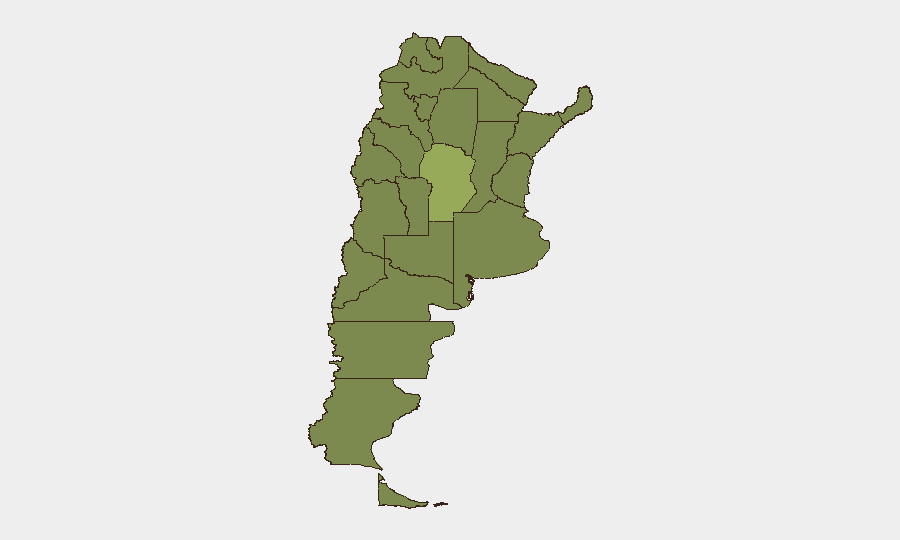
Situation Summary
Argentina remains a moderate-threat environment (composite score 37; rank #44 globally) with no major security incidents reported in the last 24–48 hours. A magnitude 4.0 earthquake struck San Juan Province on 4 July with no reported casualties or infrastructure damage. Underlying structural risks—including labor unrest, police discontent, and judicial tensions documented in recent event signals—persist but have not crystallized into acute nationwide incidents.
Key Developments
- Moderate Seismic Activity – San Juan Province, 4 July 2026
A 4.0-magnitude earthquake was recorded in Departamento de Caucete, San Juan Province. No concurrent reporting of casualties, significant infrastructure damage, or secondary public-order disruption. Risk to travel and operations remains low to routine for the region.
- Limited New Security Incidents – National, as of 5 July 2026
Open-source monitoring over the last 24–48 hours has not surfaced major new protests, riots, or violent incidents across Argentina's territory. This does not indicate absence of risk, but rather that no large-scale acute event has emerged into international reporting in that window.
Highest-Risk Areas
Córdoba Province significantly outpaces other regions with a composite risk score of 55.8—more than double the next-highest (Buenos Aires Province, 31.2). This concentration warrants targeted attention for any personnel, facilities, or supply chains in the province. Buenos Aires Province and the Autonomous City of Buenos Aires together account for the largest urban concentration of risk, driven by labor organizing, inter-agency tensions, and historical crime patterns. Santa Fe and Corrientes provinces show moderate but comparable elevated scores; they should be monitored for secondary risk transmission, particularly along border and trade corridors.
How GeoBit Would Assist
AOI Monitoring & Early Warning would provide persistent watch on Córdoba and Buenos Aires Province, with automated alerting on labor actions, police mobilizations, or judiciary decisions affecting travel corridors and facility security. Intel Sweep and multi-language OSINT (X/Twitter, local news, Telegram channels) would capture emerging unrest and inter-agency friction below the threshold of international newswire coverage—critical for duty-of-care teams managing in-country teams. Routing & Network Analysis would enable real-time alternative-route planning if demonstrations, roadblocks, or infrastructure disruptions arise in high-risk provinces.
7-Day Outlook
No imminent nationwide security crisis is signaled. However, recent event data (arrests of mayors, police–legislature tensions, worker demonstrations) suggests sustained institutional friction that could produce localized disruptions, particularly in Córdoba Province. Corporate teams should maintain standard threat-monitoring protocols and keep contingency plans current; escalation is possible but not presently indicated by available intelligence.
Data Currency: This brief reflects analysis as of 5 July 2026, 18:00 UTC. Threat rankings are composite; all locational and temporal specifics are based on GeoBit's event database and 24–48-hour OSINT sweep. No major new incidents have been independently corroborated in that window beyond the San Juan seismic event.
Highest-Risk Areas — Ranked
| # | State / Region | Risk |
|---|---|---|
| 1 | Córdoba | 55.8 |
| 2 | Buenos Aires Province | 31.2 |
| 3 | Río Negro Province | 27.5 |
| 4 | Corrientes Province | 26.8 |
| 5 | Santa Fe Province | 26.8 |
| 6 | Entre Ríos Province | 26.5 |
| 7 | Tierra del Fuego Province | 26.2 |
| 8 | Autonomous City of Buenos Aires | 26.2 |
| 9 | Tucumán Province | 26.2 |
| 10 | Santiago del Estero Province | 26.2 |
| 11 | San Juan Province | 25.8 |
| 12 | Mendoza Province | 25.8 |
Sources
Previous Daily Briefs
A new Argentina brief is written every day — each with its own risk map and downloadable CSV. Here's the last week; use the calendar to go further back.
📅 Browse every day by calendar →
Highlighted days have a brief. Tap a day for that day's map & analysis, or “csv” for that day's dataset ($5).
Atlas — our AI intelligence desk — emails them this snapshot personally. Nothing else, no list.