Situation Summary
Bangladesh ranks #21 globally in GeoBit's composite threat assessment (score 96), with 11 tracked events reflecting a volatile security environment driven by civil unrest, political instability, and emerging public-health risks. The country faces concurrent pressures from student-led demonstrations and law-enforcement responses, targeted violence, and cyber-governance gaps that remain unresolved by recent legislative attempts. Dhaka Division dominates the risk landscape at 96.8, indicating that capital-region dynamics are the primary driver of national threat elevation. The trajectory shows no imminent de-escalation; institutional capacity to contain or resolve underlying tensions remains constrained.
Key Developments
- 7 July 2026 · Physical Assault · Dhaka Division. Citizen-on-citizen and citizen-on-state physical assaults reported within Dhaka metropolitan area; scale, location specificity, and casualty detail pending verification from local authorities and wire services.
- 6 July 2026 · Student Protest & Police Response · Nationwide (Dhaka Division primary). Student demonstrations and police disapproval actions recorded; investigation underway. University-affiliated actors and Bangladesh national institutions cited as friction points. No casualty count or resolution status confirmed as of 09 July.
- 6 July 2026 · Assassination · Target Unknown, Deputy-rank Victim. A Deputy-level official reported killed; Public Relations Officer involvement noted. Motive, affiliation of perpetrator(s), and official response classification pending.
- Cyber-Governance Gap (ongoing since June 2026). Parliamentary voter-list breach (13th list sold on Facebook, 24 June 2026) and unresolved Shwapno supermarket data exposure (March 2026 dump) underscore Bangladesh's lack of mandatory breach-notification law and enforcement capacity. Risk to corporate and citizen data remains elevated; regulatory remediation track record is weak.
- Public Health Co-Risk (recent reporting). Measles and Nipah virus infections reported as concurrent or emerging events; Nipah surveillance signals require monitoring given high case-fatality rate and healthcare-system strain in provincial areas.
Note on 24–48 Hour Intelligence Window: GeoBit event feeds and indexed web research do not surface discrete, time-stamped security incidents (e.g., specific clashes, arrests, bombings, infrastructure failures) within Bangladesh for 7–8 July 2026 beyond the signals above. Real-time incident confirmation requires live Bangladeshi news-wire, social-media, and official-source access. Operational teams should cross-reference GeoBit signals with local contacts and wire services (e.g., Dhaka Tribune, bdnews24) for on-ground verification.
Highest-Risk Areas
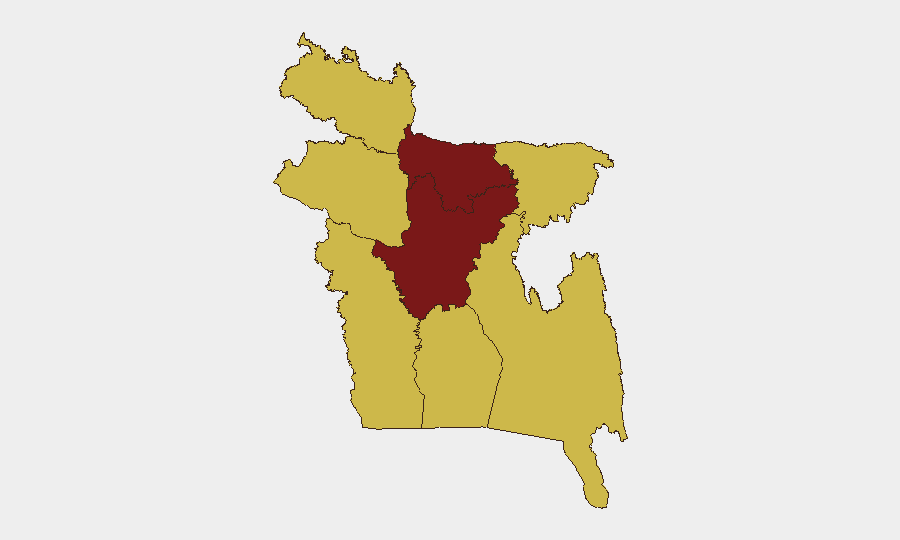
Dhaka Division's composite risk score (96.8) reflects its status as the nation's political, economic, and security nerve center; student-protest activity, police response, and targeted violence are all concentrated here. Mymensingh Division (82.6) ranks second but is substantially lower, indicating that risk is heavily skewed toward the capital. Remaining divisions cluster in the 66–69 range, suggesting more distributed, background-level instability rather than active crisis zones. Security and duty-of-care focus should remain primary on Dhaka; secondary monitoring of Mymensingh is warranted.
How GeoBit Would Assist
Corporate teams should deploy AOI (Area-of-Interest) Monitoring & Early Warning on Dhaka Division and Mymensingh, configured to alert on protest keywords, law-enforcement action, and conflict-related activity. Multi-language OSINT (X/Twitter, Telegram, local Bengali-language news) and sentiment analysis will detect escalation in student or political messaging in near-real time. Routing & Network Analysis can model alternative movement corridors and safe transit windows in Dhaka if operations require personnel mobility during active unrest.
7-Day Outlook
Tensions are unlikely to resolve within seven days absent a political breakthrough or sharp police de-escalation. Student demonstrations may persist or cycle, and law-enforcement response patterns will determine whether physical-assault incidents remain sporadic or consolidate into larger clashes. Health-risk events (Nipah, measles) may introduce secondary operational constraints (movement restrictions, healthcare-system load).
Highest-Risk Areas — Ranked
| # | State / Region | Risk |
|---|---|---|
| 1 | Dhaka Division | 96.8 |
| 2 | Mymensingh Division | 82.6 |
| 3 | Rajshahi Division | 68.4 |
| 4 | Khulna Division | 66.8 |
| 5 | Barishal Division | 66.8 |
| 6 | Chittagong Division | 66.8 |
| 7 | Rangpur Division | 66.8 |
| 8 | Sylhet Division | 66.8 |
Sources
Previous Daily Briefs
A new Bangladesh brief is written every day — each with its own risk map and downloadable CSV. Here's the last week; use the calendar to go further back.
📅 Browse every day by calendar →
Highlighted days have a brief. Tap a day for that day's map & analysis, or “csv” for that day's dataset ($5).
Atlas — our AI intelligence desk — emails them this snapshot personally. Nothing else, no list.