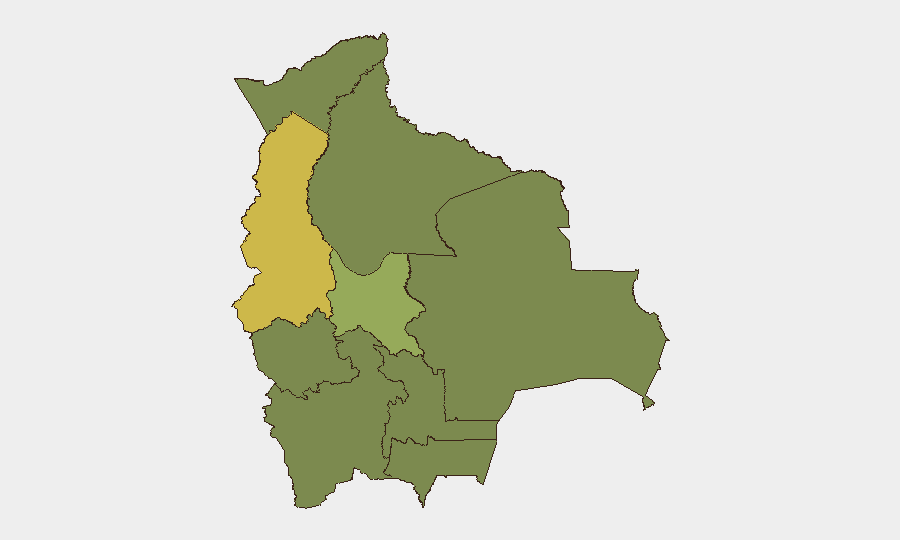
Situation Summary
Bolivia's composite threat score remains moderate (47/100, rank #46 globally), but internal political fragmentation and ongoing transport disruptions continue to create operational friction for corporate activity. La Paz and Cochabamba drive national risk disproportionately (scores 62.5 and 49.1 respectively), reflecting sustained tensions tied to political realignment and union-led protests. The past 24–48 hours show no clearly dated, new security incidents in reliable open sources, though the underlying conditions of protest blockades and political strain persist without clear resolution. Risk trajectories remain stable rather than escalating, but operational disruption risk—particularly to supply chains and movement—warrants sustained monitoring.
Key Developments
No clearly dated, new security incidents in the last 24–48 hours are verifiable in current open-source and social intelligence. Recent GeoBit event signals reference diplomatic friction (U.S.–Bolivia military posturing, Belarus consulate relations, Argentina disapproval of Bolivia), but timestamps do not indicate developments specific to June 17–18 within Bolivia's borders.
Protest blockades—ongoing, timeframe unspecified. Union-organized blockades continue to interrupt transport and supply routes nationwide; sources frame this as "weeks" or "over 40 days" of disruption linked to political backing for former president Evo Morales, but no new escalation is dated to the last 48 hours. This represents *continuing* operational friction, not a *new* trigger event.
Recommended approach: Security teams should monitor for (1) any sharp escalation in union activity, (2) widening geographic spread of blockades beyond current routes, and (3) government counter-action or negotiated settlements—each would signal a shift in trajectory. None are presently evident in the last day.
Highest-Risk Areas
La Paz's risk score (62.5) reflects its role as the political and administrative capital; the concentration of government, diplomatic, and security apparatus there means political tensions, protest mobilization, and law-enforcement responses all converge in this jurisdiction. Cochabamba (49.1) is the second driver, historically a flashpoint for labor organizing and indigenous political movements. Together, these two departments account for the majority of event density tracked by GeoBit. Potosí, Tarija, Pando, Beni, Oruro, Chuquisaca, and Santa Cruz all register similar mid-range risk (32.5–32.9), indicating diffuse baseline vulnerabilities—crime, informal economy, border porosity—rather than acute crisis points. Corporate operations in La Paz and transit corridors connecting Cochabamba should maintain heightened situational awareness; operations in the eastern lowlands (Santa Cruz, Beni) face lower political risk but persistent criminality and logistics constraints.
How GeoBit Would Assist
Security teams would deploy AOI Monitoring & Early Warning on La Paz transport hubs, border routes, and Cochabamba labor centers to detect protest escalation or blockade expansion in real time. Intel Sweep and multi-language X/Twitter OSINT would track union announcements, government counter-statements, and on-the-ground reporting to distinguish noise from material developments. Routing & Network Analysis would generate alternative supply and personnel routes bypassing high-risk corridors, while sentiment & temporal analysis on social platforms would surface shifts in political mood or mobilization early enough for duty-of-care teams to adjust operations.
7-Day Outlook
No acute security trigger is evident for the next 7 days. Protest blockades are likely to persist at current intensity absent either government concession or union exhaustion. Diplomatic friction with the U.S. and Argentina may produce rhetorical escalation but poses limited direct threat to corporate personnel or assets. Monitor for union negotiation outcomes (which could signal blockade easing) and any government enforcement action (which could sharpen street-level risk in La Paz and Cochabamba).
Highest-Risk Areas — Ranked
| # | State / Region | Risk |
|---|---|---|
| 1 | La Paz | 62.5 |
| 2 | Cochabamba | 49.1 |
| 3 | Potosí | 32.9 |
| 4 | Tarija | 32.9 |
| 5 | Pando | 32.5 |
| 6 | Beni | 32.5 |
| 7 | Oruro | 32.5 |
| 8 | Chuquisaca | 32.5 |
| 9 | Santa Cruz | 32.5 |
Sources
Previous Daily Briefs
A new Bolivia brief is written every day — each with its own risk map and downloadable CSV. Here's the last week; use the calendar to go further back.
📅 Browse every day by calendar →
Highlighted days have a brief. Tap a day for that day's map & analysis, or “csv” for that day's dataset ($5).