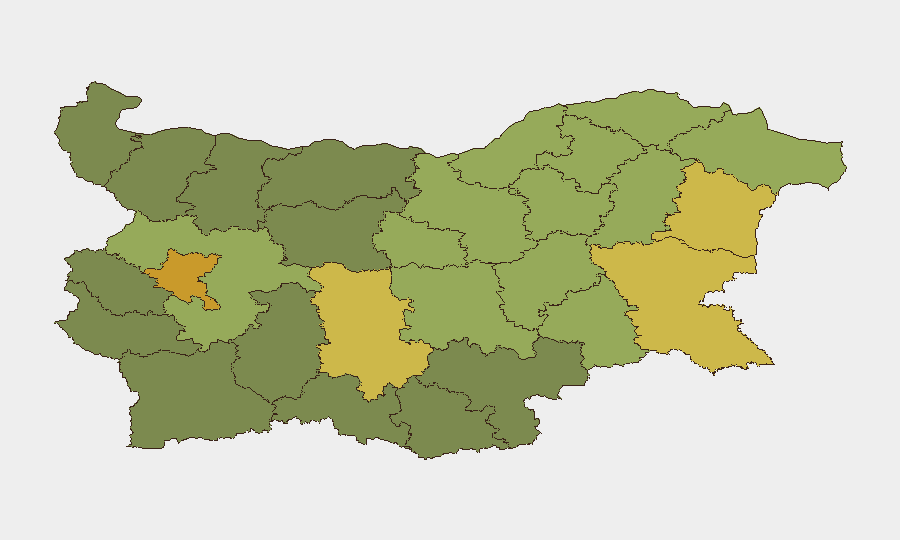
Situation Summary
Bulgaria faces a composite threat score of 6 (rank #156 globally), but recent developments have elevated near-term security awareness in specific regions. A Ukrainian-type drone carrying explosives detonated inside Bulgarian airspace on 2026-08-08 near the Trans-Balkan gas pipeline—the first explosive drone incident on Bulgarian territory since the Ukraine conflict began—triggering ongoing political and military response. Concurrent risks include a high-profile youth murder in Plovdiv (ongoing investigation and social reaction as of 2026-08-16), transportation incidents on major corridors, and continued airspace/critical-infrastructure vulnerability in the northeast border zone.
Key Developments
- Drone explosion near Kardam, Dobricht Province (2026-08-08): Unidentified Ukrainian-type Maya decoy drone crossed from Romania and detonated ~100 m inside Bulgarian airspace near the Trans-Balkan gas pipeline compressor station; no casualties or infrastructure damage reported, but marked first explosive drone incident on Bulgarian soil and triggered Defence Ministry deployment of two anti-drone systems (expected delivery 2026-08-15).
- Anti-drone system arrival announced (2026-08-14): Defence Minister confirmed delivery of two anti-drone systems on 2026-08-15, citing three prior incidents: reconnaissance drones near Primorsko (Black Sea coast), and a missile engine destroyed by Bulgarian Navy; state of emergency declared near Belitsa for cleanup operations.
- Serbian bus crash on Trakia motorway (2026-08-15): Double-decker bus with Serbian registration crashed on the Trakia motorway near Stara Zagora in South-central Bulgaria during morning hours; multiple injuries and emergency response on scene; major travel-corridor disruption affecting Sofia–Burgas route.
- Brutal murder and youth-violence reaction in Plovdiv (ongoing through 2026-08-16): 37-year-old man killed by five juveniles (ages 14–17) charged with murder "in a particularly cruel manner, motivated by hooliganism and sexual motives"; Prime Minister publicly condemned the killing on 2026-08-16, framing it as "fascist atrocity"; Interior Ministry intensified social-media monitoring for aggressive posts and hate speech.
- Political demands for airspace/NATO coordination (2026-08-10 to 2026-08-14): President, Foreign Minister, and Defence Minister issued statements demanding investigation from Ukraine, highlighting gaps in Bulgarian counter-drone systems, and calling for strengthened NATO coordination on airspace protection.
Highest-Risk Areas
Sofia-City (risk 72) and Plovdiv (risk 68) remain the highest-risk sub-national zones, driven by urban crime density, youth violence, and ongoing investigations. Varna and Burgas (risks 65 and 62) remain elevated due to coastal exposure and maritime incident patterns; Dobricht Province (ranked #12 at risk 44) has risen in operational focus following the 2026-08-08 drone incident near the Romania border and critical-infrastructure proximity. Sofia Province itself (risk 58) reflects broader capital-area exposure. Northeast border zones and coastal areas warrant elevated situational awareness through early September.
How GeoBit Would Assist
AOI Monitoring & Early Warning with persistent watch on Dobricht Province (border zone, pipeline infrastructure) and Plovdiv (civil unrest/youth violence hotspot) would detect airspace anomalies and protest/social escalation in real time. OSINT fusion (X/Twitter, Telegram, local media scanning) would track emerging hate speech, extremist rhetoric, and transport-corridor disruptions. Alternative Route & Network Analysis would enable security teams to replan personnel movement away from Trakia motorway disruptions and high-risk urban centers, while GIS & Spatial Analysis overlays threat zones with corporate asset locations for duty-of-care decisions.
7-Day Outlook
Near-term trajectory is stable but heightened. Anti-drone system deployment and NATO coordination efforts should reduce airspace risk by late August; however, Plovdiv's youth-violence and social-media escalation risk remains elevated through the investigation phase. Travel disruptions and roadway incidents (bus crash recovery, increased checkpoints) may persist for 48–72 hours. No indication of imminent broad-spectrum security deterioration, but localized risks in Sofia-City, Plovdiv, and the northeast border zone warrant continued monitoring.
Highest-Risk Areas — Ranked
| # | State / Region | Risk |
|---|---|---|
| 1 | Sofia-City | 72 |
| 2 | Plovdiv | 68 |
| 3 | Varna | 65 |
| 4 | Burgas | 62 |
| 5 | Sofia | 58 |
| 6 | Ruse | 55 |
| 7 | Stara Zagora | 52 |
| 8 | Sliven | 50 |
| 9 | Shumen | 48 |
| 10 | Razgrad | 47 |
| 11 | Yambol | 45 |
| 12 | Dobrich | 44 |
Sources
Previous Daily Briefs
A new Bulgaria brief is written every day — each with its own risk map and downloadable CSV. Here's the last week; use the calendar to go further back.
- August 14, 2026
- August 12, 2026
- August 10, 2026
- August 8, 2026
- August 6, 2026
- August 5, 2026
- August 4, 2026
📅 Browse every day by calendar →
Highlighted days have a brief. Tap a day for that day's map & analysis, or “csv” for that day's dataset ($5).
Atlas — our AI intelligence desk — emails them this snapshot personally. Nothing else, no list.