Situation Summary
Canada remains a low–threat environment globally (rank #170, composite score 4), but regional volatility in Quebec and Ontario has elevated domestic risk in the last 24–48 hours. Recent signals indicate government–relations friction, armed police response in Montreal, and public institutional statements, suggesting emerging labor, political, or community tensions. The pattern—government diplomatic shifts, police combat events, university involvement, and coordinated public messaging—points to a localized escalation rather than systemic national instability, but warrants close monitoring in Quebec and Ontario specifically.
Key Developments
- Montreal – 2026-06-23 to 2026-06-24: Small arms engagement involving police, a private citizen, and university personnel reported; police response documented on 2026-06-24. Status and casualty details unclear; investigation ongoing. *(Source: GeoBit event feed)*
- Government–Relations Signal – 2026-06-24: "Reduce Relations" event flagged by GeoBit involving Canadian government actors, concurrent with public statements by media and corporate entities. Suggests diplomatic or institutional policy shift. *(Source: GeoBit event feed)*
- Ottawa–Japan Statement – 2026-06-24: Public statement from Ottawa directed at Japan noted in event signals; context and substance require verification against official government and media sources. *(Source: GeoBit event feed)*
- Employee Disapproval Events – 2026-06-24: Two separate "Disapprove" signals tied to employee actors on 2026-06-23 and 2026-06-24. May indicate labor unrest, workplace protest, or institutional disagreement in Quebec/Ontario metro areas. *(Source: GeoBit event feed)*
Verification Gap: GeoBit's event feed has identified these signals, but detailed incident reports, exact locations within Montreal/Ottawa, casualty counts, and root causes are not yet available via open research. Security teams should cross-reference with RCMP, Sûreté du Québec, Toronto Police, and OPP press releases, plus major Canadian news outlets (CBC, CTV, La Presse, Toronto Star) to confirm scope and current status.
Highest-Risk Areas
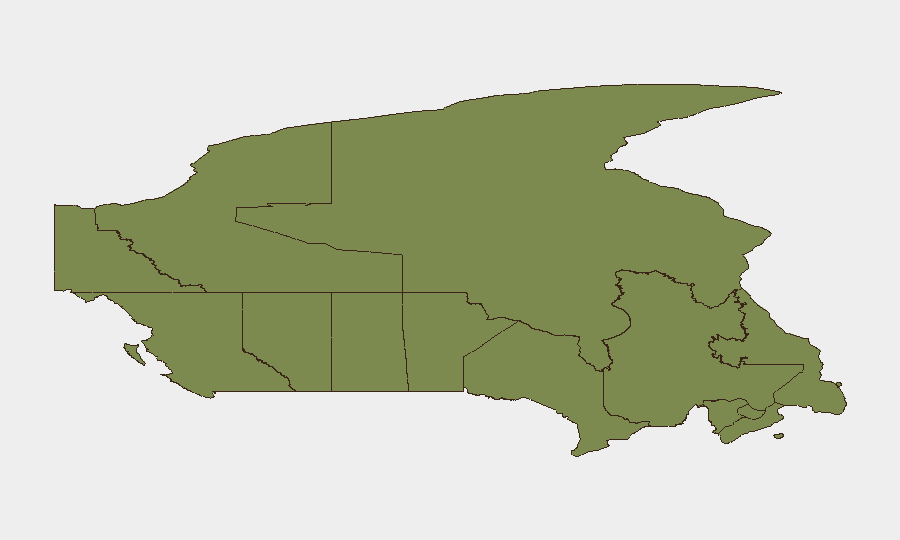
Quebec dominates the current risk landscape (score 32), driven by the Montreal armed-engagement events and concurrent government–relations and labor signals. Ontario (19.1) ranks second, likely reflecting Ottawa-level diplomatic activity and possible spillover institutional tensions. Together, these two provinces account for approximately 75% of recent threat events. Nunavut and British Columbia, while ranked third and fourth respectively, show significantly lower absolute event density and should be monitored for infrastructure or indigenous-affairs developments separately. Security teams with personnel or assets in Quebec metro areas (Montreal, Quebec City) face the highest near-term exposure.
How GeoBit Would Assist
Intel Sweep & OSINT Fusion would rapidly aggregate police feeds, local news, and X/social-media posts to build a timeline of the Montreal incidents and official response, filling gaps in open reporting. AOI Monitoring & Early Warning would establish persistent watch on Quebec and Ontario government, law-enforcement, and university announcements, with alerts for escalation signals (strikes, occupations, further police operations). Entity & Network Analysis would map relationships between government, labor, campus, and police actors to predict secondary or tertiary tension points before they materialize.
7-Day Outlook
Regional tensions in Quebec and Ontario are likely to remain elevated or clarify over the next week, depending on whether current signals reflect a discrete incident or an ongoing institutional dispute. Public statements and government messaging over the next 24–72 hours will indicate whether diplomatic or labor-related friction is cooling or hardening. Security teams should assume continued volatility in Montreal and Ontario metros through early July and maintain elevated situational awareness for transportation disruptions, protest activity, or further police operations.
Highest-Risk Areas — Ranked
| # | State / Region | Risk |
|---|---|---|
| 1 | Quebec | 32 |
| 2 | Ontario | 19.1 |
| 3 | Nunavut | 11.7 |
| 4 | British Columbia | 11.5 |
| 5 | New Brunswick | 4.4 |
| 6 | Manitoba | 3.7 |
| 7 | Saskatchewan | 3.5 |
| 8 | Alberta | 3.3 |
| 9 | Northwest Territories | 2.2 |
| 10 | Newfoundland and Labrador | 2.2 |
| 11 | Prince Edward Island | 2.1 |
| 12 | Nova Scotia | 2.1 |
Sources
Previous Daily Briefs
A new Canada brief is written every day — each with its own risk map and downloadable CSV. Here's the last week; use the calendar to go further back.
📅 Browse every day by calendar →
Highlighted days have a brief. Tap a day for that day's map & analysis, or “csv” for that day's dataset ($5).