Situation Summary
Gabon remains a stable, low-threat environment (global rank #58) with no credible reports of active civil unrest, major crime surges, or political instability in the last 24–48 hours. Routine administrative and commercial activities—including customs auctions and police personnel promotions—continue without disruption, indicating normal state function. The security picture is static; risk is concentrated in specific border and remote regions rather than distributed across the country.
Key Developments
- Libreville customs auction announcement (2026-07-03, ~20h prior): The Directorate General of Customs published logistics for a public auction of stored goods at the Owendo site near Setrag railway station, scheduled to begin the week of 6 July (Wednesdays for viewings, Thursdays–Saturdays for sales, 09:00–16:00). No security disruptions or protest activity reported; the measure is administrative and commercial.
- Police personnel promotion (2026-06-30 to 2026-07-02): Lieutenant Moundziegou advanced to Captain within the National Police. This reflects routine HR development and internal force structuring, with no operational incidents cited.
- No acute crime, violence, or protest incidents recorded in past 24–48 hours: Cross-referenced web search, social media, and news aggregation sources confirm absence of reported attacks, civil disorder, or infrastructure disruptions in the specified timeframe.
- Ongoing private-sector security hiring (within 24h): Job postings for Trust & Safety Analysts, content moderators, and senior security roles in Libreville indicate corporate investment in security functions, consistent with normal business operations.
- Economic/financial news dominates recent coverage: Available Gabon news reflects eurobond fundraising initiatives and oil-sector performance; diplomatic and international security media contain no new Gabon-specific warnings or crisis alerts.
Highest-Risk Areas
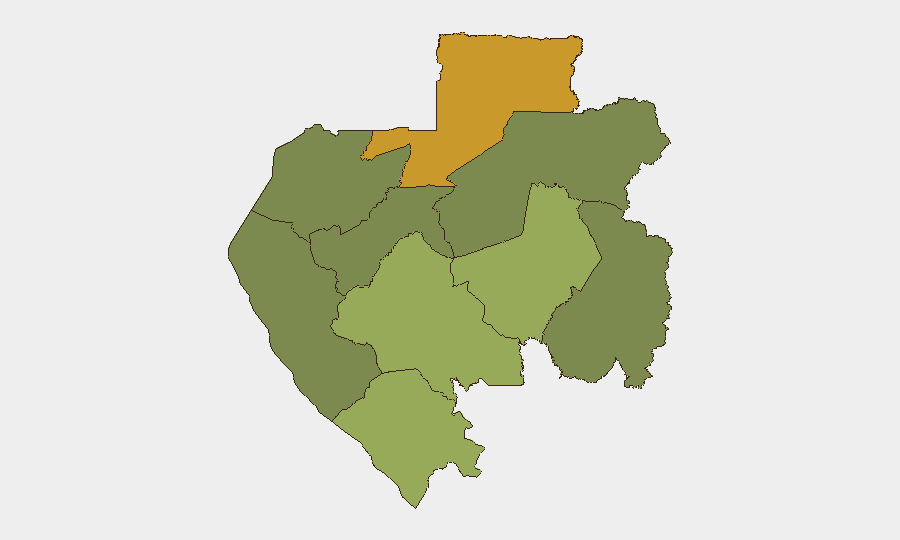
Woleu-Ntem Province (risk 72) and Ogooué-Lolo Province (risk 58) drive the national threat ranking and account for the majority of tracked security events. Both are remote, forested border regions with limited state presence, making them vulnerable to cross-border movement and low-intensity criminal activity. Ngounié Province (risk 48) ranks third, likely reflecting similar geographic and administrative constraints. In contrast, Estuaire Province—home to Libreville and the seat of national authority—records minimal risk (15), and Ogooué-Ivindo is untracked. This pattern indicates that risk is peripheralized in regions distant from capital and major commercial hubs, rather than systemic or widespread.
How GeoBit Would Assist
Corporate security teams should employ AOI Monitoring & Early Warning on Woleu-Ntem and Ogooué-Lolo to detect emerging cross-border or criminal activity before escalation. Multi-language OSINT & event-feed fusion across regional media, Telegram, and local radio will capture incidents that may not reach international news. For personnel or asset movements, routing and network analysis can identify safe transit corridors and avoid high-risk border zones, while satellite and imagery analysis can verify ground conditions in remote operational areas.
7-Day Outlook
No significant change in threat posture is forecast for the next seven days. The customs auction and routine administrative activities will proceed without reported disruption. Continued monitoring of Woleu-Ntem and Ogooué-Lolo provinces remains warranted as a precaution, particularly if cross-border activity from Cameroon or Equatorial Guinea increases; however, current indicators do not suggest an imminent escalation.
Highest-Risk Areas — Ranked
| # | State / Region | Risk |
|---|---|---|
| 1 | Woleu-Ntem | 72 |
| 2 | Ogooué-Lolo Province | 58 |
| 3 | Ngounié Province | 48 |
| 4 | Nyanga Province | 42 |
| 5 | Haut-Ogooué Province | 35 |
| 6 | Moyen-Ogooué Province | 28 |
| 7 | Ogooué-Maritime Province | 25 |
| 8 | Estuaire Province | 15 |
| 9 | Ogooué-Ivindo | 0 |
Sources
Previous Daily Briefs
A new Gabon brief is written every day — each with its own risk map and downloadable CSV. Here's the last week; use the calendar to go further back.
📅 Browse every day by calendar →
Highlighted days have a brief. Tap a day for that day's map & analysis, or “csv” for that day's dataset ($5).