Situation Summary
Georgia remains in a stable security posture with no acute incidents reported in the last 24–48 hours. The country's composite threat score of 20 reflects chronic baseline risks: frozen conflicts in Abkhazia and South Ossetia, routine political protests in Tbilisi, and endemic organized crime—none of which have escalated into active violence or major disruptions during the July 19–20 reporting window. The security environment is characterized by predictability rather than volatility, with risk concentrated in breakaway territories and northern border zones.
Key Developments
- Nationwide (July 19–20): No new armed clashes, border incidents, terrorist events, or civil unrest escalations confirmed across Georgia, including breakaway regions. All monitored zones remain at baseline tension levels.
- Abkhazia—Ochamchire and Gudauta areas (through July 20): Russian-controlled checkpoints and local transport unchanged. Routine grievances (stormwater, fare complaints) persist but have not triggered disruptive unrest or violence in the last 48 hours.
- Shida Kartli / South Ossetia border (through July 20): Chronic border tension with Russia stable; no newly confirmed detentions, shootings, or crossing incidents reported by official or independent monitoring channels.
- Tbilisi (through July 20): Ongoing political protests against government policy show no new escalation, clashes, or large disruptive events; no fresh transport disruptions or protest-related security incidents in the capital during this window.
- National crime and public safety (through July 20): Open-source incident feeds indicate no notable spike in violent crime, terrorism, or organized criminal activity affecting foreign visitors or major infrastructure beyond normal background levels.
- Travel and infrastructure (through July 20): No new border closures, major road or rail disruptions, or airport security incidents; baseline checkpoint controls in breakaway territories persist unchanged.
Highest-Risk Areas
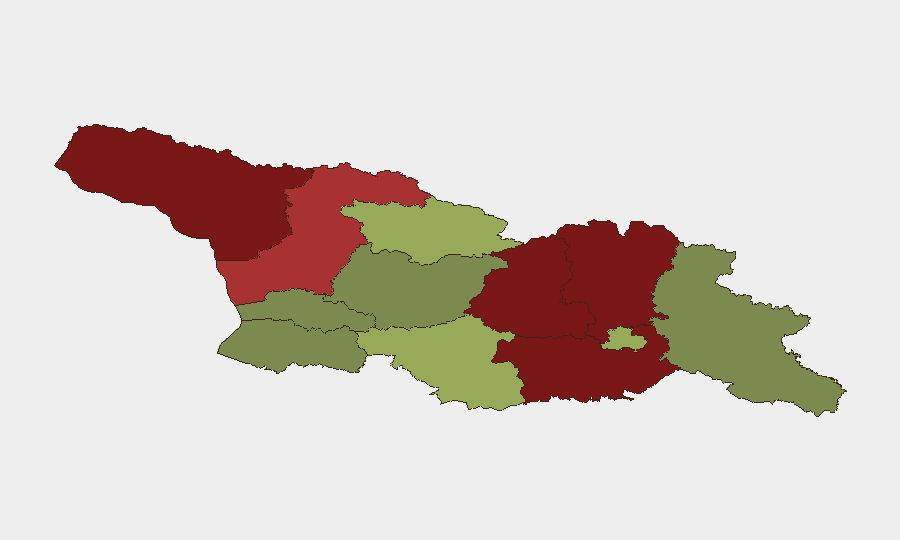
Abkhazia (risk 95) and Shida Kartli (risk 88) drive the country's threat profile due to unresolved territorial disputes, Russian military presence, and chronic cross-border tensions. Together with Lower Kartli (85) and Mtskheta-Mtianeti (82), these northern and border-adjacent regions account for the majority of Georgia's composite risk. Samegrelo-Upper Svaneti (78) faces secondary pressure from proximity to Abkhazia and legacy trafficking networks. By contrast, Tbilisi (45), despite hosting political demonstrations, remains lower-risk than the breakaway zones because protest activity remains contained and non-violent. The southern and western regions (Adjara, Imereti, Guria) register minimal threat scores and are functionally stable.
How GeoBit Would Assist
Security teams protecting people and assets in Georgia should employ AOI Monitoring & Early Warning to detect emerging clashes or protest escalations in Tbilisi and border regions, with alerts configured for Abkhazia and South Ossetia checkpoints. Intel Sweep and multi-language OSINT fusion (X/Twitter, Telegram, local news) provide real-time corroboration of unrest and sentiment shifts among key actor groups. Routing & Network Analysis enables duty-of-care teams to plan alternative transport routes that avoid high-risk border zones and protest epicenters, while Conflict & Military tracking maintains current visibility on Russian force posture and frozen-conflict stability near the breakaway regions.
7-Day Outlook
No near-term escalation is expected. Georgia's security environment will likely remain at current baseline levels through late July, with routine protest activity in Tbilisi and stable (if tense) conditions in breakaway territories. Monitoring should remain alert for cross-border incident triggers or unexpected political statements that could shift sentiment, but the probability of major violence or infrastructure disruption over the next week is low.
Highest-Risk Areas — Ranked
| # | State / Region | Risk |
|---|---|---|
| 1 | Autonomous Republic of Abkhazia | 95 |
| 2 | Shida Kartli | 88 |
| 3 | Lower Kartli | 85 |
| 4 | Mtskheta-Mtianeti | 82 |
| 5 | Samegrelo-Upper Svaneti | 78 |
| 6 | Samtskhe-Javakheti | 48 |
| 7 | Tbilisi | 45 |
| 8 | Racha-Lechkhumi and Kvemo Svaneti | 42 |
| 9 | Kakheti | 38 |
| 10 | Autonomous Republic of Adjara | 35 |
| 11 | Imereti | 32 |
| 12 | Guria | 28 |
Sources
Previous Daily Briefs
A new Georgia brief is written every day — each with its own risk map and downloadable CSV. Here's the last week; use the calendar to go further back.
📅 Browse every day by calendar →
Highlighted days have a brief. Tap a day for that day's map & analysis, or “csv” for that day's dataset ($5).
Atlas — our AI intelligence desk — emails them this snapshot personally. Nothing else, no list.