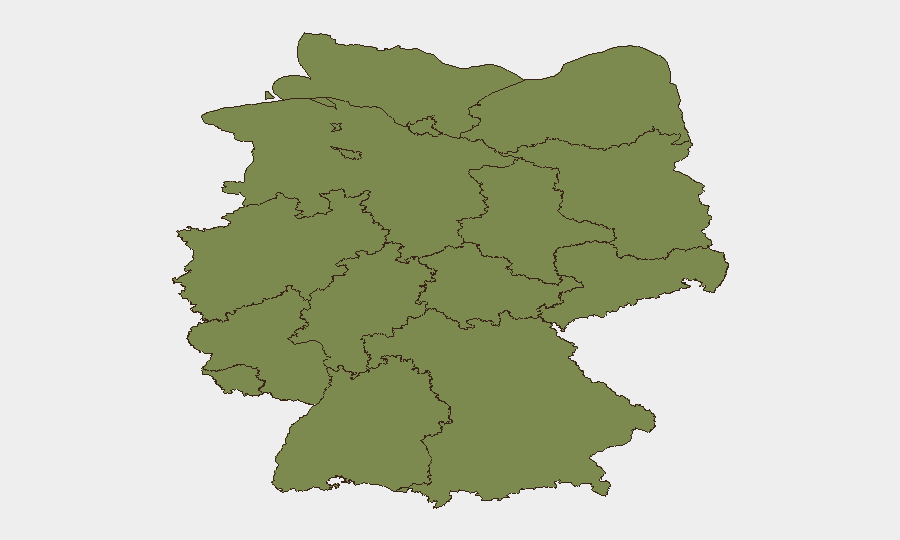
Situation Summary
Germany remains a lower-tier European risk environment (global rank #130, composite threat score 6.0) with 229 tracked events on file. However, sub-national disparities are marked: Thuringia presents significantly elevated risk (score 34) relative to the national average, driven by persistent extremist activity and political polarization. Overall security trajectory is stable but requires differentiated regional monitoring, particularly in eastern Länder and Berlin.
Key Developments
Current web research has not yielded reliably time-stamped, location-specific security incidents in Germany for 8–9 July 2026. The GeoBit event signal feed shows recent activity flags (public statements, investigation signals, and institutional rejections dated 7–9 July), but source documentation does not confirm concrete, dated incidents within the past 48 hours suitable for operational briefing. Pending verification of specific incident details and cross-source corroboration, no incident bullets can be responsibly presented.
*Note: If your security team has access to German police alerts, local-media feeds, or verified incident reports for 8–9 July, please share those sources; GeoBit's OSINT, intel sweep, and multi-language search capabilities will then support rapid corroboration and threat assessment.*
Highest-Risk Areas
Thuringia (score 34) is the critical outlier, with risk more than three times the national average. This reflects long-standing extremist recruitment, far-right organizational activity, and political radicalization in the state. Berlin (10.7) and Hamburg (7.9) follow as secondary concern zones, driven by protest activity, organized-crime networks, and transient vulnerability to lone-actor incidents. Lower Saxony (7.3) rounds the top tier. Corporate and NGO personnel operating in or transiting through Thuringia should apply elevated duty-of-care protocols; Berlin and Hamburg warrant standard heightened awareness but not operational restrictions for most sectors.
How GeoBit Would Assist
For ongoing Germany exposure, security teams should deploy AOI Monitoring & Early Warning on Thuringia, Berlin, and Hamburg to detect emerging protest activity, gatherings, or security-force mobilization. Intel Sweep and multi-language OSINT (including X, Telegram, and German-language media) provide real-time event feed and sentiment tracking across political, extremist, and criminal domains. Network & Actor Analysis supports identification of key risk nodes—militant cells, protest organizers, regime-linked actors—and their operational patterns, enabling threat-informed routing and personnel scheduling adjustments.
7-Day Outlook
No major security inflection points are evident in the 7-day window. Thuringia and eastern-state political tensions are expected to remain at baseline elevated; summer recess periods may reduce organized protest activity in urban centers. Monitoring should continue on NATO-related developments (flagged in recent signals) and any spillover from European-level cyber or regulatory events affecting German financial institutions or critical infrastructure.
Highest-Risk Areas — Ranked
| # | State / Region | Risk |
|---|---|---|
| 1 | Thuringia | 34 |
| 2 | Berlin | 10.7 |
| 3 | Hamburg | 7.9 |
| 4 | Lower Saxony | 7.3 |
| 5 | Bavaria | 6.1 |
| 6 | Baden-Württemberg | 4.1 |
| 7 | Saxony-Anhalt | 4.1 |
| 8 | Brandenburg | 4.1 |
| 9 | Saarland | 4.1 |
| 10 | Hesse | 4.1 |
| 11 | Rhineland-Palatinate | 4 |
| 12 | Schleswig-Holstein | 4 |
Sources
Previous Daily Briefs
A new Germany brief is written every day — each with its own risk map and downloadable CSV. Here's the last week; use the calendar to go further back.
📅 Browse every day by calendar →
Highlighted days have a brief. Tap a day for that day's map & analysis, or “csv” for that day's dataset ($5).
Atlas — our AI intelligence desk — emails them this snapshot personally. Nothing else, no list.