Situation Summary
Greece remains a low-to-moderate threat environment (global rank #119) with a composite threat score of 7 across 58 tracked events. However, concentrated volatility in Central Greece—driven by political violence, civil unrest, and military-civilian tensions—creates a material risk pocket that does not reflect the country's overall security profile. The security picture is characterized by episodic rather than systemic instability, with recent signal activity showing citizen rejection of government, police-state tensions, and armed incidents concentrated in specific regions.
Key Developments
- 2026-07-09 · Citizen Rejection & Military Rejection Events — Unspecified locations; citizen-level disapproval signals and military institutional rejection recorded on 9 July; pattern suggests widening political fracture beyond traditional state-opposition channels.
- 2026-07-09 · Arrest/Detain (Rochester vs. Police) — Location unclear from signal; arrest or detention event involving entity "Rochester" and police on 9 July; insufficient source corroboration available.
- 2026-07-09 · Chinese Public Statement — Unspecified Greek location; Chinese entity issued public statement on 9 July; subject matter and intended audience unclear from available intelligence.
- 2026-07-07 · Small Arms Combat (Rochester) — Location unspecified; armed combat event on 7 July; civilian or state-actor involvement not yet clarified.
- 2026-07-07 · Military Force Events — Two conventional military force incidents recorded on 7 July (MORON vs. MAYOR; SENATOR vs. GOVERNMENT); suggests civil-military friction or localized armed confrontation; specific locations and casualty/property data not available.
- 2026-07-07 · Investigative Actions — Greek and student-linked investigations launched on 7 July; suggests emerging criminal or state-security inquiry; details pending.
- 2026-07-07 · Turkish Demand — Unspecified date and subject; demand from Turkish entity on or before 7 July; likely related to ongoing bilateral maritime or territorial disputes.
Data Caveat: Live web research for the 24–48-hour window (9 July 2026) yielded no independently corroborated incidents beyond platform event signals. The most recent verified incident on file is the Thessaloniki firebomb attack of 2 July 2026, in which improvised incendiary devices targeted homes linked to Greece's New Democracy party, killing one and injuring three; this falls outside the current 24–48-hour window but reflects the political-violence risk profile in northern Greece.
Highest-Risk Areas
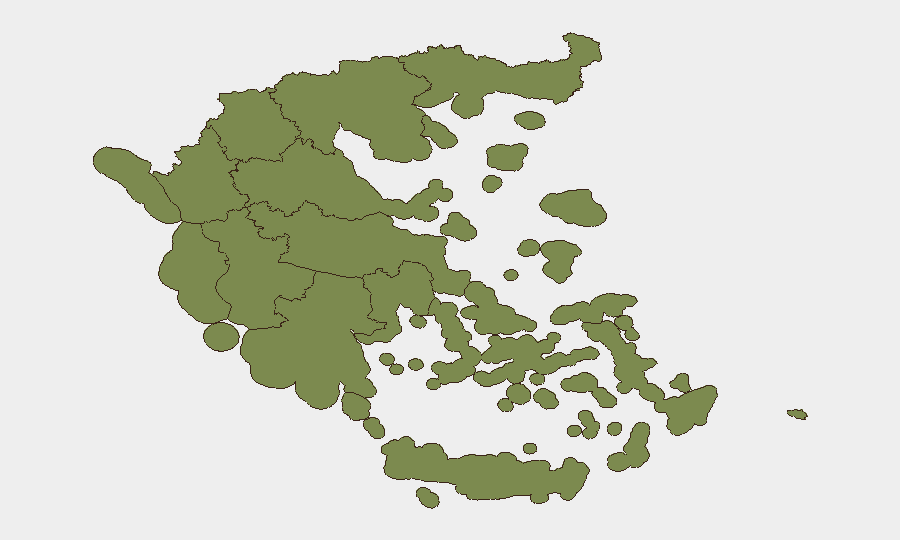
Central Greece dominates the sub-national risk ranking (31.5), representing a 6.8× multiplier over the second-highest region (Attica, 4.6). This concentration reflects a pattern of political extremism, armed activism, and state-response operations in rural and semi-urban zones around Thessaly and the interior. Attica (principally the Athens metropolitan area) carries residual risk from urban protest dynamics and police-civilian incidents but remains substantially lower-risk than Central Greece. All remaining regions score 1.5–2.1, indicating that Greece's threat profile is heavily localized rather than nationally distributed.
How GeoBit Would Assist
Corporate security teams operating in Greece should deploy AOI (area-of-interest) monitoring and early-warning watches on Central Greece, specifically around Thessaloniki and Thessaly, paired with multi-language OSINT feeds and sentiment analysis to detect shifts in protest rhetoric or armed-group communications. Routing and network analysis tools can identify safer travel corridors for personnel in high-risk regions, while event correlation and temporal analysis will clarify the relationship between the 7 July military-force signals and ongoing political tensions. Entity extraction and actor-network mapping will help distinguish state, militia, and criminal actors involved in recent armed incidents.
7-Day Outlook
Near-term trajectory points toward sustained civil-military friction and episodic protest activity, with Central Greece remaining the primary locus of risk. Turkish bilateral demands may create secondary pressure on northeastern maritime zones (Eastern Macedonia and Thrace). No indicators suggest imminent national destabilization, but localized volatility in Central Greece warrants heightened duty-of-care monitoring.
Highest-Risk Areas — Ranked
| # | State / Region | Risk |
|---|---|---|
| 1 | Central Greece | 31.5 |
| 2 | Attica | 4.6 |
| 3 | Central Macedonia | 2.1 |
| 4 | Western Macedonia | 1.5 |
| 5 | Eastern Macedonia and Thrace | 1.5 |
| 6 | Western Greece | 1.5 |
| 7 | Peloponnese Region | 1.5 |
| 8 | Thessaly | 1.5 |
| 9 | Autonomous Monastic State of the Holy Mountain | 1.5 |
| 10 | Northern Aegean | 1.5 |
| 11 | South Aegean | 1.5 |
| 12 | Crete | 1.5 |
Sources
Previous Daily Briefs
A new Greece brief is written every day — each with its own risk map and downloadable CSV. Here's the last week; use the calendar to go further back.
📅 Browse every day by calendar →
Highlighted days have a brief. Tap a day for that day's map & analysis, or “csv” for that day's dataset ($5).
Atlas — our AI intelligence desk — emails them this snapshot personally. Nothing else, no list.