Situation Summary
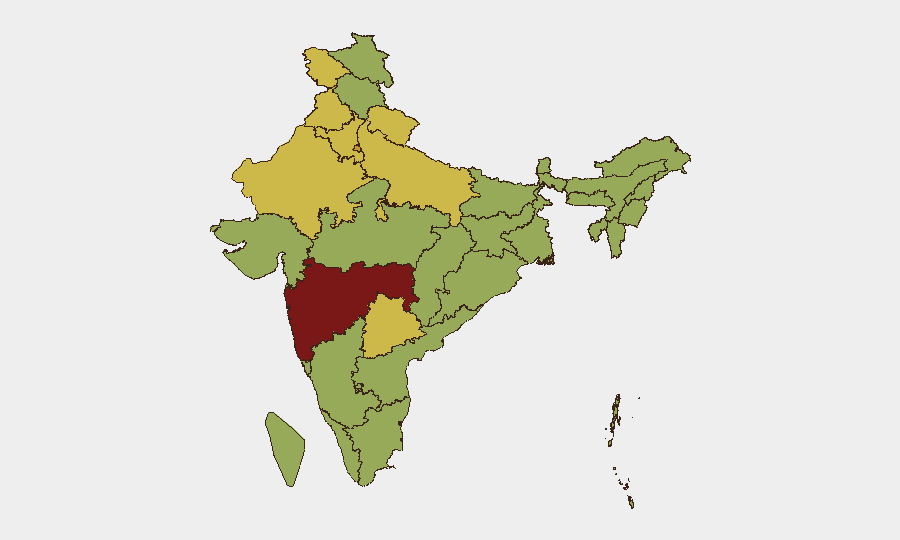
India's composite threat score of 79 places it at #17 globally, with 1,611 tracked events. Sub-national risk is heavily concentrated in Maharashtra, Delhi, and Jammu & Kashmir, reflecting ongoing tensions spanning separatist activity, communal friction, agricultural unrest, and administrative instability. Event signals from 26 June indicate police activity, arrests, ministerial statements, and inter-agency friction, but the underlying drivers remain consistent with long-standing structural vulnerabilities rather than acute escalation. The threat environment is stable but fragmented across state lines, requiring location-specific risk assessment for corporate operations.
Key Developments
Data Limitation Notice: Live web research for the last 24–48 hours (27–29 June) has returned sparse, undated, or older social-media summaries rather than confirmed recent incidents. Available signals include:
- Jammu & Kashmir / Kishtwar area (date unclear, late June): Security operations and Khalistani threat alerts reported; insufficient timestamp confirmation for 24–48 hour window.
- Delhi to Uttarakhand corridor (date unclear, late June): Khalistani-linked security alerts issued; cannot confirm recency with precision.
- Police activity / Administrative action (26 June signals): Multiple arrest/detention, investigation, and public-statement events logged on 26 June across unspecified locations; insufficient granularity to operationalize.
- Ministerial and inter-agency statements (26 June): External Affairs, Energy, and Business Ministry figures issued public statements or disapprovals; no specific security impact confirmed.
Assessment: No major new security incidents have been reliably confirmed in the 24–48 hour window with sufficient specificity for operational alerting. Existing regional tensions (separatism in J&K, farmer unrest in Punjab/Haryana, communal friction in Maharashtra) remain the primary drivers.
Highest-Risk Areas
Maharashtra (85.5) and Delhi (72.4) dominate the risk profile, driven by large urban populations, dense commercial corridors, and historical exposure to communal violence and organized-crime networks. Jammu & Kashmir (70.6) remains volatile due to ongoing separatist activity and cross-border security operations, despite counter-insurgency progress. Punjab (64.5) and Haryana (62.4) are sustained by agricultural-sector unrest and related administrative friction. Together, these five regions account for the majority of tracked threat events and should be the focus of duty-of-care monitoring for companies with personnel or assets in India.
How GeoBit Would Assist
Security teams should use Intel Sweep and multi-language OSINT fusion to monitor Indian police, state government, and ministry statements in real time, corroborating social-media and news feeds to filter signal from noise. Area-of-Interest (AOI) monitoring and early-warning alerting on Maharashtra, Delhi, J&K, and Punjab would flag police actions, communal incidents, and separatist activity before they impact corporate operations. Network and actor analysis can map relationships between protest organizers, security services, and government figures to anticipate friction points and inform journey planning for staff moving between high-risk states.
7-Day Outlook
No imminent security spike is signaled; state-level tensions are expected to persist within recent parameters. Monitor ministerial statements and police activity in Maharashtra and Delhi for signs of policy shift or enforcement escalation. Ongoing counter-insurgency operations in J&K and agricultural-sector negotiations in Punjab remain structural drivers; no resolution is forecast in the near term.
Highest-Risk Areas — Ranked
| # | State / Region | Risk |
|---|---|---|
| 1 | Maharashtra | 85.5 |
| 2 | Delhi | 72.4 |
| 3 | Jammu and Kashmir | 70.6 |
| 4 | Uttar Pradesh | 66.2 |
| 5 | Punjab | 64.5 |
| 6 | Telangana | 63.3 |
| 7 | Haryana | 62.4 |
| 8 | Rajasthan | 61.5 |
| 9 | Uttarakhand | 60.3 |
| 10 | Gujarat | 59.9 |
| 11 | Madhya Pradesh | 59.6 |
| 12 | Tamil Nadu | 59.2 |
Sources
Previous Daily Briefs
A new India brief is written every day — each with its own risk map and downloadable CSV. Here's the last week; use the calendar to go further back.
📅 Browse every day by calendar →
Highlighted days have a brief. Tap a day for that day's map & analysis, or “csv” for that day's dataset ($5).