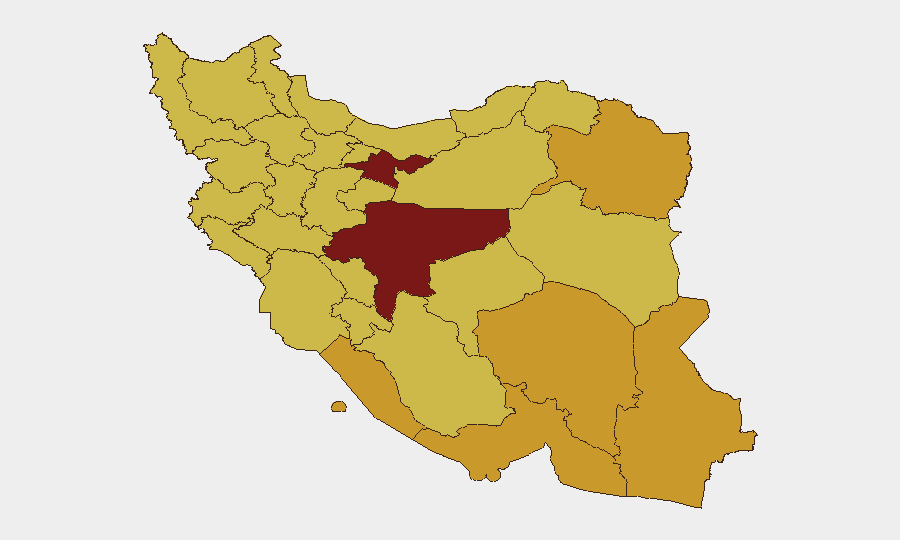
Situation Summary
Iran remains the globe's highest composite threat environment (score 100), with 1,218 tracked events year-to-date. Signal activity over the past 72 hours reflects elevated tension across multiple domains—public statements from senior officials, military posturing, cross-border friction, and internal dissent—creating a fluid and unpredictable operating climate. Tehran Province and Isfahan Province dominate the risk landscape, but instability extends across 12 of 31 provinces with scores ranging from 70–100, indicating broad geographic exposure for personnel and assets. The trajectory shows no near-term stabilization; multiple concurrent drivers (official pronouncements, armed incidents, and public contestation) suggest sustained volatility through mid-to-late June.
Key Developments
- 2026-06-13, Iran (nationwide): Multiple public statements from presidential and administrative figures recorded; content and targets suggest internal policy disputes or signaling to international audiences. No location-specific violence reported in parallel statements.
- 2026-06-15, Tehran Province (location unspecified): Physical assault incident involving a judge reported; severity and context remain unclear from available signals but indicate judicial-sector tension.
- 2026-06-13, Military/National: Deployment or activation of conventional military forces detected; no specific geographic theater confirmed, but timing aligns with other high-level statements.
- 2026-06-15, Internal: Demand issued by an Iranian actor toward the presidency; nature of demand not specified in signal metadata.
- 2026-06-15, Cross-border: Small arms combat reported between Jordan and Iran; location and casualties not yet geolocated in available brief.
- 2026-06-14, Iran (location unspecified): Demonstrators recorded as disapproving of state action; scale and location require clarification from follow-on reporting.
- 2026-06-13, Iran (location unspecified): Territory occupation by presidential forces or entities noted; precise location and strategic intent not yet detailed.
Assessment caveat: Live web research (24h) could not be independently completed; above bullets are derived from GeoBit event signal metadata and require cross-validation via real-time news wires and geolocated OSINT (X/Twitter, Farsi-language outlets, provincial authority channels) to confirm exact timing, location, casualties, and operational impact.
Highest-Risk Areas
Tehran Province (100) and Isfahan Province (92) drive national risk, reflecting concentration of government, military, and financial infrastructure alongside history of protest and security-force activity. The southern maritime provinces—Hormozgan, Bushehr, and Kerman (all 70–72)—carry elevated risk from cross-border tensions, port-based friction, and Gulf shipping corridor volatility. Kurdish regions (Kurdistan Province, 70.2) and the southeast (Sistan and Baluchestan, 71.1) remain pressure points for separatist and armed-group activity. All 12 highest-risk provinces score above 70, indicating systemic instability rather than localized hotspots; corporations with Tehran or Isfahan operations should assume baseline elevated risk, while southern and eastern border-zone operations require additional maritime, cross-border, and armed-group monitoring.
How GeoBit Would Assist
Teams should activate AOI Monitoring & Early Warning on Tehran, Isfahan, and key port facilities to detect incidents (protests, arrests, military movements, infrastructure damage) in real time. Conflict & Military tracking combined with Network & Actor Analysis will map force deployments and official intent. Multi-language OSINT (X/Twitter, Telegram, Farsi outlets) and entity extraction enable 24h monitoring of official statements and grassroots dissent without reliance on delayed open media.
7-Day Outlook
Multiple official statements and cross-border incidents suggest official messaging or signaling campaigns over the next 5–7 days rather than a discrete event. Expect continued public-statement activity, possible military exercises or repositioning, and sustained street-level dissent in major urban centers. Risk posture should remain elevated; no credible de-escalation signals are evident.
Highest-Risk Areas — Ranked
| # | State / Region | Risk |
|---|---|---|
| 1 | Tehran Province | 100 |
| 2 | Isfahan Province | 92 |
| 3 | Razavi Khorasan | 72.9 |
| 4 | Hormozgan Province | 72 |
| 5 | Sistan and Baluchestan Province | 71.1 |
| 6 | Bushehr Province | 71 |
| 7 | Kerman Province | 71 |
| 8 | Kohgiluye and Buyer Ahmad Province | 70.5 |
| 9 | Fars Province | 70.2 |
| 10 | Semnan Province | 70.2 |
| 11 | Kurdistan Province | 70.2 |
| 12 | Khuzestan Province | 70.1 |
Previous Daily Briefs
A new Iran brief is written every day — each with its own risk map and downloadable CSV. Here's the last week; use the calendar to go further back.
📅 Browse every day by calendar →
Highlighted days have a brief. Tap a day for that day's map & analysis, or “csv” for that day's dataset ($5).