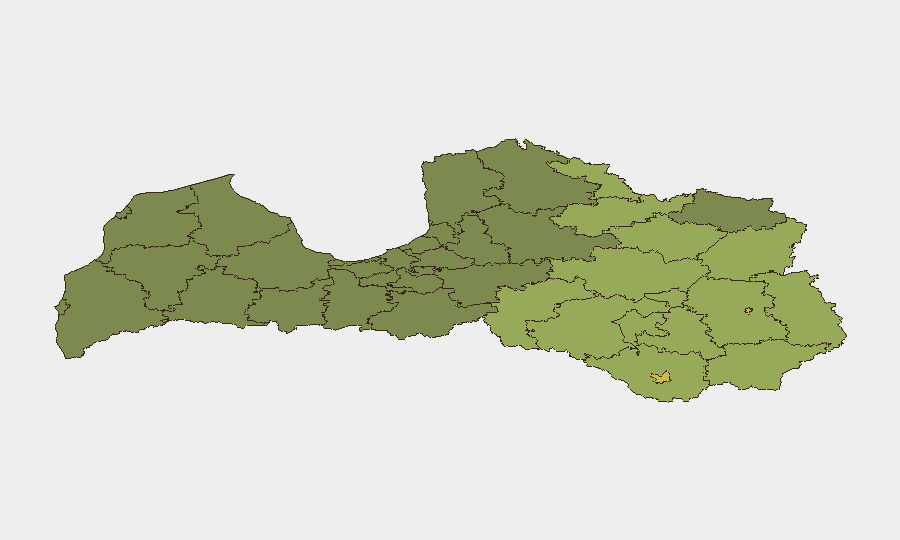
Situation Summary
Latvia remains a low-threat environment globally (rank #149) with no tracked security events recorded in the national composite score during the reporting period. However, localized risk remains concentrated in the southeastern border regions, where administrative and infrastructure incidents signal ongoing operational and administrative friction. NATO training operations near Riga have proceeded with standard operational tempo; a single friendly-fire incident during live exercises on 25 September underscores the intensity of Forward Land Forces deployments but reflects procedural controls functioning as intended.
Key Developments
- Ādaži military training area — 25 September: Four Italian soldiers assigned to NATO's Forward Land Forces were injured during a live-fire exercise when rounds from one Italian Dardo infantry fighting vehicle struck a second vehicle. One soldier sustained serious but stable injuries; all casualties were evacuated to a medical facility in Riga. A formal investigation was opened by host-nation authorities.
- Ādaži training range — 25–26 September: Latvia's National Armed Forces and Italy's Defence Ministry jointly confirmed the incident as an accidental friendly-fire event originating from a vehicle-mounted weapon system. The confirmation and rapid investigation closure indicate established NATO accident-prevention protocols are in place and functioning.
- A12 motorway near Rēzekne — reported 25 September: Multiple road signs bearing references to Russian cities (Moscow, Ostrov) were vandalized with paint. Latvia's State Police initiated criminal proceedings for suspected intentional property damage. The perpetrator's identity and motivation remain undetermined.
Highest-Risk Areas
Southeastern border regions dominate the sub-national risk landscape, with Rēzekne city (risk 68) and Daugavpils city (risk 65) leading the ranking, followed by the surrounding novads (Rēzeknes, Ludzas, Balvu, Preiļu, and Krāslavas). These areas reflect persistent cross-border administrative, infrastructure, and property-crime signals rather than direct security threats. Risk concentration in the eastern and southern periphery aligns with Latvia's geographic proximity to Russia and Belarus, where low-level vandalism, border-zone friction, and economic instability historically generate higher incident frequencies. Organizations with personnel or assets in these regions should maintain heightened situational awareness and standard duty-of-care protocols.
How GeoBit Would Assist
Security teams managing Latvia operations should employ Intel Sweep and multi-language OSINT fusion to monitor emerging developments in southeastern border regions where risk scores remain elevated; AOI Monitoring & Early Warning on Rēzekne, Daugavpils, and surrounding novads would provide persistent alerting for incidents before they escalate. GIS & Spatial Analysis combined with Routing & Network Analysis would enable alternative journey planning and asset-movement risk assessment, particularly for ground transit near the A12 and other principal roads in high-risk administrative zones. Conflict & Military tracking on NATO training operations and force posture provides real-time situational context for NATO-area incidents.
7-Day Outlook
No escalation of security conditions is anticipated over the next seven days. Vandalism and low-level property incidents in border zones are expected to remain episodic and uncoordinated. Continued NATO training operations near Riga will generate periodic operational incidents; organizations should monitor official NATO and Latvian Armed Forces announcements for traffic restrictions and exercise schedules affecting ground mobility.
Highest-Risk Areas — Ranked
| # | State / Region | Risk |
|---|---|---|
| 1 | Rēzekne | 68 |
| 2 | Daugavpils | 65 |
| 3 | Rēzeknes novads | 58 |
| 4 | Ludzas novads | 55 |
| 5 | Balvu novads | 52 |
| 6 | Preiļu novads | 50 |
| 7 | Krāslavas novads | 48 |
| 8 | Jēkabpils novads | 47 |
| 9 | Augšdaugavas novads | 46 |
| 10 | Aizkraukles novads | 45 |
| 11 | Varakļānu novads | 44 |
| 12 | Līvānu novads | 43 |
Sources
Previous Weekly Briefs
A new Latvia brief is written every Monday, covering the week — each with its own risk map and downloadable CSV. Use the calendar to go further back.
- September 22, 2026
- September 15, 2026
- September 8, 2026
- September 1, 2026
- August 30, 2026
- August 28, 2026
- August 26, 2026
📅 Browse past briefs by calendar →
Highlighted days have a brief. Tap a day for that day's map & analysis, or “csv” for that day's dataset ($5).
Atlas — our AI intelligence desk — emails them this snapshot personally. Nothing else, no list.