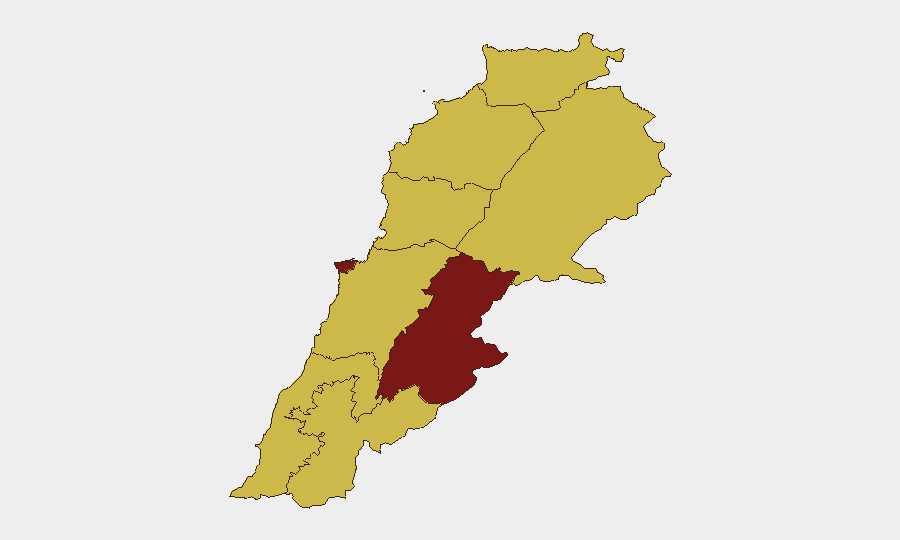
Situation Summary
Lebanon remains the third-highest global threat environment, with a composite threat score of 100 across 155 tracked events. The last 72 hours have seen escalating cross-border military exchanges, internal political tensions, and hostile foreign statements, with no clear de-escalation pathway visible. The Beqaa Governorate (risk score 100) and Beirut (80.3) dominate the threat landscape, though southern border regions continue to experience active Israeli military operations and Hezbollah counterfire. The trajectory points toward sustained high tension rather than imminent major conflict, but accident, miscalculation, or a significant trigger event could rapidly alter the picture.
Key Developments
Data Limitation Notice: Web-indexed sources reliably cover Lebanon events through approximately 17 June 2026. Real-time incidents on 18–19 June 2026 are not yet fully documented in accessible open sources. The following developments represent the most recent verified events:
- South & Nabatieh Governorates, 16–17 June 2026
Israeli airstrikes targeted Hezbollah launcher positions in southern border zones, resulting in at least four confirmed deaths. Cross-border projectile and drone exchanges continued despite ongoing U.S.–Iran diplomatic framework negotiations, indicating operational independence from higher-level talks.
- South Governorate (8–12 km buffer zone), 16–17 June 2026
Israeli "no-return" orders remained actively enforced across dozens of villages. Humanitarian monitors reported ongoing mass displacement and severe movement restrictions affecting civilian populations, with Lebanese Army advisories against civilian return.
- Beirut, 17 June 2026
Unspecified physical assault incident reported; concurrent public demand statements issued (source and nature of demand not yet clarified in available reporting).
- Foreign Policy, 17–18 June 2026
Foreign ministry public statement issued regarding Lebanon; Russia issued disapproval statement; China issued public statement. Iran–Lebanon small-arms combat reported 18 June; prior Lebanese military/security action against Iranian interests reported 16 June (seizure/damage of property and conventional military force deployment noted).
- Regional Actor Threats, 17 June 2026
Yemen issued threat statement toward Lebanon; Israel rejected unnamed Lebanese position and reported ceasefire violation on the 17th.
Note: Specific casualty figures, locations, and operational details for 18–19 June events are not yet reliably available in indexed sources.
Highest-Risk Areas
Beqaa Governorate (risk 100) is the primary driver of Lebanon's composite threat score, reflecting its role as a major transit corridor for militant activity, weapons trafficking, and cross-border operations involving Syrian, Iranian, and non-state actors. Beirut (80.3) faces elevated risk from political instability, internal security fragmentation, and potential spillover from border escalation. The northern and southern border governorates (North, South, Nabatieh, Akkar, Keserwan-Jbeil) all score 70, indicating sustained Israeli–Hezbollah friction, militant group presence, and humanitarian displacement pressure. Mount Lebanon's score of 70.1 reflects proximity to Beirut and Hezbollah strongholds.
How GeoBit Would Assist
Corporate and duty-of-care teams should deploy AOI Monitoring & Early Warning on Beqaa Governorate and Beirut to detect rapid escalation signals; Conflict & Military battle mapping and force-structure tracking to monitor Israeli, Hezbollah, and Lebanese Army positions and movements; and Network & Actor Analysis to identify emerging coalitions or actor statements that might precede major incidents. Satellite & Imagery analysis of southern border and Beqaa activity provides ground truth independent of official statements.
7-Day Outlook
The near-term trajectory remains elevated but not imminent-conflict. Cross-border exchanges are likely to persist at current or slightly higher tempo, with Hezbollah and Israeli forces maintaining operational pressure absent a credible diplomatic off-ramp. Internal Lebanese political fracturing and foreign-actor statements suggest that any significant single incident (civilian massacre, senior militant casualty, or major infrastructure strike) carries elevated risk of rapid escalation into broader conflict. Continued monitoring of Beqaa and southern border activity is essential.
Highest-Risk Areas — Ranked
| # | State / Region | Risk |
|---|---|---|
| 1 | Beqaa Governorate | 100 |
| 2 | Beirut Governorate | 80.3 |
| 3 | Mount Lebanon Governorate | 70.1 |
| 4 | North Governorate | 70 |
| 5 | Akkar Governorate | 70 |
| 6 | Keserwan-Jbeil Governorate | 70 |
| 7 | South Governorate | 70 |
| 8 | Nabatieh Governorate | 70 |
| 9 | Baalbek-Hermel Governorate | 70 |
Sources
Previous Daily Briefs
A new Lebanon brief is written every day — each with its own risk map and downloadable CSV. Here's the last week; use the calendar to go further back.
📅 Browse every day by calendar →
Highlighted days have a brief. Tap a day for that day's map & analysis, or “csv” for that day's dataset ($5).