Situation Summary
Lithuania faces elevated regional security pressure stemming from NATO's active air defense operations in the Baltic, triggered by drone incursions over neighboring Latvia on 14 August and intelligence assessments of potential Russian strikes on critical infrastructure. While Lithuania itself has not experienced direct incidents in the last 48 hours, the country is operating as part of a NATO response posture that includes military deployment to key energy and infrastructure sites. The threat environment is characterized by indirect spillover from regional instability rather than domestic crisis, but senior political figures are warning of possible false-flag operations, signaling heightened vigilance across government and critical sectors.
Key Developments
- NATO air defense activation from Lithuanian airbase (14 August, morning): Italian Eurofighter jets launched from Šiauliai Air Base in northern Lithuania to intercept an unidentified drone over eastern Latvia (Balvi region); one aircraft shot down the drone with no casualties. The incident demonstrates active use of Lithuanian territory in NATO's real-time response to regional airspace intrusions.
- Lithuanian PM warns of false-flag risk (14 August): Prime Minister Mindaugas Sinkevičius stated in media remarks that a staged attack or false-flag operation cannot be ruled out in connection with the Latvian drone incident, though no evidence has been presented. The comment reflects elevated concern at senior level about potential sabotage and hybrid threats.
- Regional drone pattern affecting Lithuania's airspace: Reporting on 14 August confirms military drones have strayed into or over the airspace of Finland, Estonia, Latvia, and Lithuania, indicating Lithuania is part of a multi-country zone experiencing persistent drone incursions linked to Russian operations.
- Military intelligence assessment cited in current briefings (14 August context): Media reports reference Lithuanian military intelligence information that Russia is considering attacks on Baltic critical infrastructure using Ukrainian-origin drones, a threat assessment now actively circulated in connection with the 14 August Latvia incident.
- DNA forensic link between Lithuanian arson suspect and German explosive drone (15 August): German investigators identified DNA from an explosive-laden drone seized at Leipzig/Halle Airport that matches a suspect in a Lithuanian arson investigation (arson incident in 2024). The newly reported forensic connection suggests cross-border networks capable of sabotage in multiple countries.
Highest-Risk Areas
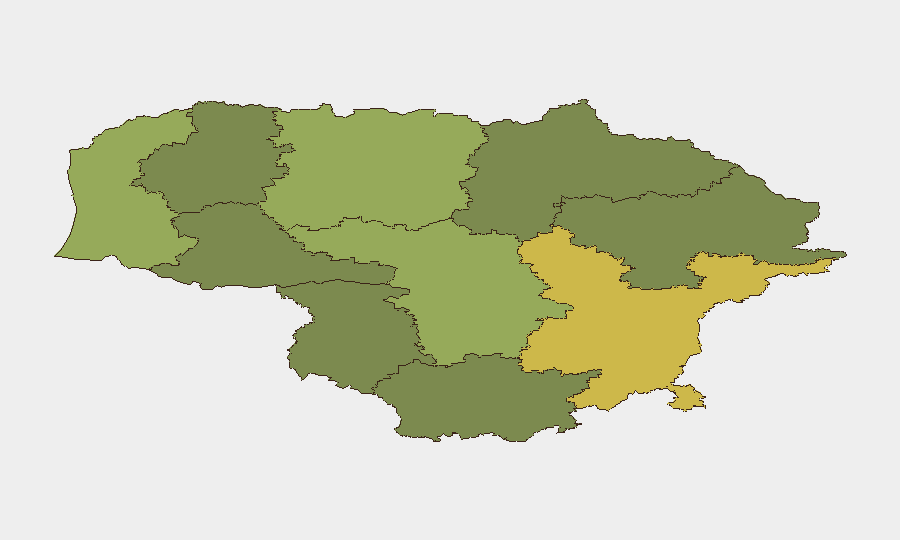
Vilnius County (risk 68) and Kaunas County (risk 58) carry significantly elevated composite scores, reflecting both urban concentration and strategic importance as Lithuania's largest population centers and administrative/economic hubs. Klaipėda County (risk 52) ranks third and is critical due to its role hosting Lithuania's LNG terminal and oil products import facility—both now under military protection following recent deployment. The northern regions including Šiauliai County (risk 42) carry elevated risk due to the active NATO air base and proximity to Belarus and the Russian border, making them focal points for hybrid threats, irregular migration (e.g., the 12 August tunnel discovery in Druskininkai), and potential drone or sabotage activity.
How GeoBit Would Assist
Security teams should employ AOI Monitoring & Early Warning on critical energy infrastructure (LNG, oil terminals, Kruonis hydro plant) and border regions to detect anomalous activity or drone signatures in real time. OSINT fusion and multi-language search across Lithuanian, Russian, and English sources will track emerging intelligence assessments and political statements signaling threat escalation. Network & Actor Analysis applied to the cross-border arson-drone nexus uncovered in the German investigation will identify potential sabotage networks active in Lithuania.
7-Day Outlook
Drone incursion activity is likely to persist across the Baltic region through the near term, driven by ongoing Russian testing of NATO air defenses and infrastructure vulnerability. Lithuanian critical infrastructure will remain under heightened alert and military protection. Risk of false-flag or staged attacks cannot be discounted, and organizations should maintain contingency protocols for rapid response to disruption claims or incidents.
Highest-Risk Areas — Ranked
| # | State / Region | Risk |
|---|---|---|
| 1 | Vilnius County | 68 |
| 2 | Kaunas County | 58 |
| 3 | Klaipeda County | 52 |
| 4 | Siauliai County | 42 |
| 5 | Panevezys County | 38 |
| 6 | Taurage County | 35 |
| 7 | Utena County | 33 |
| 8 | Alytus County | 32 |
| 9 | Telsiai County | 28 |
| 10 | Marijampole County | 25 |
Sources
Previous Daily Briefs
A new Lithuania brief is written every day — each with its own risk map and downloadable CSV. Here's the last week; use the calendar to go further back.
- August 13, 2026
- August 11, 2026
- August 9, 2026
- August 7, 2026
- August 5, 2026
- August 4, 2026
- August 3, 2026
📅 Browse every day by calendar →
Highlighted days have a brief. Tap a day for that day's map & analysis, or “csv” for that day's dataset ($5).
Atlas — our AI intelligence desk — emails them this snapshot personally. Nothing else, no list.