Situation Summary
Mauritania remains a low-frequency, moderate-baseline threat environment (global rank #126, composite score 7) with no tracked security incidents recorded in the immediate surveillance window. The country's threat profile is heavily concentrated in its eastern and southern border regions, where ungoverned space, narcotics trafficking, and cross-border criminal networks create persistent instability. Recent anti-narcotics operations by national police suggest ongoing law-enforcement activity against trafficking flows, though operational tempo remains unexceptional by regional standards.
Key Developments
- Mauritania (location unspecified) — Last 24 hours — National police conducted an anti-narcotics operation resulting in the arrest of 7 suspects and seizure of approximately 210 kg of cannabis resin and related contraband. Source confidence: single-source, snippet-only; exact date and geographic specificity not independently verified.
- Guerguerat crossing (Mauritania–Morocco border) — 2026-07-28 — Moroccan police seized 61 kg of cocaine and arrested two individuals at the border crossing, reflecting ongoing narcotics transit through the region. This incident, while across the border, signals active trafficking corridors affecting Mauritania's northwestern approaches.
- No other confirmed incidents within 24–48 hour window. Broader regional OSINT, travel advisories, and conflict-mapping sources returned no additional Mauritania-specific security events meeting verification thresholds for this reporting period.
Highest-Risk Areas
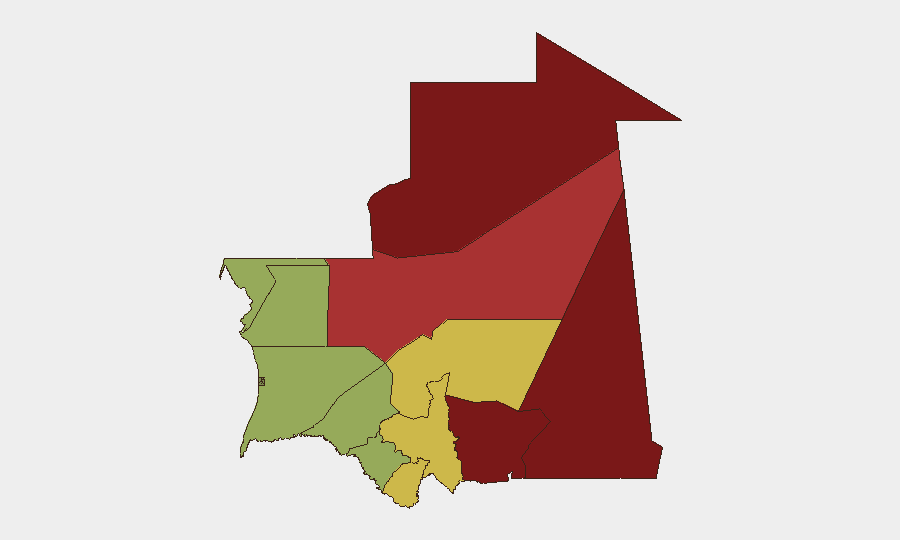
The eastern tier—Tiris Zemmour (95), Hodh Ech Chargui (85), and Hodh El Gharbi (80)—dominates the sub-national risk landscape and reflects the Saharan frontier's structural vulnerabilities: sparse state presence, porous borders with Algeria and Mali, militant sanctuary potential, and historical ungoverned-space dynamics. Adrar (78) and Tagant (68) extend this eastern-corridor risk profile westward. The southern regions Guidimaka (65) and Assaba (62) face cross-border pressures from Senegal and ongoing criminal-network activity. By contrast, coastal and capital-proximate zones (Dakhlet Nouadhibou at 45, Brakna at 48) remain lower-risk, indicating that state capacity and urbanization correlate inversely with threat concentration.
How GeoBit Would Assist
Security teams operating in Mauritania should employ persistent AOI Monitoring & Early Warning on high-risk eastern and southern zones to detect emerging militant activity, trafficking surges, or cross-border incursions before they escalate. Multi-language OSINT & event-feed fusion combined with network and actor analysis would track narcotics and arms trafficking networks operating through Mauritania's borders. Conflict mapping and border-dispute monitoring applied to the Tiris Zemmour and Hodh regions would provide early signals of militia activity or Polisario-linked incidents that could destabilize operations in those areas.
7-Day Outlook
No significant deterioration is anticipated in the near term. Narcotics enforcement activity will likely persist, consistent with regional counter-trafficking pressures. The eastern border regions will remain chronically elevated but stable absent a major cross-border spillover event from Mali, Algeria, or the Western Sahara dispute. Duty-of-care teams should maintain standard vigilance protocols; travel to Tiris Zemmour, Hodh regions, and southern border zones warrants enhanced vetting and real-time tracking.
Highest-Risk Areas — Ranked
| # | State / Region | Risk |
|---|---|---|
| 1 | Tiris Zemmour | 95 |
| 2 | Hodh Ech Chargui | 85 |
| 3 | Hodh El Gharbi | 80 |
| 4 | Adrar | 78 |
| 5 | Tagant | 68 |
| 6 | Guidimaka | 65 |
| 7 | Assaba | 62 |
| 8 | Gorgol | 58 |
| 9 | Trarza | 55 |
| 10 | Inchiri | 52 |
| 11 | Brakna | 48 |
| 12 | Dakhlet Nouadhibou | 45 |
Sources
Previous Daily Briefs
A new Mauritania brief is written every day — each with its own risk map and downloadable CSV. Here's the last week; use the calendar to go further back.
📅 Browse every day by calendar →
Highlighted days have a brief. Tap a day for that day's map & analysis, or “csv” for that day's dataset ($5).
Atlas — our AI intelligence desk — emails them this snapshot personally. Nothing else, no list.