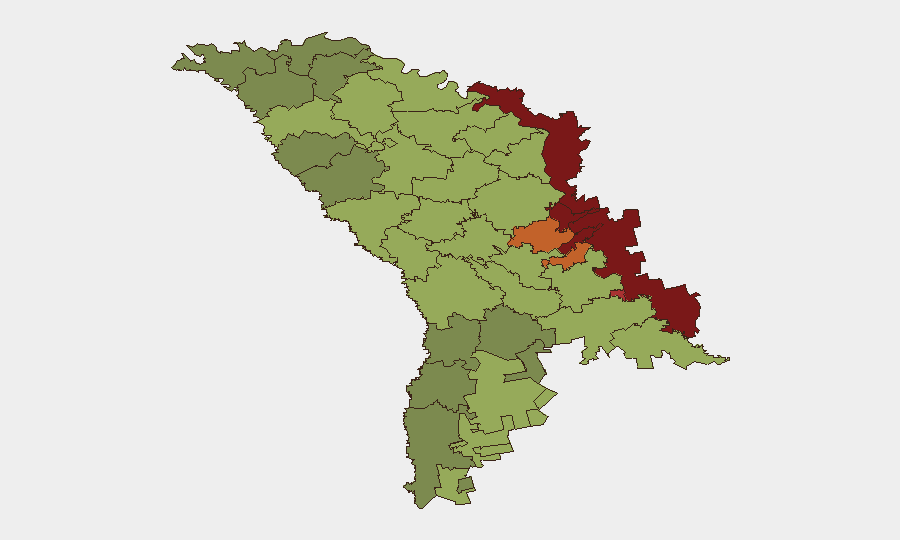
Situation Summary
Moldova faces elevated but localized security pressure, primarily from Russian military operations in neighboring Ukraine and resulting spillover into Moldovan airspace and border zones. The country's overall threat ranking remains moderate (#149 globally, composite score 6), but sub-national risk is heavily concentrated in the Dniester Left Bank region and districts bordering Russian-controlled territory. Recent drone and missile incidents underscore persistent cross-border military activity rather than a fundamental shift in the threat environment.
Key Developments
- Crocmaz, Ștefan Vodă district (2026-08-09): A drone-missile device crashed and exploded near the village, damaging nearby property. Moldova's Foreign Ministry condemned the incident and recalled its ambassador from Russia for consultations. No casualties reported.
- Moldovan airspace incursion (2026-08-10): Russia's Defense Ministry confirmed a Shahed-type drone briefly entered Moldovan airspace (~1 minute duration) during strikes on Ukraine's Odesa region before exiting toward Ukrainian territory. Ukrainian and Romanian sources corroborated timing and flight path.
- Cross-border power infrastructure (2026-08-09): Russian strikes on Ukraine's energy grid damaged Moldova's primary electricity interconnect with Romania, reducing transmission capacity and increasing dependence on alternative power sources.
Highest-Risk Areas
The Left Bank Dniester region (administrative-territorial units, Dubăsari, Bender; risk scores 79–85) represents Moldova's critical vulnerability. These territories remain outside Chișinău's control, populated by Russian-sympathetic populations, and host Russian military presence. Nearby border districts (Criuleni, Rezina, Căușeni, Soroca, Ștefan Vodă) are exposed to both military spillover and infrastructure disruption. Chișinău itself (risk 49) faces secondary risks from energy shortages and political fallout, but remains significantly safer than borderland zones. The concentration of risk in transnistrian and pro-Russian regions reflects the ongoing frozen conflict and Russia's continued military footprint, now intensified by active operations in Ukraine.
How GeoBit Would Assist
Security teams with staff or assets in Moldova should deploy AOI (Area-of-Interest) Monitoring & Early Warning on highest-risk districts (Ștefan Vodă, Dubăsari, Bender, Criuleni) to track airspace violations, border incidents, and infrastructure damage in near-real-time. Conflict & Military mapping combined with satellite and imagery analysis would provide persistent visibility on Russian force positioning and drone activity patterns around the Left Bank. Intel Sweep and multi-language OSINT (particularly Romanian, Russian, and Ukrainian sources) enable continuous corroboration of cross-border incidents and political escalation signals, reducing reliance on single-source reporting and supporting duty-of-care documentation.
7-Day Outlook
Drone and missile spillover into Moldovan territory is likely to continue at low frequency as long as Russian operations in Ukraine remain active. Energy infrastructure damage will persist as a secondary stressor, potentially triggering power rationing in the capital and western regions. No major escalation in Moldova itself is anticipated in the near term, but border zones and the Dniester region should be treated as persistent, moderate-risk areas requiring continuous monitoring.
Highest-Risk Areas — Ranked
| # | State / Region | Risk |
|---|---|---|
| 1 | Administrative-Territorial Units of the Left Bank of the Dniester | 85 |
| 2 | Dubăsari | 82 |
| 3 | Bender | 79 |
| 4 | Criuleni | 75 |
| 5 | Rezina | 58 |
| 6 | Taraclia | 55 |
| 7 | Gagauzia | 54 |
| 8 | Căușeni | 53 |
| 9 | Soroca | 52 |
| 10 | Ștefan Vodă | 51 |
| 11 | Orhei | 50 |
| 12 | Chișinău | 49 |
Sources
Previous Daily Briefs
A new Moldova brief is written every day — each with its own risk map and downloadable CSV. Here's the last week; use the calendar to go further back.
📅 Browse every day by calendar →
Highlighted days have a brief. Tap a day for that day's map & analysis, or “csv” for that day's dataset ($5).
Atlas — our AI intelligence desk — emails them this snapshot personally. Nothing else, no list.