Situation Summary
North Korea remains at composite threat rank #42 globally (score 53), with no verified security incidents, civil unrest, or military activity recorded inside the country over the last 24–48 hours. Open-source monitoring across English-language media, specialist Korea-watchers, and OSINT platforms confirms stable conditions in key urban centers including Pyongyang and South Pyongan, albeit under routine heightened observation. The primary security-relevant development in the region is South Korea's announced adjustment of civilian access controls on its side of the DMZ, not an incident within North Korea itself.
Key Developments
- Inter-Korean border (South Korean side), 17–18 Jun 2026: South Korea's defence ministry announced a northward shift of the Civilian Control Line (CCL) by an average of ~6 km, narrowing restricted zones near the DMZ and easing civilian access while maintaining core military security protocols. This represents a posture adjustment rather than a crisis trigger, but reflects evolving bilateral security management.
- Seoul policy statement, 17–18 Jun 2026: South Korean authorities reiterated plans to restore elements of inter-Korean military agreements while implementing the CCL repositioning, framed as tension-management and community-access improvement measures.
- Pyongyang and South Pyongan, 16–18 Jun 2026: Open-source corroboration (cross-checked across media, social OSINT, and specialist feeds) confirms no new lockdowns, infrastructure failures, arrests of foreign nationals, or other destabilizing events in these highest-monitored population centers.
- No border clashes or missile activity recorded, 16–18 Jun 2026: Satellite and OSINT monitoring detect no fresh conventional military activity or weapons tests within North Korea or at launch-capable sites during this window.
Highest-Risk Areas
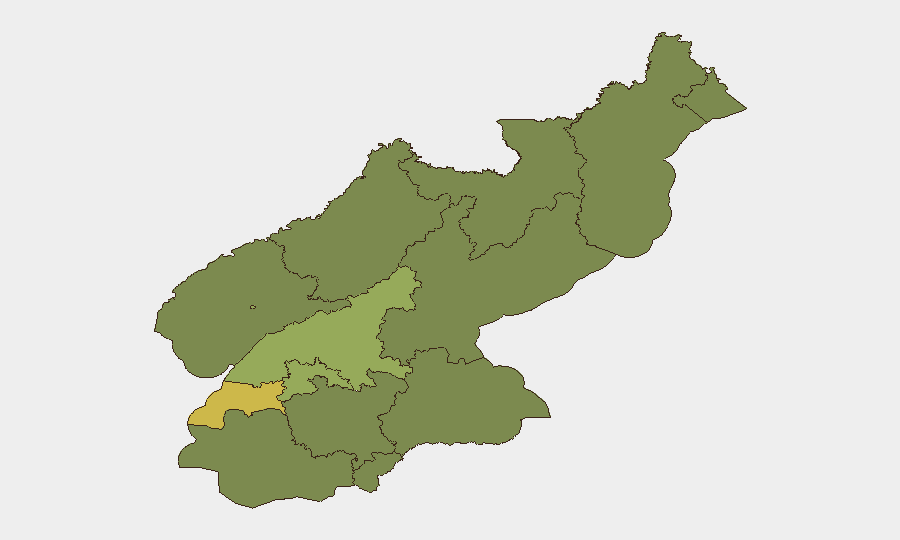
Nampo (risk 67.1) remains the single highest-risk sub-national zone, likely driven by its status as North Korea's principal port and logistics hub, where economic strain, sanctions evasion activity, and foreign-contact exposure converge. Pyongyang (40.3) and South Pyongan (42.6) rank second and third; their elevated scores reflect population density, regime surveillance intensity, and historical sensitivity to foreign nationals and economic volatility. Remaining provinces cluster at 37.1, indicating a relatively distributed baseline of administrative control and resource scarcity rather than acute localized crises. The gap between Nampo and other zones suggests port-area vulnerabilities—smuggling, sanctions circumvention, supply-chain disruption—warrant specific focus for organizations with logistics or trade exposure.
How GeoBit Would Assist
Organizations with personnel or assets in North Korea should employ AOI Monitoring & Early Warning to maintain persistent watch over Nampo port facilities, Pyongyang airfield and border crossings, and South Pyongan transport corridors, with automated alerting on movement, gathering, or infrastructure anomalies. Intel Sweep and OSINT fusion across X/Telegram, local media, and specialist feeds enable 24/7 corroboration of incident claims and early detection of regime statements signaling policy shifts or restrictions. Satellite & Imagery analysis combined with Conflict & Military tracking provide independent verification of military posture, sanctions evasion, or emergency mobilization—critical early warning before announcements.
7-Day Outlook
No acute triggers are evident in the immediate outlook. The South Korean CCL adjustment may generate North Korean commentary, but does not itself alter DPRK internal stability or foreign-national risk profiles. Routine monitoring for regime policy announcements, economic sanctions announcements, or adjacent geopolitical friction (U.S.–DPRK rhetoric, Russian military coordination) remains the appropriate baseline posture through late June.
Highest-Risk Areas — Ranked
| # | State / Region | Risk |
|---|---|---|
| 1 | Nampo | 67.1 |
| 2 | South Pyongan | 42.6 |
| 3 | P'yŏngyang | 40.3 |
| 4 | Ryanggang | 37.1 |
| 5 | North Hamgyong | 37.1 |
| 6 | North Pyongan | 37.1 |
| 7 | Chagang | 37.1 |
| 8 | South Hwanghae | 37.1 |
| 9 | North Hwanghae | 37.1 |
| 10 | South Hamgyong | 37.1 |
| 11 | Kaesong | 37.1 |
| 12 | Kangwon | 37.1 |
Sources
Previous Daily Briefs
A new North Korea brief is written every day — each with its own risk map and downloadable CSV. Here's the last week; use the calendar to go further back.
📅 Browse every day by calendar →
Highlighted days have a brief. Tap a day for that day's map & analysis, or “csv” for that day's dataset ($5).