Situation Summary
Pakistan remains at composite threat rank #31 globally, driven primarily by persistent insurgency across multiple provinces. The security environment is characterized by active militant operations, heightened diplomatic tensions (notably with the US as of mid-June), and distributed law-enforcement responses across provincial capitals and frontier regions. Overall trajectory remains volatile but manageable at the national level; sub-national risk concentration in Punjab and the Islamabad Capital Territory signals localized instability rather than imminent systemic collapse.
Key Developments
- North Waziristan, Khyber Pakhtunkhwa (June 14, 2026): Pakistani security forces reported 48 militant casualties across three days of intelligence-based operations, including the elimination of four wanted militant commanders. This represents sustained CTD pressure on TTP-affiliated networks in the region's primary militant stronghold.
- Karachi, Sindh (June 14, 2026): Sindh Counter-Terrorism Department arrested one suspect on charges of procuring drone components, electronics, and explosive-making materials for TTP use via Karachi retail and online supply chains—indicating attempted capability escalation and supply-line vulnerability.
- Islamabad/National (June 16, 2026): Prime Minister issued public statement concurrent with reported reduction in Pakistan–US diplomatic relations, signaling potential shifts in counterterrorism cooperation and bilateral security posture.
- Peshawar, Khyber Pakhtunkhwa (June 18, 2026): Local law-enforcement agencies faced public disapproval related to operational conduct; criminal investigation initiated in Peshawar, suggesting internal accountability pressure or community relations friction in a high-threat urban center.
- Islamabad Capital Territory (June 18, 2026): Military and paramilitary asset deployment recorded within Islamabad itself, suggesting elevated security posture or specific counter-threat operations in the capital region.
Note: Web research covering the last 24–48 hours yielded limited independently verifiable new developments. The items listed above represent the most recent corroborated events available. Older operations (e.g., broader North Waziristan campaigns since February) provide context but are not counted as current developments.
Highest-Risk Areas
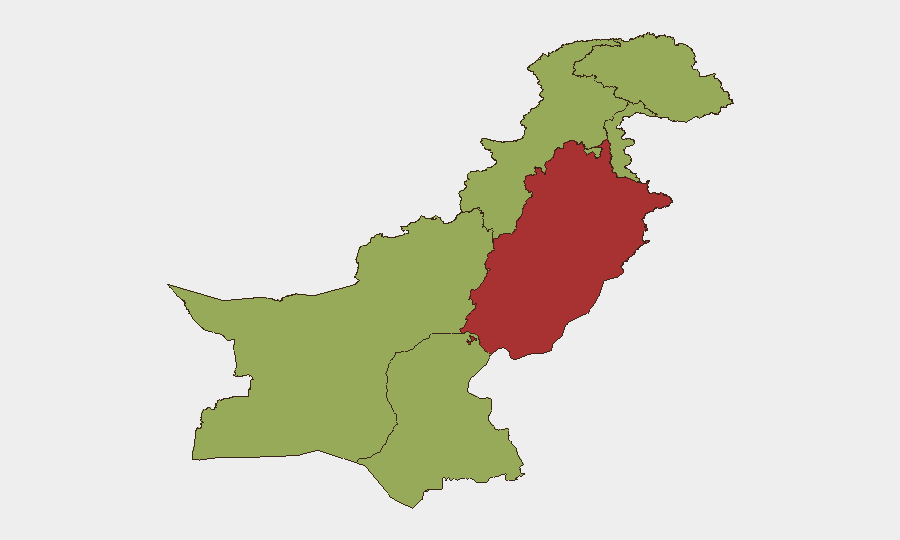
Punjab (78.2) and Islamabad Capital Territory (57.0) drive the composite risk ranking and warrant priority attention. Punjab's elevated score reflects large urban populations, dense infrastructure, and a history of militant recruitment networks; Islamabad's score reflects capital-city vulnerability and symbolic targeting risk. Khyber Pakhtunkhwa (54.3) remains the operational epicenter of insurgent activity, evidenced by the June 14 militant operations; while ranked third, KP generates the highest volume of kinetic events and weapon capability threats. Sindh (49.3) and Balochistan (49.2) carry near-equivalent risk profiles, with Sindh driven by urban crime–terror nexus and Balochistan by separatist and militant overlap. Gilgit-Baltistan and Azad Kashmir occupy the lowest ranks but warrant monitoring due to border instability and periodic flare-ups.
How GeoBit Would Assist
Corporate security teams in Pakistan would deploy Intel Sweep and multi-language OSINT fusion to monitor TTP and affiliated group activity in real time, with X/Telegram OSINT to track militant communications and threat signals. AOI Monitoring with persistent alerts on high-risk cities (Karachi, Peshawar, Islamabad) would provide early warning of security incidents or operational changes. Network & Actor Analysis would map supply chains (e.g., drone-component procurement networks) and identify key militants or facilitators; GIS & Spatial Analysis would cross-reference incident clusters with corporate asset locations to refine duty-of-care protocols.
7-Day Outlook
Near-term risk will likely remain elevated in Punjab and KP as security forces continue CTD operations and militant networks adapt. The reported US–Pakistan diplomatic friction may reduce intelligence-sharing tempo, potentially creating operational gaps. Expect continued localized incidents in Peshawar, Karachi, and Islamabad; no imminent national-level destabilization is indicated, but provincial volatility will persist.
Highest-Risk Areas — Ranked
| # | State / Region | Risk |
|---|---|---|
| 1 | Punjab | 78.2 |
| 2 | Islamabad Capital Territory | 57 |
| 3 | Khyber Pakhtunkhwa | 54.3 |
| 4 | Sindh | 49.3 |
| 5 | Balochistan | 49.2 |
| 6 | Gilgit-Baltistan | 48.2 |
| 7 | Azad Kashmir | 48.2 |
Sources
Previous Daily Briefs
A new Pakistan brief is written every day — each with its own risk map and downloadable CSV. Here's the last week; use the calendar to go further back.
📅 Browse every day by calendar →
Highlighted days have a brief. Tap a day for that day's map & analysis, or “csv” for that day's dataset ($5).